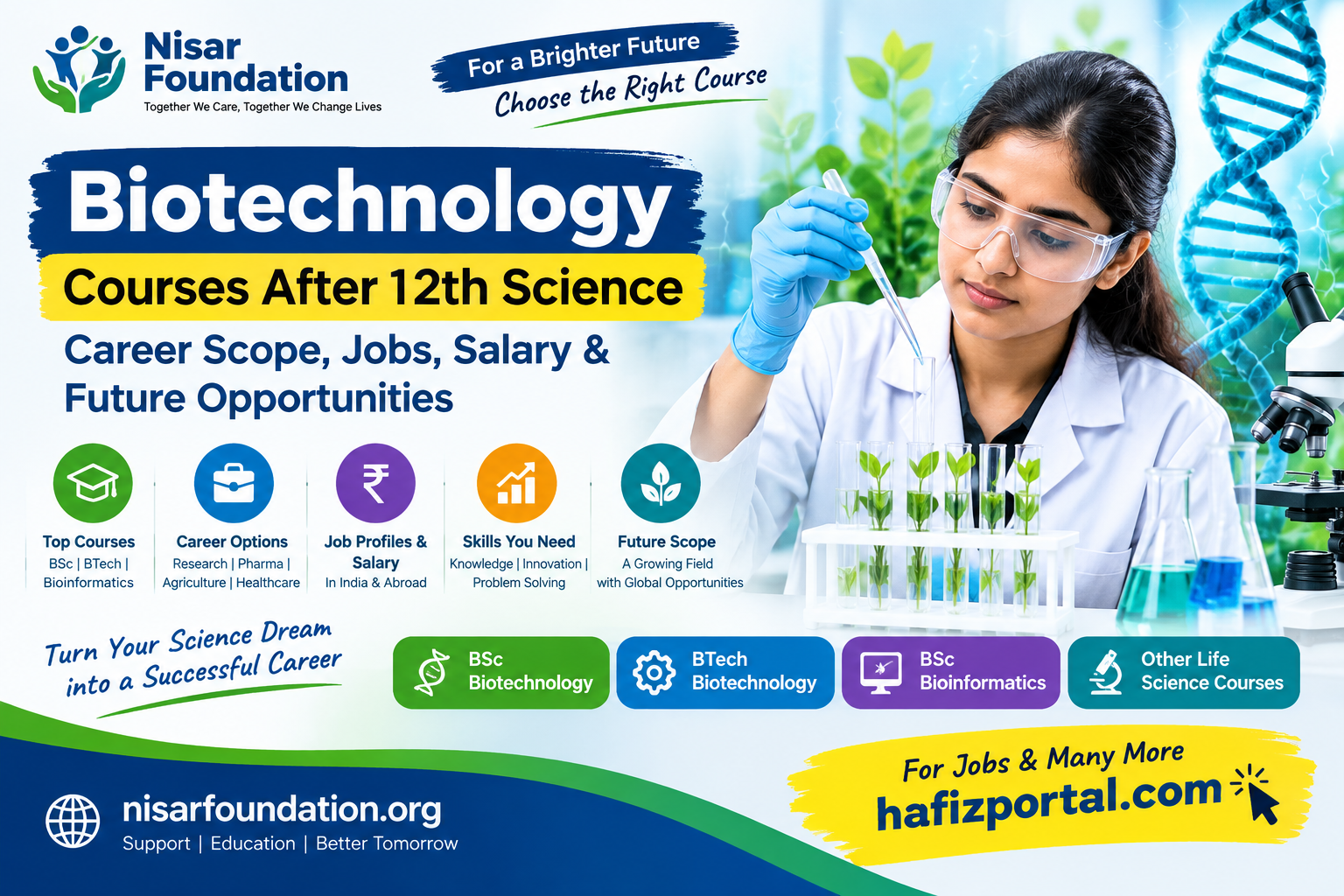
Biotechnology Courses After 12th Science: Career Scope, Jobs, Salary and Future Opportunities
Biotechnology Courses After 12th Science: Jobs, Salary & Career Scope
Biotechnology Courses After 12th Science are becoming an interesting choice for students who enjoy Biology, Chemistry, laboratory work, research and modern technology. Biotechnology combines biological science with technology to develop useful products and processes in areas such as healthcare, pharmaceuticals, agriculture, food, environmental science and research.
Students who complete Class 12 Science can choose from several biotechnology-related courses, including B.Sc Biotechnology, B.Tech Biotechnology, B.Sc Microbiology, Biochemistry, Biomedical Science, Bioinformatics and other life-science programmes.
This complete guide explains biotechnology courses after 12th Science, eligibility, course duration, admission options, subjects, specializations, jobs, salary, higher studies, skills and career scope.
Important: Course names, eligibility rules, entrance examinations and admission procedures can vary between universities. Always check the official admission notification of the institution before applying.
What Is Biotechnology?
Biotechnology is a science-based field that uses living organisms, cells, biological systems and biological processes to develop useful products, technologies and solutions.
Biotechnology is connected with several areas, including:
- Medicine and healthcare
- Pharmaceutical research
- Agriculture
- Food technology
- Environmental science
- Genetics
- Microbiology
- Molecular biology
- Industrial production
- Bioinformatics
- Clinical research
- Vaccine and drug research
- Quality control
- Scientific research
A biotechnology professional may work in a laboratory, pharmaceutical company, research organisation, manufacturing facility, hospital-related laboratory, agriculture company, educational institution or other science-based organisation.
Biotechnology Courses After 12th Science
After completing Class 12 Science, students can consider different undergraduate courses related to biotechnology.
Some common options include:
| Course | Typical Duration | Main Area |
|---|---|---|
| B.Sc Biotechnology | 3–4 years* | Biotechnology and life sciences |
| B.Tech Biotechnology | 4 years | Biotechnology engineering |
| B.Sc Microbiology | 3–4 years* | Microorganisms |
| B.Sc Biochemistry | 3–4 years* | Chemistry of life |
| B.Sc Biomedical Science | 3–4 years* | Biology and healthcare |
| B.Sc Bioinformatics | 3–4 years* | Biology + computing |
| B.Sc Genetics | 3–4 years* | Genes and heredity |
| B.Sc Molecular Biology | 3–4 years* | Molecular-level biology |
| B.Pharm | 4 years | Pharmaceutical sciences |
| Related Life Science Courses | Varies | Research and applied science |
*Duration can vary because universities now offer different undergraduate structures and multiple-entry/exit options under the changing higher-education framework. The UGC has introduced a Curriculum and Credit Framework for Undergraduate Programmes with flexible and multidisciplinary approaches.
1. B.Sc Biotechnology
B.Sc Biotechnology is one of the most common choices for students interested in biotechnology after Class 12.
The course generally introduces students to biology, chemistry, microbiology, genetics, molecular biology, biochemistry and biotechnology laboratory techniques.
Common subjects may include:
- Cell Biology
- Molecular Biology
- Genetics
- Microbiology
- Biochemistry
- Immunology
- Genetic Engineering
- Plant Biotechnology
- Animal Biotechnology
- Industrial Biotechnology
- Environmental Biotechnology
- Bioinformatics
- Biostatistics
- Laboratory Techniques
The exact syllabus differs between universities.
Who can choose B.Sc Biotechnology?
Students from the Science stream with Biology or Biotechnology are commonly eligible, but requirements differ between universities.
For example, some universities specify Physics, Chemistry and Biology or Biotechnology combinations, while others may accept Mathematics-based combinations. CUET participating institutions also publish their own subject combinations and eligibility conditions.
2. B.Tech Biotechnology
B.Tech Biotechnology combines biotechnology with engineering and technology.
It can be suitable for students who are interested in both biological sciences and technological applications.
Common subjects may include:
- Engineering Mathematics
- Biochemistry
- Microbiology
- Cell Biology
- Molecular Biology
- Genetics
- Bioprocess Engineering
- Genetic Engineering
- Immunology
- Bioinformatics
- Fermentation Technology
- Biochemical Engineering
- Industrial Biotechnology
- Process Control
- Research Methods
Eligibility and entrance requirements vary by institution.
For engineering admissions through JEE Main, the National Testing Agency states that B.E./B.Tech eligibility for participating NITs, IIITs and other CFTIs includes Physics and Mathematics as compulsory subjects along with one of Chemistry, Biotechnology, Biology or a technical vocational subject. Students should therefore check the exact requirements of their target institution.
3. B.Sc Microbiology
Microbiology focuses on microorganisms such as:
- Bacteria
- Viruses
- Fungi
- Protozoa
- Other microorganisms
Students learn how microorganisms interact with humans, animals, plants and the environment.
Microbiology can lead to careers in laboratory testing, pharmaceutical companies, food industries, research organisations and quality-control departments.
4. B.Sc Biochemistry
Biochemistry combines Biology and Chemistry.
Students study chemical reactions and processes occurring inside living organisms.
Important topics can include:
- Proteins
- Enzymes
- Carbohydrates
- Lipids
- DNA
- RNA
- Metabolism
- Molecular biology
- Clinical biochemistry
This course can be useful for students interested in laboratory science, healthcare-related research and postgraduate study.
5. B.Sc Biomedical Science
Biomedical Science focuses on the biological and scientific foundations of human health and disease.
It can be relevant for students interested in:
- Medical research
- Laboratory science
- Molecular biology
- Human biology
- Clinical research
- Healthcare research
For example, the University of Delhi’s Biomedical Science information describes undergraduate study involving Physics, Chemistry and Biology/Biotechnology, with research exposure and laboratory-oriented learning.
6. B.Sc Bioinformatics
Bioinformatics combines:
Biology + Computer Science + Data Analysis
It is useful for students who enjoy both biology and computers.
Students may learn about:
- Biological databases
- DNA sequence analysis
- Protein analysis
- Computational biology
- Statistics
- Programming
- Data analysis
- Genomics
Bioinformatics can be particularly useful for students interested in the growing relationship between life sciences and data science.
7. Genetics and Molecular Biology
Students interested in genes, DNA and heredity can explore courses related to genetics and molecular biology.
Possible study areas include:
- DNA
- RNA
- Gene expression
- Genetic disorders
- Molecular techniques
- Genomics
- Genetic engineering
- Molecular diagnostics
These subjects are also important for research and advanced study.
Eligibility for Biotechnology Courses After 12th
Eligibility depends on the university and course.
In general, students applying for biotechnology-related undergraduate programmes should have completed Class 12 or an equivalent examination from a recognised board.
Many programmes expect Science subjects such as:
- Physics
- Chemistry
- Biology/Biotechnology
- Mathematics, where required
- English, where specified
However, there is no single eligibility rule for every biotechnology course in India.
For example, CUET participating universities publish individual course requirements. One participating university lists B.Sc Biotechnology eligibility using Physics, Chemistry and Mathematics/Biology with English, while another institution may use different requirements.
Important advice
Before filling out an application form, check:
- Required Class 12 subjects
- Minimum percentage
- Age requirements, if any
- Entrance examination requirement
- CUET requirement, if applicable
- Category-specific requirements
- University-specific eligibility
- Application deadline
- Counselling procedure
Entrance Exams for Biotechnology Courses
There is no single entrance examination for every biotechnology course.
Depending on the college and programme, admission may be based on:
- Class 12 merit
- CUET-UG
- JEE Main
- State-level entrance examinations
- University-level entrance examinations
- Institution-specific admission procedures
CUET-UG
The Common University Entrance Test is used by participating universities for undergraduate admissions.
The official CUET syllabus includes Biology/Biological Science/Biotechnology/Biochemistry as a domain subject. The participating-university list also includes central, state, deemed, private and other government institutions.
Students should always check the course-specific subject combination required by the university they want to join.
Biotechnology Course Admission Process
A typical admission process may look like this:
Step 1: Complete Class 12
Complete Class 12 Science with the subjects required by your selected course.
Step 2: Shortlist Courses
Compare B.Sc Biotechnology, B.Tech Biotechnology and related courses.
Step 3: Check Eligibility
Read the official university admission notification carefully.
Step 4: Apply for Entrance Examination
If an entrance examination is required, register before the deadline.
Step 5: Apply to Universities
Complete the university application or counselling process.
Step 6: Check Merit or Entrance Result
Admission may depend on marks, entrance scores, rank or other institutional criteria.
Step 7: Complete Counselling
Participate in counselling if applicable.
Step 8: Confirm Admission
Submit documents and fees according to the university’s instructions.
Biotechnology Course Subjects
The subjects depend on the university and specialization, but biotechnology students commonly study areas such as:
Basic Science
- Biology
- Chemistry
- Physics
- Mathematics or Statistics
Core Biotechnology
- Cell Biology
- Molecular Biology
- Genetics
- Microbiology
- Biochemistry
- Immunology
- Genetic Engineering
Applied Biotechnology
- Pharmaceutical Biotechnology
- Industrial Biotechnology
- Agricultural Biotechnology
- Environmental Biotechnology
- Food Biotechnology
- Medical Biotechnology
Modern Skills
- Bioinformatics
- Data analysis
- Genomics
- Proteomics
- Laboratory instrumentation
Practical laboratory training is particularly important because biotechnology is not only a theory-based subject.
Biotechnology Specializations
After gaining basic knowledge, students can explore several specialization areas.
Medical Biotechnology
Medical biotechnology focuses on healthcare applications.
Possible areas include:
- Diagnostics
- Vaccines
- Therapeutics
- Molecular medicine
- Disease research
Pharmaceutical Biotechnology
This area connects biotechnology with pharmaceutical development.
Students may learn about:
- Drug development
- Biopharmaceuticals
- Production processes
- Quality control
- Research
Agricultural Biotechnology
Agricultural biotechnology focuses on improving agricultural systems using biological science.
Possible areas include:
- Crop improvement
- Plant tissue culture
- Plant genetics
- Seed technology
- Plant disease research
Industrial Biotechnology
Industrial biotechnology uses biological processes in manufacturing and production.
It may involve:
- Fermentation
- Enzymes
- Biofuels
- Industrial microorganisms
- Bioprocessing
Environmental Biotechnology
This field applies biotechnology to environmental problems.
Examples include:
- Waste treatment
- Pollution control
- Bioremediation
- Environmental monitoring
Food Biotechnology
Food biotechnology involves biological science and technology in food production, quality and safety.
Jobs After Biotechnology Courses
After completing a biotechnology-related degree, graduates may find opportunities in different sectors.
Common job roles include:
- Biotechnologist
- Laboratory Technician
- Research Assistant
- Microbiologist
- Quality Control Executive
- Quality Assurance Executive
- Clinical Research Associate
- Biochemistry-related roles
- Molecular Biology Assistant
- Production Executive
- Laboratory Analyst
- Research Associate
- Technical Support Executive
- Scientific Sales Executive
- Medical Writer
- Bioinformatics-related roles
- Biotechnology Instructor
The exact role depends on the qualification, skills, experience and employer.
Indeed’s India career guidance identifies roles such as laboratory technician, microbiologist, biochemist, biostatistician, clinical research associate and biotechnology instructor among career options related to biotechnology.
Biotechnology Jobs in Different Industries
Biotechnology graduates can explore employment in several sectors.
Pharmaceutical Industry
Possible work areas include:
- Research
- Production
- Quality control
- Quality assurance
- Laboratory testing
- Documentation
Healthcare and Diagnostics
Graduates may work in laboratories and organisations involved in diagnostic testing and research.
Agriculture
Biotechnology has applications in:
- Crop research
- Plant biotechnology
- Seed technology
- Agricultural laboratories
Food Industry
Possible areas include:
- Food testing
- Quality control
- Microbiology
- Product development
Research Institutions
Research-based organisations may offer positions for candidates with appropriate qualifications and laboratory skills.
Environmental Sector
Biotechnology knowledge can be used in:
- Waste management
- Environmental testing
- Bioremediation
- Research
Biotechnology Salary in India
Salary is one of the most searched questions among students.
However, there is no fixed salary for biotechnology graduates.
Your salary can depend on:
- Degree
- Specialization
- College
- Technical skills
- Laboratory experience
- Internship experience
- Location
- Employer
- Job role
- Higher qualification
- Research experience
Current Indeed India career data lists examples such as laboratory technician and microbiologist roles in the mid-teens of thousands of rupees per month on average, while other specialised roles have different salary figures. These figures are market estimates and can change over time; they should not be treated as guaranteed starting salaries.
Indicative career-stage view
| Career Stage | Possible Salary Pattern |
|---|---|
| Fresher | Entry-level salary varies significantly |
| 1–3 years experience | Usually higher with relevant skills |
| Experienced professional | Depends strongly on specialization and employer |
| Research professional | Often depends on qualification and project |
| Senior industry role | Can increase with experience and specialization |
| PhD/research career | Depends on institution, fellowship, project and position |
Instead of choosing biotechnology only because of salary, students should consider their interest in science, laboratory work, research and long-term education.
How to Increase Your Salary Potential in Biotechnology
A biotechnology degree alone may not be enough for every specialised role.
Students can improve their career profile by developing practical skills.
1. Laboratory Skills
Learn laboratory techniques and follow proper safety procedures.
2. Computer Skills
Basic computer knowledge is important. Students interested in bioinformatics can learn programming and data analysis.
3. Research Skills
Learn how to:
- Read scientific papers
- Collect data
- Maintain laboratory records
- Analyse results
- Prepare reports
4. Internship Experience
Internships can help students understand real laboratory and industrial environments.
5. Communication Skills
English communication, scientific writing and presentation skills can be valuable.
6. Specialization
After graduation, a focused postgraduate degree can help students build deeper knowledge.
Higher Studies After B.Sc Biotechnology
Students who want to continue their education can consider postgraduate programmes such as:
- M.Sc Biotechnology
- M.Sc Microbiology
- M.Sc Biochemistry
- M.Sc Molecular Biology
- M.Sc Bioinformatics
- M.Sc Genetics
- M.Tech Biotechnology
- M.Tech Bioprocess Engineering
- Pharmaceutical Biotechnology
- Medical Biotechnology
- Related Life Science programmes
Higher education can be especially useful for students planning careers in research, specialised industry roles or teaching.
The UGC’s current undergraduate framework supports flexible, multidisciplinary approaches in higher education, so students should examine the structure and progression options of individual institutions.
PhD After Biotechnology
Students interested in advanced research can consider a PhD after completing the required postgraduate qualification.
Possible research areas include:
- Cancer biology
- Genetics
- Molecular biology
- Microbiology
- Immunology
- Pharmaceutical biotechnology
- Plant biotechnology
- Environmental biotechnology
- Bioinformatics
- Genomics
- Drug discovery
Research careers generally require strong academic preparation, research experience and specialised knowledge.
For postgraduate biotechnology and allied programmes, national-level examinations such as GAT-B have been used for admission to Department of Biotechnology-supported postgraduate programmes. NTA has also conducted the Biotechnology Eligibility Test for DBT-Junior Research Fellowship. Students should check the latest official notification for the relevant admission year.
Biotechnology Career Scope
Biotechnology has a broad academic and professional scope because biological science is connected with many industries.
Career areas can include:
Healthcare → Pharmaceuticals → Agriculture → Food → Environment → Research → Diagnostics → Bioinformatics → Industrial Biotechnology
This means students are not limited to one type of job.
A biotechnology graduate can develop a career in laboratory work, quality control, research, production, technical support, scientific communication or further education.
However, career outcomes are not guaranteed. Students should build relevant skills and select qualifications according to their target role.
Is Biotechnology a Good Course After 12th Science?
Biotechnology can be considered by students who:
- Enjoy Biology
- Like Chemistry
- Are interested in laboratory work
- Enjoy scientific experiments
- Want to understand genetics and cells
- Are interested in research
- Want to work in pharmaceutical or healthcare-related industries
- Are interested in agriculture or environmental science
- Are comfortable with higher education and continuous learning
Students who strongly dislike laboratory work or scientific subjects should carefully compare biotechnology with other career options before choosing it.
B.Sc Biotechnology vs B.Tech Biotechnology
| Feature | B.Sc Biotechnology | B.Tech Biotechnology |
|---|---|---|
| Type | Science degree | Technology/engineering degree |
| Focus | Biological sciences | Biotechnology + engineering |
| Duration | Usually 3–4 years depending on structure | Usually 4 years |
| Laboratory Work | High | High |
| Engineering Subjects | Limited | More prominent |
| Research Path | Strong option | Strong option |
| Industry Path | Available | Available |
| Higher Studies | M.Sc/related PG | M.Tech/M.Sc/related PG |
| Best For | Students interested in life sciences | Students interested in biotechnology and technology |
Neither course is automatically suitable for every student. Compare the syllabus, eligibility, college, laboratory facilities, internships and future career plans before making a decision.
Biotechnology vs Microbiology
Biotechnology and microbiology are related but not identical.
Microbiology focuses mainly on microorganisms and their biological activities.
Biotechnology is broader and focuses on using biological systems and processes for practical applications.
A student interested specifically in microorganisms may prefer microbiology, while a student interested in genetic engineering, industrial applications, pharmaceutical research and multiple biological applications may consider biotechnology.
Skills Required for a Biotechnology Career
Students should gradually develop the following skills:
Scientific Skills
- Biology
- Chemistry
- Genetics
- Molecular biology
- Microbiology
Technical Skills
- Laboratory techniques
- Instrument handling
- Data recording
- Basic statistical analysis
- Research methodology
Digital Skills
- MS Office or equivalent tools
- Data analysis
- Scientific databases
- Bioinformatics tools
- Programming for specialised roles
Soft Skills
- Communication
- Teamwork
- Problem solving
- Time management
- Scientific writing
- Presentation skills
How to Choose the Right Biotechnology College
Do not select a college only because its advertisement says that it offers biotechnology.
Check the following:
- University recognition and status
- Course curriculum
- Laboratory facilities
- Faculty qualifications
- Internship opportunities
- Research facilities
- Placement information
- Total fees
- Hostel and transport facilities
- Admission procedure
- Accreditation or applicable approvals
- Student reviews and official information
The UGC provides information about higher-education regulations and university-related matters, while AICTE provides information about approved technical institutions and programmes under its mandate.
University Grants Commission (UGC)
All India Council for Technical Education (AICTE)
Biotechnology Courses After 12th PCB
Students with PCB — Physics, Chemistry and Biology can explore several biotechnology and life-science programmes.
Possible options include:
- B.Sc Biotechnology
- B.Sc Microbiology
- B.Sc Biochemistry
- B.Sc Biomedical Science
- B.Sc Genetics
- B.Sc Molecular Biology
- B.Sc Bioinformatics
- B.Sc Life Sciences
- Biotechnology-related programmes
- Other allied biological science courses
Eligibility varies by institution, so PCB students should check the exact subject requirements before applying.
Biotechnology Courses After 12th PCM
Students with PCM — Physics, Chemistry and Mathematics may have different options depending on the university.
Some biotechnology engineering programmes accept Mathematics-based combinations, while some B.Sc Biotechnology programmes may specifically require Biology or Biotechnology.
Therefore, PCM students should not assume that every biotechnology course is open to them.
Always check the official eligibility notification.
Biotechnology Courses After 12th PCMB
Students who have Physics, Chemistry, Mathematics and Biology generally have a wider range of science and technology options.
Depending on eligibility, they may explore:
- B.Sc Biotechnology
- B.Tech Biotechnology
- Bioinformatics
- Microbiology
- Biochemistry
- Biomedical Science
- Genetics
- Life Sciences
- Other biological and engineering programmes
Having both Mathematics and Biology can be useful when comparing different academic pathways, but actual admission depends on the university’s rules.
Frequently Asked Questions
Is Biotechnology a good career after 12th Science?
Biotechnology can provide opportunities in research, pharmaceuticals, laboratories, agriculture, food, environmental science, diagnostics, quality control and other areas. Career outcomes depend on education, skills, experience and the selected specialisation.
Which biotechnology course is best after 12th?
There is no single course that is best for every student. B.Sc Biotechnology is suitable for students interested in life sciences, while B.Tech Biotechnology may suit students who want a stronger technology and engineering component.
Can PCB students study biotechnology?
Yes, many biotechnology-related undergraduate programmes accept students with Biology, but eligibility differs between institutions.
Can PCM students study biotechnology?
Some biotechnology engineering and related programmes accept PCM students, while some B.Sc programmes require Biology or Biotechnology. Check the official eligibility criteria before applying.
What is the salary after B.Sc Biotechnology?
There is no fixed salary. Entry-level salaries vary according to role, employer, location and skills. Current salary data from Indeed shows different average figures for different biotechnology-related occupations rather than one standard biotechnology salary.
Is an MSc necessary after BSc Biotechnology?
An MSc is not mandatory for every job, but postgraduate study can help students develop specialised knowledge and may be useful for research-oriented careers.
Can biotechnology graduates work in pharmaceutical companies?
Yes. Biotechnology graduates may find roles related to research, production, laboratory testing, quality control, quality assurance and other functions, depending on their qualification and employer requirements.
Can biotechnology students do research?
Yes. Students can enter research through undergraduate projects, internships, postgraduate study and eventually doctoral programmes.
Is biotechnology only about laboratory work?
No. Biotechnology careers can also involve quality assurance, production, clinical research, bioinformatics, scientific communication, technical support, education and other functions.
Final Career Advice for Biotechnology Students
Choosing a biotechnology course after 12th Science should be based on your interest, academic strengths, preferred career area and long-term education plan.
If you enjoy Biology, Chemistry, laboratory experiments and scientific research, biotechnology can be an interesting field to explore.
Before admission, compare:
Course + College + Eligibility + Fees + Laboratory Facilities + Internship + Placement Information + Higher Study Options
Do not select a course only because someone promises a high salary or a guaranteed job.
A strong biotechnology career is usually built through a combination of academic knowledge, practical laboratory skills, internships, communication skills, digital knowledge and specialised education.
Students should also use official university websites and government education portals when checking current admission rules.
Useful Official Links
- CUET-UG Official Website
- National Testing Agency
- University Grants Commission
- AICTE Official Website
Disclaimer
This article is intended for general educational and career guidance. Admission rules, course duration, eligibility, entrance examinations, fees, salary figures and job requirements can change. Always verify the latest information from the official website of the university, examination authority or organisation before making an admission or career decision.
Recommended Internal Links on Hafiz Portal
Add contextual internal links to relevant Hafiz Portal articles such as:
- Engineering Courses After 12th
- B.Com Courses and Career Options
- Career Options After 12th Science
- Medical and Paramedical Courses
- Scholarships for Science Students
- Career Guidance After 10th
- Government Jobs
- Private Jobs
- Scholarship Opportunities