OBC Non-Creamy Layer Certificate: Eligibility, Documents & Apply Online
OBC Non-Creamy Layer (NCL) Certificate: Eligibility, Documents, Benefits and How to Apply
The OBC Non-Creamy Layer (NCL) Certificate is an important document for eligible candidates belonging to the Other Backward Classes (OBC) category. It is commonly required when an eligible OBC candidate wants to claim reservation benefits in certain Central Government jobs, educational admissions, competitive examinations, scholarships, and other government opportunities.
However, OBC-NCL rules can differ depending on whether you are applying under the Central Government OBC-NCL system or a State Government system. Therefore, applicants should always check the latest notification of the examination, recruitment, college, counselling authority, or government department.
For Central Government purposes, the creamy-layer income ceiling is currently ₹8 lakh per annum, according to Government of India information. The ₹8 lakh figure should not be understood as the only test in every case because the creamy-layer framework also contains other conditions and categories.
This complete guide explains what an OBC-NCL certificate is, who may need it, required documents, the application process, important precautions, and how it can be used.
What Is an OBC Non-Creamy Layer Certificate?
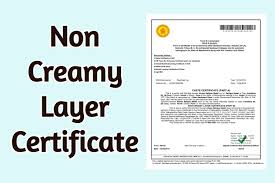
An OBC Non-Creamy Layer Certificate is a government-issued certificate that confirms that an applicant belongs to an eligible OBC community and does not fall under the applicable creamy-layer criteria.
The certificate is particularly important for candidates applying for opportunities where OBC-NCL status is specifically required.
For example, the Joint Seat Allocation Authority (JoSAA) provides a specific OBC-NCL certificate format for admissions under its counselling process. The 2026 JoSAA website lists an OBC-NCL certificate format among its official certificate documents.
In Central Government recruitment, OBC candidates who fall under the creamy layer do not receive the OBC reservation benefit. The Department of Personnel and Training (DoPT) has stated that the current income ceiling used for determining the creamy-layer status is ₹8 lakh per annum.
Who Can Apply for an OBC-NCL Certificate?
Generally, an applicant needs to satisfy the applicable OBC and non-creamy-layer conditions.
The exact requirements can vary by authority, so candidates should check the relevant official notification.
Common requirements include:
- The applicant should belong to an eligible OBC community.
- For Central Government benefits, the community should generally be included in the Central List of OBCs where the concerned opportunity requires Central OBC status.
- The applicant must satisfy the applicable creamy-layer criteria.
- Required caste and income-related documents must be available.
- The certificate should be issued by the competent government authority.
- The certificate should meet the format and date requirements specified by the concerned examination or admission authority.
Simply having an OBC caste certificate does not automatically mean that a candidate can claim OBC-NCL benefits in every Central Government recruitment or admission.
This distinction is very important.
OBC vs OBC-NCL: What Is the Difference?
Many students and job applicants confuse an OBC certificate with an OBC-NCL certificate.
An OBC certificate establishes the applicant’s caste/category status according to the applicable rules.
An OBC-NCL certificate additionally establishes that the applicant does not fall under the applicable creamy-layer criteria.
For Central Government opportunities, candidates may therefore be asked to produce an OBC certificate in the prescribed format that also establishes non-creamy-layer status.
Simple example
Suppose a candidate belongs to an OBC community included in the relevant Central List.
That alone may not be enough to claim Central OBC reservation.
The candidate may also have to satisfy the applicable non-creamy-layer conditions and provide the required certificate in the prescribed format.
Therefore:
OBC + applicable NCL eligibility + valid prescribed certificate = OBC-NCL claim where required.
What Is the ₹8 Lakh OBC-NCL Income Limit?
The ₹8 lakh annual income ceiling is frequently mentioned when discussing OBC creamy-layer status.
The Government of India has stated that the annual parental income limit for the relevant OBC sections is ₹8 lakh, and the limit was last revised in 2017.
However, applicants should avoid interpreting this as:
“If family income is below ₹8 lakh, everyone automatically gets OBC-NCL.”
That is an oversimplification.
The creamy-layer framework includes additional conditions and categories. Depending on the circumstances, the treatment of different sources of income and the status/category of parents can matter.
Therefore, candidates should not decide their eligibility only by adding up every source of household income and comparing it with ₹8 lakh.
Important point
The ₹8 lakh figure relates to the Central Government creamy-layer framework. State governments can have their own procedures and requirements for State-level benefits.
Always check the applicable rules for:
- Central Government jobs
- State Government jobs
- Central educational institutions
- State educational institutions
- Competitive examinations
- Scholarship schemes
- Admission counselling
Is Agricultural Income Included in the ₹8 Lakh Limit?
This is one of the most common questions about OBC-NCL.
The answer should not be reduced to a simple statement such as:
“Agricultural income is never counted.”
Creamy-layer determination is based on the applicable Government of India rules and categories. The treatment of income depends on the specific criteria and circumstances.
Therefore, applicants should not assume that agricultural income automatically makes them eligible or ineligible for OBC-NCL status.
If your family has income from:
- Agriculture
- Salary
- Business
- Profession
- Investments
- Property
- Other sources
you should check the applicable official rules and the requirements of the authority issuing or accepting the certificate.
Benefits of an OBC-NCL Certificate
An eligible OBC-NCL candidate may receive reservation-related benefits where the applicable rules provide them.
1. Reservation in Central Government Jobs
For direct recruitment through all-India open competition, the Central Government provides 27% reservation for OBCs, subject to the applicable rules and exclusions, including the creamy-layer condition.
This does not mean that every OBC-NCL candidate automatically gets a job.
Candidates still need to satisfy:
- Educational qualification
- Age requirement
- Examination requirements
- Skill requirements
- Cut-off requirements
- Document verification
- Medical or physical standards, where applicable
- Other conditions in the recruitment notification
2. Benefits in Central Educational Institutions
OBC reservation is also provided in Central Government educational institutions under applicable rules.
The Ministry of Social Justice & Empowerment has stated that 27% reservation for OBCs is implemented in Central Government educational institutions and Central Government posts, subject to applicable rules.
Students should carefully check the admission brochure of the institution or counselling authority.
For example, JoSAA publishes an official OBC-NCL certificate format for its counselling process.
3. IIT, NIT and Other Technical Admissions
Students applying through JoSAA may need an OBC-NCL certificate in the prescribed format when claiming the OBC-NCL category.
JoSAA’s 2026 certificate section includes an official FORM-OBC-NCL.
Therefore, students preparing for JEE-based admissions should not wait until the final counselling stage.
Check the latest JoSAA notification and certificate requirements before counselling begins.
4. Competitive Examination Benefits
Depending on the examination rules, eligible OBC candidates may receive category-related benefits.
These can include:
- Reservation
- Age relaxation
- Fee-related concessions
- Category-specific cut-offs or qualifying conditions
- Other benefits specifically mentioned in the examination notification
However, not every examination provides exactly the same benefits.
For example, UPSC publishes specific instructions and proformas for candidates claiming OBC benefits. Its official forms page includes an OBC benefits proforma and OBC certificate-related instructions.
Therefore, never rely only on a general article. Read the current notification of the examination you are applying for.
Documents Required for OBC-NCL Certificate
Document requirements differ from one State and issuing authority to another.
For example, the Maharashtra Aaple Sarkar portal lists the following documents for its Non-Creamy Layer Certificate service.
Identity Proof
Any one applicable document may include:
- Aadhaar Card
- PAN Card
- Passport
- Voter ID
- Driving Licence
Address Proof
Depending on the service requirements, documents may include:
- Aadhaar Card
- Ration Card
- Electricity Bill
- Water Bill
- Passport
- Voter ID
- Driving Licence
- Property Tax Receipt
- 7/12 and 8A extracts
- Rent receipt
Mandatory Documents in Maharashtra
The Maharashtra Aaple Sarkar service page specifically lists:
- Income proof
- Caste certificate
as mandatory documents for the Non-Creamy Layer Certificate service.
This means applicants should check the document list shown by their own State or competent authority before submitting an application.
Common Documents You Should Keep Ready
A practical document checklist may include:
- OBC caste certificate
- Income proof
- Aadhaar card
- Address proof
- Passport-size photograph
- Parent/family income-related documents, where required
- Previous NCL certificate, if applicable
- Supporting revenue documents, where applicable
- Self-declaration or undertaking, where required
- Any additional document mentioned by the issuing authority
Do not upload unnecessary documents unless the official portal or authority asks for them.
How to Apply for an OBC-NCL Certificate Online
The exact online procedure depends on your State.
Step 1: Visit the Official Government Portal
Use the official portal of your State or the competent authority.
Avoid unofficial websites that ask for unnecessary payments or personal information.
For Maharashtra, the Aaple Sarkar portal provides information and services related to the Non-Creamy Layer Certificate.
Step 2: Create an Account
If registration is required:
- Enter your mobile number.
- Complete OTP verification.
- Create your login credentials.
- Enter your personal details carefully.
The Maharashtra Aaple Sarkar registration process allows citizens to create a profile and provides instructions for uploading photograph, identity proof and address proof.
Step 3: Select Non-Creamy Layer Certificate
Find the relevant service under the Revenue Department or the appropriate department.
Step 4: Enter Your Details
You may need to enter:
- Full name
- Date of birth
- Address
- Parent details
- Caste details
- Income details
- Other supporting information
Check every spelling carefully before submission.
Step 5: Upload Documents
Upload clear and readable copies of the required documents.
Make sure:
- Name matches across documents where required.
- Documents are not expired.
- Scanned copies are readable.
- File sizes follow the portal requirements.
Step 6: Submit the Application
Review all details before submitting.
Save the:
- Application number
- Acknowledgement receipt
- Submission date
- Login details
These details can be useful for tracking your application.
How to Apply Offline
Some applicants may need to use an offline or assisted application process depending on their State.
You may be directed to an appropriate:
- Sub-Divisional Office
- Revenue Office
- Tehsil/Tahsil office
- Service centre
- Other designated government office
The exact authority varies by State.
For Maharashtra, the official Aaple Sarkar service information identifies the Sub-Divisional Officer as the designated officer for the Non-Creamy Layer Certificate.
How Long Does an NCL Certificate Take?
Processing time depends on the State, authority, verification process and completeness of the application.
For Maharashtra, the Aaple Sarkar portal lists a 21-day service time limit for the Non-Creamy Layer Certificate and identifies the Sub-Divisional Officer as the designated officer.
This should not be interpreted as a universal 21-day period for every State in India.
If verification takes longer or documents are incomplete, the process may take additional time.
How to Track Your NCL Certificate Application
After submitting your application, keep your application ID or acknowledgement number.
The Maharashtra Aaple Sarkar portal provides an option to track the application using the application ID. It also provides certificate verification using the certificate’s barcode.
Always use the official government portal to check your application status.
How to Verify an NCL Certificate
Certificate verification is important when submitting an NCL certificate for:
- Government recruitment
- College admission
- Counselling
- Scholarships
- Competitive examinations
The verification method differs by State.
Maharashtra’s Aaple Sarkar portal provides an online facility to verify an authenticated certificate using its barcode.
Is an OBC-NCL Certificate Valid for One Year?
There is no single simple validity rule that should be applied to every OBC-NCL certificate in India.
The required certificate date can depend on:
- Central Government recruitment
- Examination notification
- Admission counselling
- State Government rules
- Certificate format
- Document verification date
For example, official recruitment instructions can specify how recent an OBC certificate must be and when the candidate must produce it.
UPSC publishes specific OBC certificate instructions and proformas for candidates claiming OBC benefits.
Similarly, JoSAA publishes its own certificate formats for its admission process.
Best practice
Before applying for an exam or admission:
- Read the latest official notification.
- Check the required certificate format.
- Check the certificate date requirement.
- Check whether a Central List OBC certificate is required.
- Obtain or renew the certificate if necessary.
- Keep the original certificate safely.
Central OBC-NCL and State OBC-NCL Are Not Always the Same
This is one of the most important points for applicants.
India has both:
- Central Government reservation rules
- State Government reservation rules
A candidate may be eligible under a State’s OBC/Backward Class system but may not automatically qualify for a Central OBC-NCL benefit.
If a Central Government examination asks for OBC-NCL status, check whether your community appears in the relevant Central OBC List and follow the certificate format prescribed by the concerned authority.
Do not assume that a State OBC certificate alone is sufficient.
Important Mistakes to Avoid
Mistake 1: Assuming ₹8 lakh is the only condition
The ₹8 lakh ceiling is an important part of the Central creamy-layer framework, but it is not the only consideration.
Mistake 2: Using an old certificate without checking the notification
An old certificate may not satisfy the date or format requirement of a particular examination.
Mistake 3: Confusing OBC with OBC-NCL
An OBC certificate and an OBC-NCL claim are not necessarily interchangeable.
Mistake 4: Using the wrong OBC list
For Central Government opportunities, check the relevant Central OBC List requirements.
Mistake 5: Waiting until the last date
Certificate preparation can take time.
Apply early if you know that an upcoming examination or admission process requires OBC-NCL documentation.
Mistake 6: Uploading unclear documents
Blurred documents can cause verification problems.
Mistake 7: Depending on unofficial websites
Use official government websites whenever possible.
OBC-NCL Certificate for Students
Students may need an OBC-NCL certificate for different admission processes.
For example, JoSAA’s 2026 counselling information includes a specific OBC-NCL certificate format.
Students should therefore prepare their category documents before counselling begins.
A student should keep ready:
- Caste certificate
- OBC-NCL certificate, where required
- Aadhaar or other identity proof
- Educational certificates
- Photograph
- Other documents listed in the counselling brochure
Always follow the current admission authority’s instructions.
OBC-NCL Certificate for Government Jobs
Candidates applying for Central Government jobs should read the recruitment advertisement carefully.
The notification may specify:
- Whether OBC reservation is available
- Whether Central OBC-NCL status is required
- Certificate format
- Certificate issue date
- Cut-off date
- Competent issuing authority
- Document verification requirements
The Central Government’s reservation framework provides 27% OBC reservation in direct recruitment on an all-India basis through open competition, subject to applicable rules and exclusions.
What Happens If Your NCL Certificate Is Rejected?
If your application is rejected, first check the reason.
Common reasons may include:
- Incomplete documents
- Incorrect income information
- Caste certificate issue
- Wrong document format
- Address mismatch
- Missing supporting documents
- Incorrect information
- Failure to satisfy applicable eligibility conditions
In Maharashtra, the Aaple Sarkar system provides an appeal mechanism under the Maharashtra Right to Public Services framework. The portal identifies the Additional Collector and Collector as appellate authorities after the designated officer.
Follow the official appeal procedure applicable to your State.
Frequently Asked Questions About OBC-NCL Certificate
1. What is an OBC-NCL certificate?
It is a government certificate used to establish eligible OBC status along with non-creamy-layer status where such certification is required.
2. What is the Central OBC-NCL income limit?
The currently stated Central Government creamy-layer income ceiling is ₹8 lakh per annum. The Government has stated that this limit was last revised in 2017.
3. Does earning below ₹8 lakh automatically make me OBC-NCL?
No. The creamy-layer framework contains additional conditions. Eligibility should be determined according to the applicable rules.
4. Is OBC-NCL required for every OBC student?
No. It depends on the admission process, institution, counselling authority and applicable rules.
5. Is OBC-NCL required for every government job?
No. It depends on the recruitment notification and applicable reservation rules.
6. Can a State OBC certificate be used for Central Government recruitment?
Not necessarily. Central Government opportunities may require OBC status according to the Central List and the prescribed certificate format.
7. Can I apply online?
In many States, online or assisted online services are available. Maharashtra provides Non-Creamy Layer Certificate services through Aaple Sarkar.
8. How long does the certificate take in Maharashtra?
The Maharashtra Aaple Sarkar service page lists a 21-day time limit for the Non-Creamy Layer Certificate.
9. What documents are required?
Requirements vary, but commonly include a caste certificate and income proof. Maharashtra’s official service page lists identity proof, address proof, income proof and caste certificate requirements.
10. Can I use the same certificate for every exam?
Not always. Different authorities may specify different certificate formats and date requirements.
Official Links for OBC-NCL Information
Applicants should use official websites for the latest requirements.
Maharashtra Aaple Sarkar
For Maharashtra residents, the official Aaple Sarkar portal provides information about the Non-Creamy Layer Certificate service, required documents, application tracking and certificate verification.
Department of Personnel and Training
The DoPT publishes information relating to reservation policy and Central Government service rules.
UPSC
Candidates applying for UPSC examinations can check the official UPSC forms and OBC-related instructions.
JoSAA
Students participating in JoSAA counselling can check the official certificate formats, including the OBC-NCL form.
Final Checklist Before Applying for OBC-NCL
Before submitting your application, check these points:
- I belong to an eligible OBC community.
- I checked whether the relevant opportunity requires Central or State OBC status.
- I checked the applicable creamy-layer conditions.
- I have a valid caste certificate.
- I have the required income proof.
- My identity details are correct.
- My address details are correct.
- I checked the latest official notification.
- I checked the prescribed certificate format.
- I checked the required certificate date.
- I saved my application acknowledgement.
- I will keep the original certificate safely.
Conclusion
The OBC Non-Creamy Layer (NCL) Certificate can be an important document for eligible OBC candidates seeking reservation-related benefits in Central Government jobs, educational admissions and other opportunities where OBC-NCL status is specifically required.
The Central Government currently states an ₹8 lakh annual income ceiling for the relevant OBC creamy-layer determination, but applicants should remember that creamy-layer eligibility is not determined by a simple income comparison alone. Other conditions can also apply.
The most important step is to check the latest official notification for the particular job, examination, admission or counselling process.
For Maharashtra applicants, the official Aaple Sarkar portal lists the Non-Creamy Layer Certificate service, required documents and a 21-day notified service time.
Do not wait until the last date. Keep your caste certificate, income documents and identity documents ready in advance and always use official government portals for applications and verification.
Information source: Government of India, Department of Personnel & Training, Ministry of Social Justice & Empowerment, UPSC, JoSAA and Government of Maharashtra.