Career in Refrigeration and Air Conditioning: Courses, Jobs, Skills and Salary
Career in Refrigeration and Air Conditioning: Courses, Jobs, Skills and Future Scope
A career in refrigeration and air conditioning can be a practical choice for students who enjoy technical work, machines, electrical systems, tools, and problem-solving. Refrigeration and air conditioning are important parts of modern life. Homes, offices, hospitals, hotels, restaurants, shopping malls, factories, supermarkets, transport systems, and many other businesses depend on cooling and temperature-control equipment.


The field is commonly connected with HVAC, which stands for Heating, Ventilation and Air Conditioning. Refrigeration is also an important part of the industry because food, medicines, chemicals, industrial products, and many other goods need controlled temperatures during storage and transportation.
People working in this field may install, inspect, maintain, troubleshoot, repair, and service air conditioners, refrigerators, cold rooms, chillers, freezers, cooling systems, and related equipment.
For students who want a skill-based technical career, this field can provide several paths. A person can work as a technician, service engineer, maintenance technician, installation technician, refrigeration mechanic, HVAC technician, or eventually start an independent service business.
What Is Refrigeration and Air Conditioning?
Refrigeration is the process of removing heat from a space, product, or system to maintain a lower temperature. Air conditioning involves controlling indoor air conditions, including temperature and comfort.
A simple example is a home air conditioner. The AC removes heat from the indoor room and transfers that heat outside. A refrigerator works on a similar basic principle but is designed to maintain a much lower temperature inside its storage compartment.
Commercial and industrial refrigeration systems can be much larger and more complex. They may be used in supermarkets, cold-storage facilities, food-processing plants, pharmaceutical facilities, hotels, restaurants, and manufacturing units.
An air-conditioning technician needs to understand mechanical, electrical, and refrigeration-related components. This makes the profession practical and technical at the same time.
Why Choose a Career in Refrigeration and Air Conditioning?
There are several reasons students consider this field.
1. Practical and Skill-Based Work
Refrigeration and air conditioning is a hands-on profession. Technicians use tools, testing equipment, electrical instruments, gauges, and other equipment to identify and solve technical problems.
Students who prefer practical learning over purely theoretical study may find this type of career interesting.
2. Applications in Many Industries
Cooling systems are used in many industries. For example:
- Residential buildings
- Offices
- Hotels
- Hospitals
- Restaurants
- Shopping malls
- Supermarkets
- Cold-storage facilities
- Food-processing companies
- Pharmaceutical companies
- Manufacturing plants
- Data centres
- Transport and logistics
- Commercial buildings
Because cooling and temperature control are required in many places, refrigeration and air-conditioning skills can be useful across different industries.
3. Different Career Paths
A trained person does not have to follow only one career path. Depending on education, experience, and additional skills, a person may work in installation, servicing, maintenance, sales, technical support, or supervision.
Experienced technicians may also develop their own customer base and start a repair and maintenance business.
4. Opportunity to Develop a Skilled Trade
Technical skills can become valuable when they are combined with experience, safety awareness, customer service, and continuous learning.
A beginner may start with basic servicing work and gradually learn more advanced systems.
Courses for a Career in Refrigeration and Air Conditioning
Students can enter this field through different technical and vocational education routes.
One important option in India is the Refrigeration and Air Conditioning Technician trade under the Directorate General of Training (DGT).
According to the current DGT trade information, the Refrigeration and Air Conditioning Technician trade is a two-year course with a 2,400-hour duration. The listed eligibility is passing Class 10 with Science and Mathematics, or an equivalent vocational subject in the same sector. The trade is listed at NSQF Level 4. Students should always check the latest official admission information before applying because course rules can change.
Other possible learning routes can include:
- ITI courses
- Diploma-level technical education
- Skill-development programmes
- Apprenticeship training
- Short-term HVAC training
- Manufacturer training programmes
- On-the-job technical training
- Advanced refrigeration and HVAC courses
Students should compare the course duration, eligibility, practical training, certification, institute facilities, placement support, and fees before choosing an institute.
Eligibility for Refrigeration and Air Conditioning Courses
Eligibility depends on the course and institution.
For the DGT Refrigeration and Air Conditioning Technician trade, the official information states that candidates should have passed Class 10 with Science and Mathematics or an equivalent vocational subject in the same sector.
However, private training institutes may have different requirements for short-term courses.
Before admission, students should check:
- Minimum educational qualification
- Age requirements
- Course duration
- Practical training hours
- Certification
- Examination system
- Fees
- Apprenticeship opportunities
- Placement assistance
- Recognition of the qualification
Choosing a recognized and suitable training programme can help students build a stronger technical foundation.
What Do Refrigeration and Air Conditioning Technicians Learn?
A technician needs knowledge of several areas.
Refrigeration Basics
Students learn how refrigeration systems work and how different components work together to transfer heat.
Air Conditioning Systems
Training may cover different types of air-conditioning systems and their installation, operation, maintenance, and servicing.
Electrical Systems
Many HVAC and refrigeration faults involve electrical components. Students therefore need basic knowledge of wiring, motors, capacitors, relays, controls, electrical safety, and testing procedures.
Mechanical Components
Technicians may work with compressors, fans, motors, pumps, valves, pipes, filters, and other mechanical components.
Troubleshooting
Troubleshooting is one of the most important skills in this career.
A technician needs to identify the actual cause of a problem instead of simply replacing parts.
Maintenance
Regular maintenance can help equipment operate properly and may reduce unexpected breakdowns.
Safety
Electrical systems, pressurized refrigerant systems, rotating machinery, and tools can create safety risks. Proper training and protective equipment are essential.
Important Skills for an HVAC or Refrigeration Technician
Technical knowledge is important, but soft skills also matter.
Technical Skills
A technician should gradually develop knowledge of:
- Refrigeration cycles
- Air-conditioning systems
- Electrical circuits
- Motors and compressors
- Temperature measurement
- Pressure measurement
- System diagnosis
- Preventive maintenance
- Installation procedures
- Basic controls
- Tools and testing instruments
Problem-Solving Skills
Customers usually call a technician because something is not working correctly.
The technician must inspect the equipment, identify symptoms, test components, and determine the probable cause.
Good troubleshooting skills become stronger with practical experience.
Communication Skills
A technician often communicates directly with customers, supervisors, contractors, or other technicians.
Being able to explain a technical problem in simple language is an important professional skill.
Time Management
Service technicians may handle several jobs in one day. Planning the work properly can help them complete jobs efficiently.
Safety Awareness
Safety should always come before speed.
Technicians should follow proper electrical safety procedures, use appropriate protective equipment, follow manufacturer instructions, and handle refrigerants and tools responsibly.
Career Options After Refrigeration and Air Conditioning Training
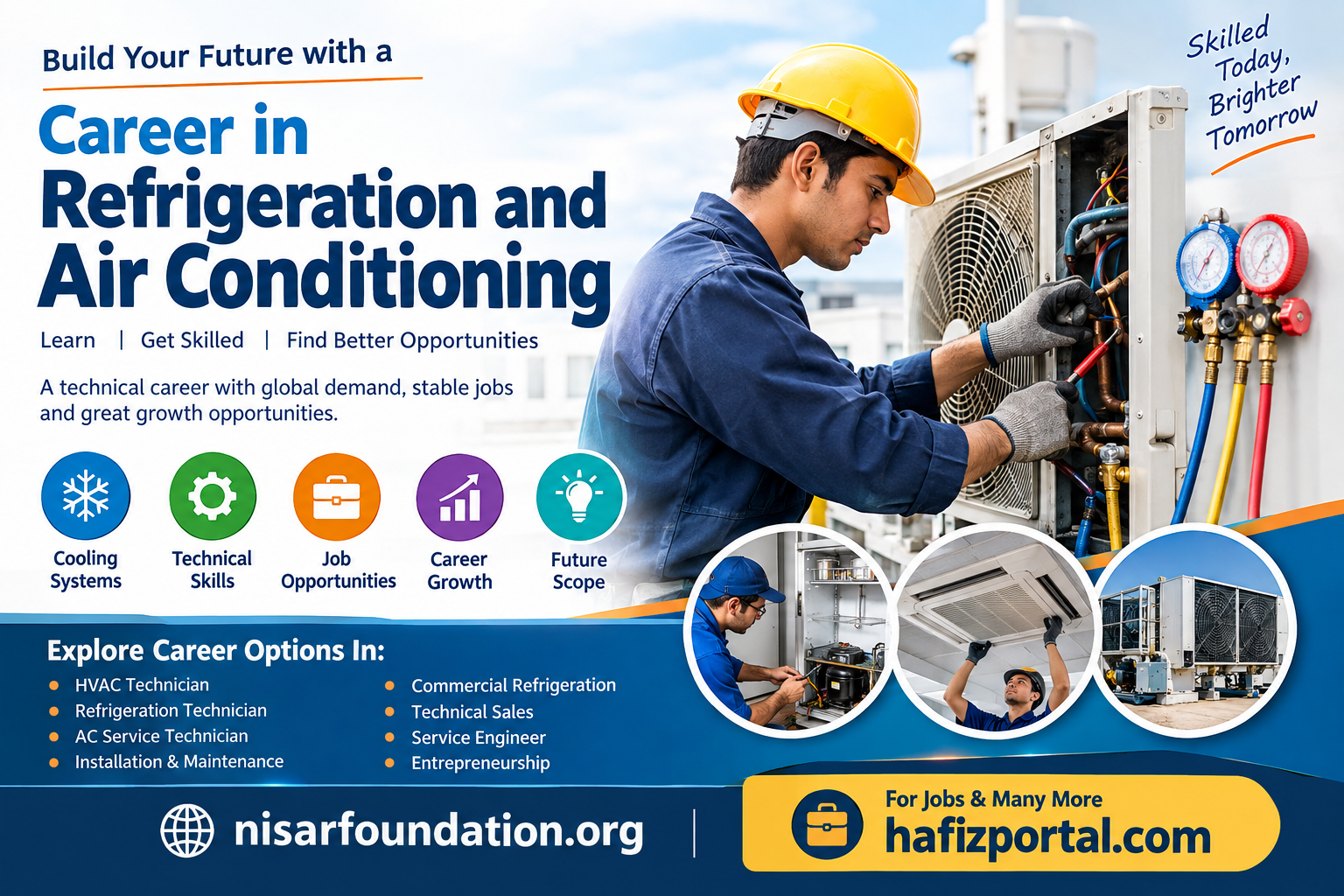
After completing suitable training and gaining experience, students can explore roles such as:
HVAC Technician
An HVAC technician installs, maintains, and services heating, ventilation, and air-conditioning equipment.
Refrigeration Technician
A refrigeration technician works with refrigerators, freezers, cold rooms, commercial refrigeration systems, and other cooling equipment.
AC Service Technician
An AC service technician may install, inspect, clean, maintain, troubleshoot, and repair residential and commercial air-conditioning systems.
Installation Technician
Installation technicians help install new AC, refrigeration, ventilation, or cooling equipment.
Maintenance Technician
Maintenance technicians focus on preventive maintenance and breakdown-related service work.
Refrigeration Mechanic
A refrigeration mechanic works on refrigeration equipment and related mechanical and electrical components.
HVAC Maintenance Supervisor
With experience and additional technical knowledge, a technician may move into supervisory or team-lead positions.
Service Engineer
People with higher technical qualifications and relevant experience may work in technical service and engineering roles.
Technical Sales
Technical knowledge can also be useful in equipment sales, where professionals explain products and systems to customers.
Entrepreneurship
Experienced technicians can start businesses providing:
- AC installation
- AC servicing
- Refrigeration repair
- Annual maintenance contracts
- Commercial HVAC maintenance
- Cold-room maintenance
- Spare-parts services
- Equipment installation
A business owner also needs knowledge of pricing, customer service, accounting, marketing, and local business regulations.
Where Can Refrigeration and Air Conditioning Technicians Work?
The work environment can vary significantly.
Technicians may find opportunities with:
- HVAC companies
- Refrigeration companies
- Appliance service companies
- Hotels
- Hospitals
- Restaurants
- Shopping malls
- Supermarkets
- Manufacturing companies
- Food-processing companies
- Cold-storage companies
- Pharmaceutical companies
- Facility-management companies
- Construction companies
- Building-maintenance companies
Some technicians work mainly indoors, while others travel to customer locations.
Salary in Refrigeration and Air Conditioning
Salary varies according to several factors.
These can include:
- Qualification
- Practical skills
- Work experience
- Location
- Employer
- Type of equipment
- Industry
- Job responsibilities
- Customer-service ability
- Additional certifications
A beginner generally starts at an entry-level position and can build experience over time. Skilled technicians with experience in commercial or industrial systems may qualify for more specialized responsibilities.
It is better to avoid choosing a course only because of a promised salary. Students should consider the quality of training, practical exposure, certification, career progression, and actual employment opportunities.
When researching salaries online, compare current job listings in your city and industry rather than relying on old salary figures.
Career Growth in Refrigeration and Air Conditioning
Career growth usually depends on continuous learning and practical experience.
A possible career journey can look like this:
Trainee → Junior Technician → Technician → Senior Technician → Supervisor → Service Manager
Another path can be:
Trainee → Technician → Specialized HVAC Technician → Commercial/Industrial Technician → Technical Specialist
Some professionals eventually move into technical sales, project coordination, facility management, or entrepreneurship.
The exact career path depends on qualifications, experience, employer, and individual goals.
How to Become a Successful HVAC Technician
A certificate alone is not enough to become a strong technician.
Students should focus on practical learning.
Step 1: Complete a Suitable Course
Choose an appropriate ITI, diploma, or skill-development course.
Step 2: Build Practical Skills
Spend time working with actual equipment under proper supervision.
Step 3: Learn Electrical Basics
Electrical knowledge is extremely useful for troubleshooting AC and refrigeration systems.
Step 4: Understand Refrigeration Principles
Learn how the refrigeration cycle works and understand the purpose of major components.
Step 5: Improve Troubleshooting
Do not focus only on replacing components. Learn how to identify the actual fault.
Step 6: Learn Safety Procedures
Follow safe working practices every time.
Step 7: Gain Work Experience
Apprenticeships, internships, and entry-level jobs can provide valuable practical exposure.
Step 8: Continue Learning
HVAC technology continues to change. Keep learning about new equipment, controls, energy efficiency, refrigerants, and servicing practices.
Importance of Apprenticeship and Practical Training
Practical experience can make a significant difference in technical careers.
A classroom can teach principles, but real equipment helps students understand how systems behave under different conditions.
During practical training, students may learn how to:
- Inspect equipment
- Use tools correctly
- Measure electrical values
- Check temperatures
- Read pressure measurements
- Identify faults
- Perform basic maintenance
- Follow installation procedures
- Communicate with customers
- Maintain workplace safety
Students should choose practical training opportunities carefully and work under qualified supervision.
Future Scope of Refrigeration and Air Conditioning
Cooling technology is important for homes, businesses, industries, healthcare, food storage, and other applications.
The field is also becoming more technology-driven.
Modern HVAC systems can include:
- Digital controls
- Smart thermostats
- Sensors
- Energy-management systems
- Variable-speed technology
- Automated monitoring
- Advanced control systems
Technicians who combine traditional mechanical skills with electrical and digital knowledge can broaden their technical capabilities.
Energy efficiency is another important area. Businesses and building owners often want systems that provide effective cooling while controlling operating costs.
This creates a need for technicians who understand installation quality, maintenance, system performance, and efficient operation.
Refrigeration and Air Conditioning in the Food Industry
Refrigeration plays an important role in food storage and distribution.
Restaurants, supermarkets, food-processing companies, warehouses, and cold-storage facilities may use refrigeration equipment to maintain appropriate temperatures.
Technicians working in this sector may deal with:
- Display refrigerators
- Commercial freezers
- Cold rooms
- Walk-in coolers
- Ice machines
- Food-storage refrigeration
- Industrial cooling systems
Commercial refrigeration can require specialized knowledge, so additional training and practical experience can be useful.
Refrigeration and Air Conditioning in Hospitals
Hospitals and healthcare facilities require reliable environmental control and temperature management.
Depending on the facility and system, HVAC professionals may work on air-conditioning equipment, ventilation systems, cooling equipment, and maintenance operations.
Healthcare environments can have strict operational and safety requirements, so technicians should follow facility procedures and professional standards.
Is Refrigeration and Air Conditioning a Good Career for Students?
Students should make this decision based on their interests, abilities, education goals, and career plans.
This field may suit people who enjoy:
- Practical work
- Machines
- Electrical systems
- Troubleshooting
- Technical tools
- Fieldwork
- Repair and maintenance
- Learning through practice
Students who prefer purely desk-based work may want to compare this field with other career options.
The important point is to understand the actual work before choosing a technical course.
Advantages of a Career in Refrigeration and Air Conditioning
Some potential advantages include:
- Practical technical work
- Multiple industry applications
- Opportunities for specialization
- Possibility of employment and self-employment
- Scope for skill development
- Different career paths
- Opportunities to work with modern technology
However, the profession can also involve physical work, travel, working in different temperatures, emergency service calls, and handling equipment.
Students should understand both the benefits and challenges before entering the field.
How to Choose the Right Refrigeration and Air Conditioning Course
Before joining a course, ask these questions:
- Is the institute recognized?
- What is the course duration?
- What qualification is required?
- How much practical training is included?
- Are workshops and equipment available?
- What certificate will students receive?
- Does the course include electrical training?
- Does it cover modern air-conditioning systems?
- Are apprenticeship opportunities available?
- Does the institute provide reliable placement information?
Do not select a course only because of advertisements promising a high salary or guaranteed employment.
Always verify course information from the official institute or government source.
Frequently Asked Questions
What is a career in refrigeration and air conditioning?
A career in refrigeration and air conditioning involves installing, servicing, maintaining, troubleshooting, and repairing cooling and HVAC equipment.
What qualification is required for an RAC technician course?
Requirements vary by programme. The DGT Refrigeration and Air Conditioning Technician trade currently lists Class 10 with Science and Mathematics, or an equivalent vocational subject in the same sector, as the eligibility requirement.
How long is the DGT Refrigeration and Air Conditioning Technician course?
The DGT currently lists the trade as a two-year programme with 2,400 hours of training.
Can I start my own AC repair business?
Yes. After gaining suitable technical knowledge and practical experience, a person can explore self-employment in AC servicing, installation, refrigeration repair, maintenance contracts, and related services. Local registration, tax, safety, and business requirements should be checked before starting a business.
Is HVAC the same as refrigeration?
They are related but not exactly the same. HVAC covers heating, ventilation, and air conditioning, while refrigeration focuses on cooling applications where temperatures are maintained below the surrounding environment. Many technicians work across both areas.
What skills are important for an HVAC technician?
Important skills include refrigeration fundamentals, electrical knowledge, troubleshooting, equipment maintenance, tool handling, safety awareness, communication, and practical problem-solving.
Can women build a career in HVAC and refrigeration?
Yes. Technical careers are open to people who meet the relevant education, training, safety, and job requirements. Women interested in technical careers can consider refrigeration, HVAC, maintenance, technical support, design, sales, and related roles according to their qualifications and interests.
Does HVAC have future career opportunities?
HVAC and refrigeration are used in residential, commercial, industrial, healthcare, food, retail, and other sectors. Future opportunities will depend on industry demand, technology, location, qualifications, and individual skills.
Final Thoughts
A career in refrigeration and air conditioning can provide a practical route into the technical and skilled-services sector. Students can begin with vocational training and gradually build experience in installation, servicing, maintenance, troubleshooting, commercial refrigeration, HVAC systems, or other specialized areas.
The most important step is to choose the right training programme and develop genuine practical skills. Along with technical knowledge, students should build communication, safety, troubleshooting, and customer-service skills.
For students in India, official government sources such as the Directorate General of Training and National Skill Development Corporation can be useful starting points when researching vocational qualifications and occupational standards.
Whether you want to become an HVAC technician, refrigeration mechanic, service technician, maintenance professional, or eventually start your own technical service business, continuous learning and practical experience can help you build your career step by step.
Always verify the latest course eligibility, duration, certification, admission dates, and employment information directly from official sources before making an education or career decision.
Suggested Internal Links
If this article is published on an education or career website, connect it naturally to related pages such as:
- ITI Courses After 10th
- Best Technical Courses After 10th
- HVAC Technician Course
- Refrigeration and Air Conditioning Course
- ITI Admission Guide
- Career Options After ITI
- Apprenticeship Opportunities
- Skill Development Courses
- Technical Jobs in India
- Vocational Courses After 10th
Suggested Related Article Topics
For stronger website structure, you can also publish supporting articles such as:
- What Is an HVAC Technician?
- ITI Refrigeration and Air Conditioning Course
- HVAC Technician Salary in India
- Best ITI Courses After 10th
- How to Become an AC Technician
- Refrigeration Technician Career Guide
- HVAC vs Refrigeration: What Is the Difference?
- AC Technician Tools and Equipment
- Commercial Refrigeration Career
- Career Options After ITI
Disclaimer
This article is intended for general educational and career information. Course eligibility, duration, admission rules, salaries, job requirements, and certifications can change. Readers should verify current information with the relevant government department, training institute, employer, or official authority before making a decision.