European Space Agency International Internship 2027: Funded Student Opportunity in Europe
European Space Agency International Internship 2027 (Funded)
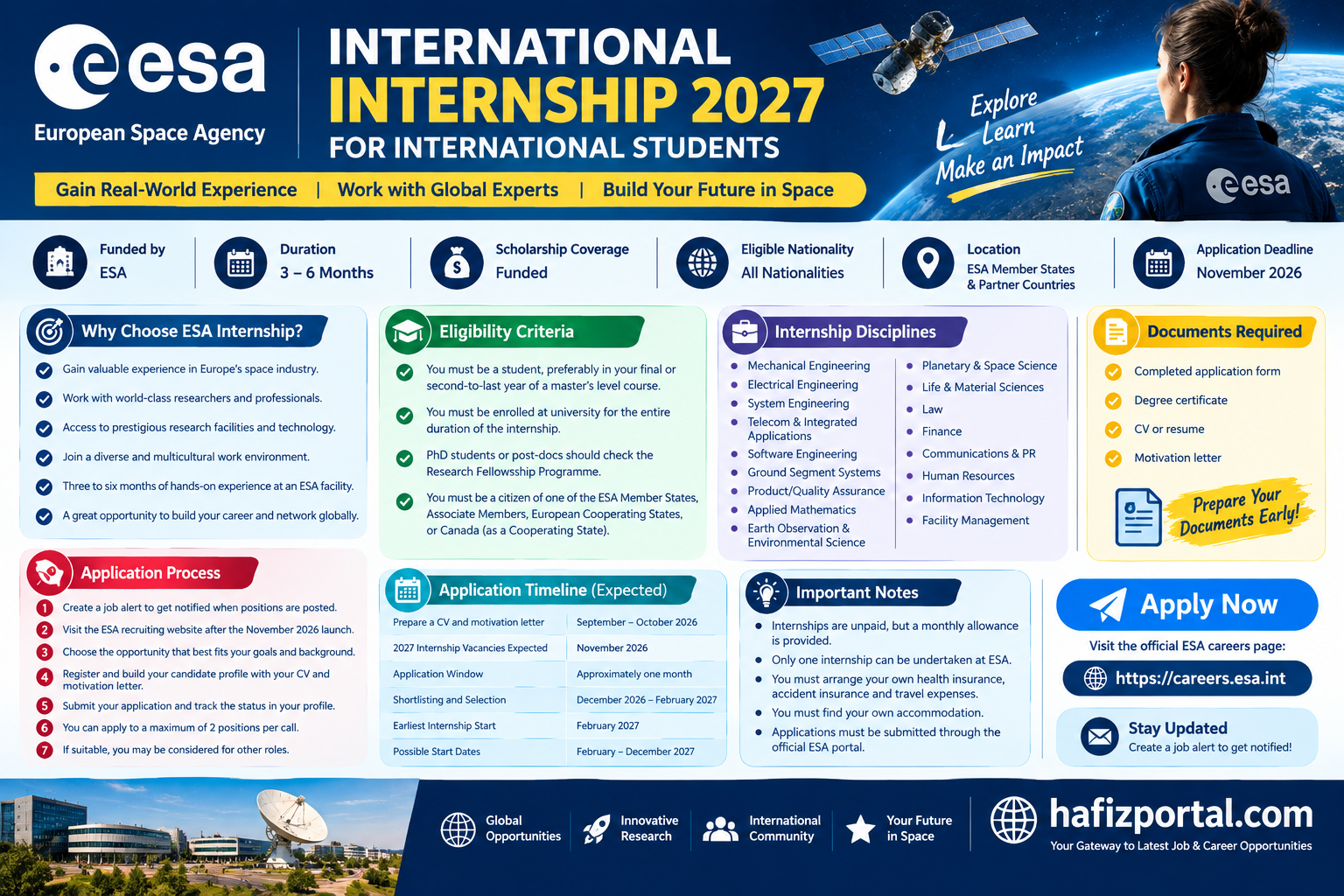
European Space Agency International Internship 2027 is an excellent opportunity for eligible university students who want to gain practical experience in Europe’s space sector. The European Space Agency (ESA) offers student internships in a wide range of technical and non-technical areas, including engineering, software, space science, Earth observation, mathematics, law, finance, communications, human resources and information technology.
According to ESA, its student internships generally last three to six months and are designed primarily for students who are in the final or second-to-last year of a university course at Master’s level. Importantly, applicants must remain enrolled at their university for the entire internship period. (European Space Agency)
ESA normally publishes student internship opportunities in November, with vacancies remaining open for approximately one month. The selection process generally takes place from December to February, and internships can begin from February, with the exact starting date agreed between ESA and the university. (European Space Agency)
Important: Although this opportunity is often described online as an “international” internship, it is not open to every nationality worldwide. Eligibility depends on citizenship. Applicants should always check the nationality requirement listed on the individual ESA vacancy before applying. (European Space Agency)
Quick Facts: ESA International Internship 2027
| Detail | Information |
|---|---|
| Program | ESA Student Internship Programme |
| Host Organization | European Space Agency |
| Duration | 3–6 months |
| Mode | On-site |
| Expected Application Period | November 2026 |
| Expected Application Window | Approximately one month |
| Earliest Expected Start | February 2027 |
| Academic Level | Mainly Bachelor/Master students, with preference for final or second-to-last-year Master’s students |
| Funding | Monthly allowance; internships are unpaid |
| Nationality | Eligible ESA Member/Associate/Cooperating State and other specifically eligible citizenships listed by ESA |
| Application Limit | Maximum two applications per person |
| Official Portal | ESA Careers |
The above timeline reflects ESA’s published student-internship recruitment process. Applicants should verify the actual 2027 vacancies and their individual eligibility when the official call is published. (European Space Agency)
What Is the ESA Student Internship Programme?
The European Space Agency Student Internship Programme gives university students an opportunity to work with ESA teams while completing their studies. The programme covers both technical and non-technical areas, allowing students with different academic backgrounds to explore careers connected to Europe’s space activities.
An ESA internship can be particularly valuable because students work in an international and multicultural environment. Depending on the selected position, an intern may contribute to research, engineering development, software projects, space missions, Earth observation activities, business support or other ESA programmes.
ESA states that internships are normally between three and six months and take place at an ESA establishment. The internships are unpaid, but a monthly allowance is provided. (European Space Agency)
Benefits of the ESA International Internship
An ESA internship can provide much more than classroom knowledge. It can help students understand how large-scale scientific and engineering projects operate in a professional environment.
1. Practical International Experience
Students can gain experience working alongside professionals, researchers, engineers and other specialists in a major European space organization.
2. Monthly Allowance
ESA internships are unpaid, but eligible interns receive a monthly allowance. This makes the programme financially supported, although applicants should carefully review the conditions of the specific internship. (European Space Agency)
3. Multicultural Working Environment
ESA describes its workplace as international and multicultural. Students can work with colleagues from different European countries and professional backgrounds. (European Space Agency)
4. Exposure to the Space Sector
The internship can help students understand real-world applications of engineering, science, software, data, research and business skills within the space sector.
5. Career Development
An ESA internship may strengthen a student’s CV and provide valuable professional experience for future opportunities in space, research, engineering, technology and related industries.
6. Master’s Thesis Possibility
ESA notes that, after selection and subject to agreement with the tutor, students may be able to complete their Master’s thesis during an internship if it is related to their internship work. (European Space Agency)
Internship Fields and Disciplines
ESA offers internships across a broad range of disciplines. The exact vacancies available in 2027 will be published on the official recruitment portal.
Potential areas include:
- Mechanical Engineering
- Optical Engineering
- Propulsion
- Thermal Engineering
- Structures and Materials
- Robotics
- Electrical Engineering
- Radio Frequency and Antennas
- Power and Data Systems
- Microelectronics
- Electromagnetic Compatibility
- Systems Engineering
- Telecommunications
- Software Engineering
- Ground Segment Systems
- Product and Quality Assurance
- Safety
- Applied Mathematics
- Earth Observation
- Environmental Science
- Geophysics
- Meteorology
- Climatology
- Astronomy
- Astrophysics
- Solar Physics
- Planetary and Space Science
- Life Sciences
- Materials Science
- Law
- Finance
- Communications and Public Relations
- Human Resources
- Information Technology
- Facility Management
ESA’s official internship page lists these technical and non-technical disciplines as areas in which student placements can be available. (European Space Agency)
Who Can Apply for ESA Internships?
The eligibility requirements are important because the programme is not open to students of every nationality.
Generally, applicants must:
- Be university students.
- Preferably be in their final or second-to-last year of a Master’s-level university course.
- Remain enrolled at their university for the entire internship.
- Hold citizenship of an eligible ESA Member State, Associate Member, European Cooperating State or Canada as a Cooperating State, subject to the detailed eligibility rules applicable to the vacancy.
- Meet the education and technical requirements stated in the individual internship advertisement.
ESA’s FAQ also makes clear that PhD students should generally look at the Research Fellowship Programme rather than the student internship programme. (European Space Agency)
Therefore, students from countries outside the eligible citizenship groups should not assume they can apply simply because the programme is described as an international internship.
Documents to Prepare
Applicants should prepare their documents well before the expected November application period.
Recommended documents include:
Updated CV or Resume
Your CV should clearly show your education, technical skills, academic projects, internships, research experience, software knowledge and relevant achievements.
Motivation Letter
Your motivation letter should explain why you are interested in the specific internship and how your academic background matches the opportunity.
ESA advises applicants to keep their motivation clear and concise while demonstrating motivation, interests and enthusiasm. (European Space Agency)
Academic Information
Keep your current degree details and university information ready. Make sure your enrolment status will remain valid for the complete internship period.
Supporting Information
Some vacancies may request additional information or specific qualifications. Always read the individual vacancy carefully before submitting an application.
ESA Internship Application Timeline for 2027
Based on ESA’s published annual recruitment process, students can use the following timeline for preparation:
| Stage | Expected Period |
|---|---|
| Prepare CV and motivation letter | September–October 2026 |
| Internship opportunities expected | November 2026 |
| Application period | Approximately one month |
| Shortlisting and selection | December 2026–February 2027 |
| Earliest possible start | February 2027 |
| Other possible start dates | February–December 2027 |
ESA currently states that student internship opportunities are normally published in November and remain open for one month. The earliest internship start is generally in February, while starting dates can be agreed for any first working day from February through December of the same year. (European Space Agency)
How to Apply for ESA International Internship 2027
Students should follow the official ESA recruitment process rather than relying on third-party application websites.
Step 1: Check Your Eligibility
First, confirm your citizenship, academic status and enrolment period. Also check whether your academic background matches the requirements of the position.
Step 2: Prepare Your CV
Create a concise, professional CV focused on your education, relevant projects, technical abilities, research experience and achievements.
Step 3: Write a Targeted Motivation Letter
Do not use the same generic motivation letter for every position. Explain why you are interested in that particular opportunity and connect your skills with the position requirements.
Step 4: Create an ESA Candidate Profile
Once the vacancies are published, register on ESA’s recruitment platform and create your candidate profile with the required information.
Step 5: Select Suitable Internship Opportunities
Read the complete vacancy descriptions carefully. ESA currently states that applicants can submit a maximum of two applications per person. Applying beyond the permitted number can result in applications being disregarded. (European Space Agency)
Step 6: Submit Your Application
Complete the online application and submit it before the vacancy closes.
Step 7: Track Your Application
After applying, candidates can log in to their candidate profile to monitor the status of their application. (European Space Agency)
Important Things Applicants Should Know
The ESA internship is a highly valuable opportunity, but applicants should understand its conditions before applying.
The internship is on-site. ESA says student internships take place in person rather than remotely. (European Space Agency)
Accommodation is the intern’s responsibility. Students should plan their accommodation before travelling to the host location.
Travel and insurance costs are the student’s responsibility. ESA states that student interns are responsible for their own health insurance, accident insurance and travel expenses. (European Space Agency)
Only one ESA internship can be undertaken. This rule is intended to allow more students to benefit from the programme. (European Space Agency)
Tips to Improve Your ESA Internship Application
Start preparing early instead of waiting for the vacancy announcement.
First, update your CV and remove unnecessary information. Highlight academic projects and practical experience that directly relate to the internship.
Second, research ESA’s activities and understand the department connected to the position you want.
Third, customize your motivation letter for the specific vacancy.
Fourth, review your technical skills. For software-related opportunities, for example, relevant programming or data skills may be important. Recent ESA internship vacancies have included areas such as software, artificial intelligence, machine learning, extended reality and data science. (ESA Careers)
Finally, carefully check the nationality and academic requirements for every vacancy before submitting an application.
Frequently Asked Questions
Is the ESA International Internship 2027 fully funded?
ESA student internships are unpaid, but ESA provides a monthly allowance. Students are also responsible for their own health insurance, accident insurance, travel expenses and accommodation. (European Space Agency)
How long is an ESA student internship?
The duration is normally three to six months, with six months being the maximum according to ESA’s FAQ. (European Space Agency)
Can international students apply?
Only students who meet ESA’s citizenship requirements can apply. The programme should not be interpreted as being open to all nationalities worldwide. The exact eligible citizenship list should be checked in the individual vacancy. (European Space Agency)
When are ESA internships usually announced?
ESA says student internship opportunities are normally published in November each year and remain open for approximately one month. (European Space Agency)
Can PhD students apply?
ESA recommends that PhD students and postdoctoral researchers explore its Research Fellowship Programme instead of the student internship programme. (European Space Agency)
Can I apply for more than two internships?
ESA currently states that it accepts a maximum of two applications per person during the student internship call. Applicants who submit more applications may have all applications disregarded. (European Space Agency)
Official Application Link
For the latest vacancies, eligibility requirements and application instructions, always use the official ESA Careers and Student Internships pages:
ESA Student Internships – Official Information
ESA Careers – Official Recruitment Portal
Final Words
The European Space Agency International Internship 2027 can be an outstanding opportunity for eligible university students who want to gain practical experience in Europe’s space sector. With placements across engineering, software, science, Earth observation, mathematics, finance, law, communications, IT and other areas, students from diverse academic backgrounds can find opportunities that match their interests.
However, preparation is essential. Since ESA normally publishes student internships in November, students should use the months before the announcement to improve their CV, prepare a focused motivation letter, identify suitable fields and verify their citizenship and academic eligibility.
Most importantly, applicants should rely on the official ESA recruitment website for the final 2027 vacancies, deadlines and eligibility rules because individual internship advertisements may have additional requirements. (European Space Agency)