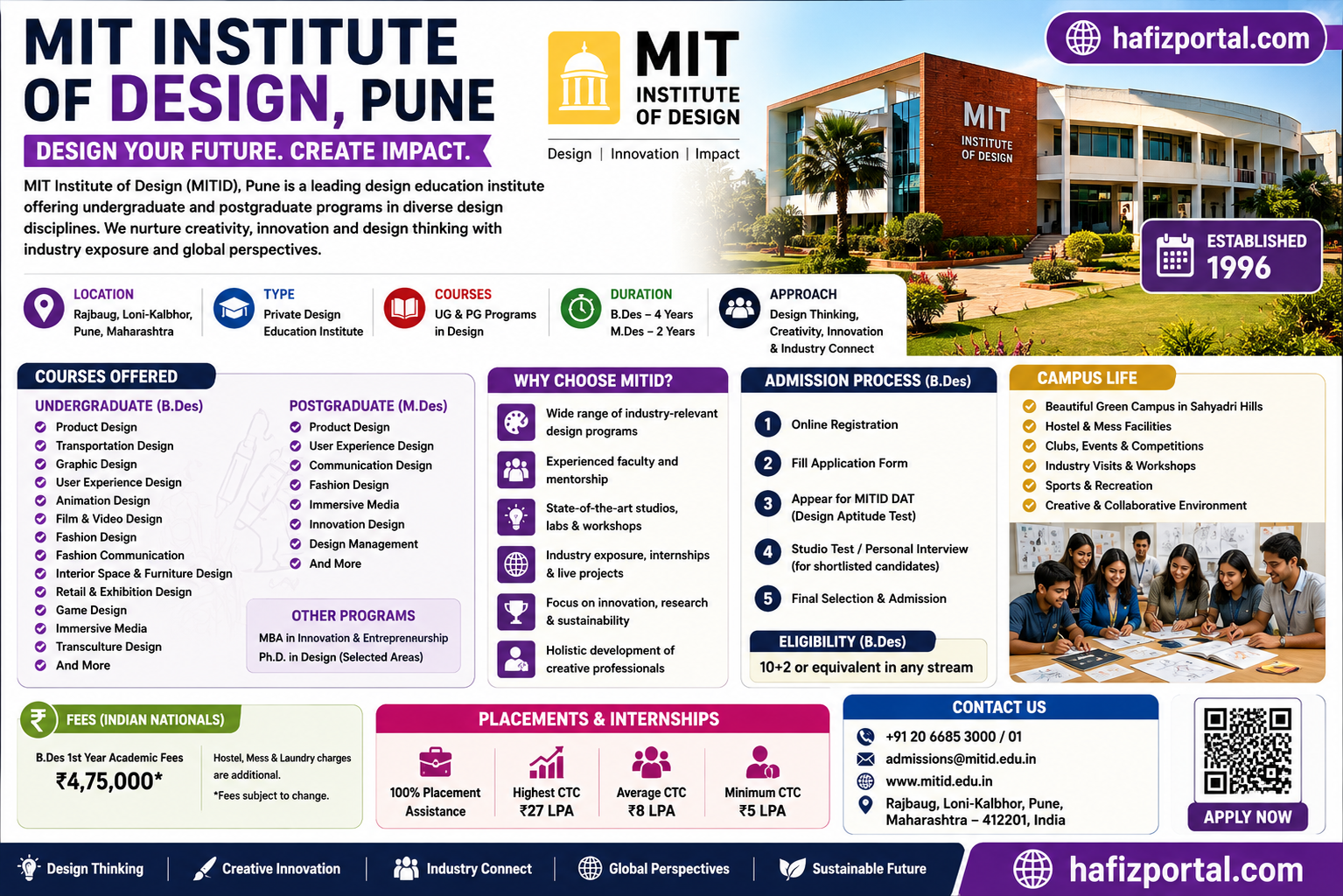
MIT Institute of Design Pune: Courses, Admission, Eligibility, Fees, Campus, Placements and Career Opportunities
MIT Institute of Design (MITID), Pune is a well-known design education institute for students who want to build careers in product design, graphic design, user experience, fashion, animation, transportation design, film, interior design and other creative fields. Located at Rajbaug, Loni-Kalbhor, Pune, MITID focuses on design thinking, practical learning, creativity, innovation and industry exposure.
The institute offers undergraduate and postgraduate design programmes and provides students with opportunities to work on projects, internships and industry-oriented assignments. Its official course list includes areas such as Product Design, Transportation Design, Graphic Design, User Experience Design, Animation Design, Film and Video, Fashion Design, Fashion Communication, Furniture Design, Game Design, Immersive Media and several other specialisations. (MIT ID)
For students looking for a design college in Pune, MIT Institute of Design can be an option worth exploring, especially if they want a learning environment that combines creative thinking with practical design skills.
MIT Institute of Design Pune – Quick Overview
| Particular | Details |
|---|---|
| Institute Name | MIT Institute of Design |
| Location | Rajbaug, Loni-Kalbhor, Pune, Maharashtra |
| Type | Design Education Institute |
| Courses | Undergraduate & Postgraduate |
| Major Areas | Product, Graphic, UX, Fashion, Animation, Film, Transportation and more |
| B.Des Eligibility | 10+2 from any stream |
| B.Des Duration | 4 years |
| Admission Test | MITID DAT for applicable B.Des programmes |
| Campus | Rajbaug, Loni-Kalbhor |
| Official Website | MIT Institute of Design |
MITID is part of the broader MIT Art, Design and Technology University ecosystem. The institute’s official information describes its vision around future-ready design professionals, technology, research, innovation and a planet-centric perspective. (MIT ID)
What Makes MIT Institute of Design Different?
Design education is not limited to drawing or making attractive graphics. Professional designers need to understand people, technology, business, materials, communication and real-world problems.
MITID’s admission guidelines highlight abilities such as analytical thinking, problem-solving, learning ability, interpretation, planning and application of knowledge. This approach reflects the broader nature of professional design education. (MIT ID)
Students can therefore expect a learning experience that goes beyond traditional classroom teaching. Depending on the programme, they may work on design projects, presentations, research, prototyping, studio activities and industry-oriented assignments.
Courses Offered at MIT Institute of Design
MITID provides a wide selection of design disciplines. According to its official course information, students can explore undergraduate and postgraduate programmes in areas including:
Undergraduate and Postgraduate Design Areas
- Product Design
- Transportation Design
- Graphic Design
- User Experience Design
- Animation Design
- Film and Video Design
- Fashion Design
- Fashion Communication
- Interior Space and Furniture
- Retail and Exhibition Design
- Game Design
- Transculture Design
- Immersive Media
- Innovation
- Automotive Clay and Digital Sculpting
- Fashion Management
- Design Management
The institute also offers postgraduate opportunities such as M.Des programmes and an MBA in Innovation and Entrepreneurship. Its course portfolio continues to include emerging areas such as AI-enabled design and information design and data visualization. (MIT ID)
Students should always check the official programme page before applying because course availability, eligibility, intake and admission schedules can change.
B.Des at MIT Institute of Design
The Bachelor of Design (B.Des) is a four-year undergraduate programme. The basic eligibility listed by MITID is 10+2 from any stream, meaning students do not necessarily need to come from a science or commerce background to consider design education. (MIT ID)
This can make design an interesting career option for students from different educational backgrounds who have creativity, curiosity and an interest in solving problems.
Possible areas of specialisation include product design, graphic design, user experience, transportation, animation, fashion and other design disciplines.
MITID Admission Process
Admission requirements depend on the programme. For B.Des and B.Des Fashion programmes, MITID uses the MITID Design Aptitude Test (MITID DAT) as part of the admission process.
The official admission process explains that applicants register online, complete the application form, upload the required documents and pay the applicable application fee. Shortlisted candidates may then proceed to the next stage of selection. (MIT ID)
The admission process is designed to evaluate more than academic marks. MITID’s guidelines mention design inclination, analytical ability, logical thinking, communication skills and personality-related qualities as areas considered during the aptitude assessment. (MIT ID)
Typical Admission Steps
- Select your preferred design programme.
- Check the official eligibility requirements.
- Register for the applicable admission process.
- Complete the online application form.
- Upload the required documents.
- Pay the application fee.
- Appear for MITID DAT or the applicable selection process.
- Attend further tests, studio activities or interviews if shortlisted.
- Check the final selection list.
- Complete admission formalities after selection.
For M.Des programmes, the process can be different. For example, the official M.Des admission process includes submission and evaluation of a portfolio and Statement of Purpose (SOP), followed by the next selection stage for shortlisted candidates. (MIT ID)
Eligibility for MIT Institute of Design
Eligibility varies according to the programme.
For B.Des, students generally need to have completed 10+2 from a recognised board and any stream. MITID’s published information also specifies programme-specific eligibility requirements, so applicants should carefully check the criteria before submitting an application. (MIT ID)
For M.Des programmes, applicants normally need a bachelor’s degree, but the accepted background can differ by specialisation. For example, Product Design may accept degrees in areas such as engineering, architecture and industrial design, while some communication-related specialisations accept bachelor’s degrees in broader disciplines. (MIT ID)
Therefore, candidates should not assume that one eligibility rule applies to every MITID course.
MIT Institute of Design Fees
Design education requires investment in tuition, accommodation and other academic facilities. MITID publishes programme-wise fee information on its official website.
For the 2026–27 academic year, the official fee page lists first-year B.Des/B.Des Fashion academic fees of ₹4,75,000 for Indian nationals, with separate charges for security deposit, hostel, mess and laundry. The listed first-year total for students using the hostel facility is ₹7,04,500. EWS and international-category fee structures are different. (MIT ID)
The institute also states that the composite fees may increase in subsequent years. Hostel availability is subject to space, while mess and laundry charges apply when hostel facilities are used. (MIT ID)
Because fees can change, students should verify the latest official fee structure before making financial plans.
Scholarships and Financial Support
MIT Institute of Design also provides scholarship opportunities for eligible students.
According to the institute’s published information, scholarships are intended to make design education more accessible to students from economically weaker backgrounds. The institute states that full or partial scholarships may be offered to around 5% of total students each year, with eligibility based on factors including academic performance and financial need. (MIT ID)
Students interested in financial assistance should check the current scholarship conditions and required documents directly with MITID.
Campus and Learning Environment
MIT Institute of Design is located at Rajbaug, Loni-Kalbhor, next to Hadapsar on the Pune-Solapur Highway. The official admission information lists the campus address as MIT Institute of Design, Rajbaug, Loni-Kalbhor, Pune – 412201. (MIT ID)
The learning environment is designed around creative education, studio-based work, design projects and interaction between students and faculty. For aspiring designers, access to workshops, creative spaces, technology and peer collaboration can be an important part of the educational experience.
Internships and Placement Opportunities
Career preparation is an important part of design education. MITID has a dedicated Industry Relations Department that works to connect students with professional opportunities.
According to the institute’s official placement information, students can participate in internships, graduation projects and campus placements. The institute reports a placement record with a highest CTC of ₹27 lakh per annum, average CTC of ₹8 lakh and minimum CTC of ₹5 lakh on its published page. These figures are institute-reported and should not be interpreted as a guaranteed salary for every graduate. (MIT ID)
The institute also states that final-year students undertake live graduation projects, typically involving guidance from both faculty and industry mentors. Summer internships are also part of the professional development process for eligible students. (MIT ID)
Career Opportunities After Design Education
A design qualification can lead to careers across multiple industries.
Depending on their specialisation, graduates may explore roles such as:
- Product Designer
- UX Designer
- UI/UX Researcher
- Graphic Designer
- Fashion Designer
- Transportation Designer
- Animation Designer
- Film and Video Designer
- Interior and Furniture Designer
- Design Researcher
- Brand Designer
- Design Manager
- Innovation Consultant
- Creative Strategist
- Game Designer
The growth of digital products, e-commerce, entertainment, mobility, technology and consumer brands has created demand for professionals who can combine creativity with research and problem-solving.
Who Should Consider MIT Institute of Design?
MITID may be suitable for students who:
- Enjoy creative problem-solving.
- Like drawing, visual communication or making things.
- Are interested in technology and innovation.
- Want a career in design or creative industries.
- Enjoy project-based learning.
- Want to understand users and their needs.
- Are interested in building a professional portfolio.
- Want to work with companies and industry professionals.
However, students should research individual courses carefully rather than choosing an institute only because of its name.
How to Apply to MIT Institute of Design
Students should begin by visiting the official MITID website and checking the latest admission notification for their preferred course.
Official MIT Institute of Design website:
MIT Institute of Design Official Website
Admission process:
MITID Admission Process
Courses:
MITID Courses
Fees and scholarships:
MITID Fees & Scholarships
Applicants should verify the latest dates, eligibility conditions, fees, entrance requirements and available programmes directly on the official website before applying.
Frequently Asked Questions About MIT Institute of Design
Is MIT Institute of Design good for design education?
MITID offers a broad range of design programmes, practical learning opportunities, industry interaction and specialised design disciplines. Students should compare its curriculum, fees, location and career goals with other design colleges before making a decision.
What is the eligibility for B.Des at MITID?
The institute lists 10+2 from any stream as the basic B.Des eligibility requirement. Programme-specific rules should be checked before application. (MIT ID)
Does MITID conduct an entrance exam?
Yes. The MITID DAT is used for applicable B.Des and B.Des Fashion admissions. The examination evaluates areas such as design inclination, analytical thinking, logical reasoning and communication. (MIT ID)
Does MITID provide scholarships?
Yes. MITID publishes scholarship opportunities based on factors such as financial need and student performance. (MIT ID)
Where is MIT Institute of Design located?
MITID is located at Rajbaug, Loni-Kalbhor, Pune, Maharashtra, on the Pune-Solapur Highway. (MIT ID)
Final Words
MIT Institute of Design Pune can be a strong option for students who want to turn creativity, curiosity and problem-solving ability into a professional design career. With programmes covering product, graphic, UX, fashion, animation, transportation, film, furniture, immersive media and innovation, students can select a pathway that matches their interests.
The most important step is to choose the right specialisation, understand the admission process, prepare seriously for the required entrance or portfolio evaluation, and consider the complete cost of education. Since admission dates, fees and programme details can change, always confirm the latest information through the official MITID website before applying.