Bachelor of Commerce (B.Com): Courses, Eligibility, Subjects & Career
Bachelor of Commerce (B.Com): Courses, Eligibility, Subjects, Career Options, Jobs and Salary
Introduction
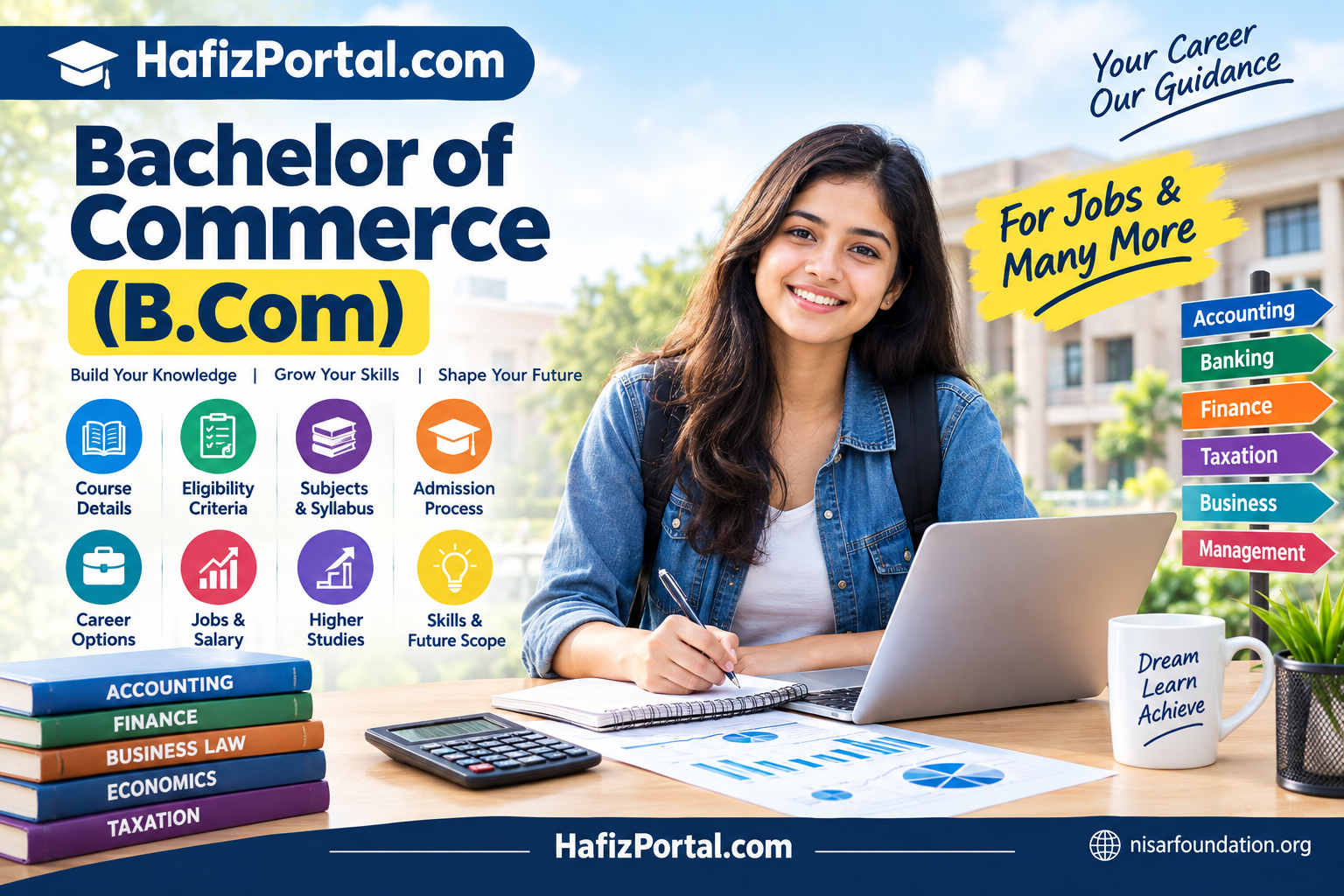
The Bachelor of Commerce (B.Com) is one of the most popular undergraduate degree programmes for students interested in commerce, accounting, finance, banking, business, taxation, economics and management.
After completing Class 12, students from the Commerce stream often consider B.Com because it provides a foundation in important areas of business and finance. However, B.Com is not limited only to students who studied Commerce in Class 11 and 12. Admission eligibility depends on the rules of the university or college.
A B.Com degree can also be useful for students who want to prepare for professional qualifications and competitive examinations. Depending on their interests, graduates can explore careers in accounting, banking, financial services, taxation, insurance, business administration, sales, customer service, auditing and other areas.
The University Grants Commission (UGC) has developed a Curriculum and Credit Framework for Undergraduate Programmes under the National Education Policy framework. The framework promotes flexibility, multidisciplinary learning, skill development and multiple entry and exit options in undergraduate education. However, students should always check the latest rules of their selected university before applying. (UGC)
In this article, you will learn about B.Com eligibility, duration, subjects, admission process, specialisations, career options, jobs, higher studies, skills, salary factors and future opportunities.
What Is B.Com?
B.Com stands for Bachelor of Commerce.
It is an undergraduate degree that introduces students to the principles of commerce, accounting, economics, finance, business and related areas.
The course can help students understand how businesses operate and how financial information is recorded, analysed and used for decision-making.
Depending on the college and university, a B.Com programme may include subjects such as:
- Financial Accounting
- Business Economics
- Business Law
- Corporate Accounting
- Cost Accounting
- Taxation
- Auditing
- Business Communication
- Statistics
- Banking
- Finance
- Marketing
- Management
- Entrepreneurship
- Computer Applications
- E-Commerce
The exact syllabus is not identical across all institutions. Students should check the official university syllabus before selecting a college.
The UGC maintains information relating to undergraduate education, degree regulations and curriculum frameworks on its official website. (UGC)
Official UGC website:
University Grants Commission (UGC)
B.Com Course Duration
The duration of B.Com depends on the structure offered by the university.
A traditional B.Com programme is commonly offered as a three-year undergraduate degree, while some institutions now provide four-year undergraduate structures in accordance with their applicable academic framework.
For example, university records for some colleges affiliated with Savitribai Phule Pune University show B.Com as a three-year undergraduate programme. (BCUD Pune University)
Therefore, students should not assume that every B.Com programme has exactly the same duration.
Before admission, check:
- Course duration
- University affiliation
- Current syllabus
- Eligibility criteria
- Admission process
- Examination pattern
- Fee structure
- Internship opportunities
- Recognition and applicable regulations
B.Com Eligibility Criteria
The eligibility criteria for B.Com vary from one university or college to another.
Generally, students need to have completed Class 12 or an equivalent qualification from a recognised board.
Some colleges may accept students from different streams, while others may have specific subject or percentage requirements.
Common eligibility conditions may include:
- Passed Class 12 or equivalent examination.
- Studied from a recognised board.
- Fulfilled the minimum percentage requirement prescribed by the institution.
- Met subject requirements, if applicable.
- Completed the admission process within the prescribed dates.
Students should always verify the current admission notification of the university or college because eligibility requirements can change.
UGC states that degrees are awarded by statutory universities according to applicable regulations and institutional requirements. (UGC)
Can Arts or Science Students Do B.Com?
Yes, in some institutions, students from Arts or Science backgrounds may be eligible for B.Com.
However, this is not a universal rule.
Some colleges may require Commerce subjects or particular subjects at Class 12 level. Other colleges may accept students from multiple streams.
Therefore, an Arts or Science student interested in B.Com should check the official admission rules of the specific college.
Do not rely only on social media posts or coaching advertisements. Always check the latest official admission notice.
B.Com Admission Process
The B.Com admission process depends on the university, college and admission system.
A typical process may include:
Step 1: Complete Class 12
Students first need to complete their higher secondary education or equivalent qualification.
Step 2: Check Eligibility
Visit the official website of the university or college and check the latest eligibility criteria.
Step 3: Check Admission Dates
Admission windows are different for different institutions.
Step 4: Complete the Application Form
Enter personal, educational and contact information carefully.
Step 5: Upload Documents
Common documents may include:
- Class 10 marksheet
- Class 12 marksheet
- Leaving certificate
- Passport-size photograph
- Identity document
- Category certificate, where applicable
- Domicile or other documents, where required
Step 6: Merit or Entrance Process
Some institutions may use merit-based admission, while others may follow an entrance examination or another selection process.
Step 7: Pay the Required Fees
After admission is confirmed, students may need to pay the prescribed college or university fees.
Always follow the official admission instructions of the institution.
B.Com Subjects
B.Com subjects can differ according to the university, year, programme structure and specialisation.
Common B.Com subjects include:
1. Financial Accounting
Students learn the basics of recording financial transactions and preparing financial statements.
2. Business Economics
This subject introduces economic concepts related to consumers, businesses, markets and the wider economy.
3. Business Law
Students learn basic legal concepts related to business and commercial activities.
4. Corporate Accounting
This subject deals with accounting concepts related to companies and corporate financial reporting.
5. Cost Accounting
Students learn how businesses calculate, analyse and control costs.
6. Taxation
Tax-related subjects introduce students to taxation concepts and applicable laws.
Tax rules can change regularly, so students should use current official sources when studying practical taxation.
7. Auditing
Auditing introduces the principles and procedures used to examine financial records and controls.
8. Business Communication
Communication skills are important for presentations, emails, interviews, reports and workplace interaction.
9. Business Statistics
Students learn statistical concepts used for analysing business and economic information.
10. Banking and Finance
Depending on the programme, students may study banking systems, financial markets and financial services.
Popular B.Com Specialisations
Some colleges offer specialised B.Com programmes.
Examples include:
- B.Com Accounting and Finance
- B.Com Banking and Finance
- B.Com Taxation
- B.Com Computer Applications
- B.Com Business Administration
- B.Com Financial Management
- B.Com International Business
- B.Com Marketing
- B.Com E-Commerce
The availability of these programmes depends on the institution.
Students should compare the actual syllabus rather than choosing a programme only because of its title.
Skills Students Can Develop Through B.Com
A B.Com degree can help students develop both academic and practical skills.
Important skills include:
Accounting Skills
Students can learn basic accounting principles, financial statements and accounting processes.
Financial Understanding
Students can develop an understanding of financial concepts and business transactions.
Computer Skills
Modern commerce careers often require familiarity with spreadsheets, accounting software and digital business tools.
Communication Skills
Written and verbal communication can help students in interviews and professional workplaces.
Analytical Skills
Commerce education involves working with numbers, financial information and business data.
Problem-Solving Skills
Students can develop the ability to analyse business situations and identify possible solutions.
Business Awareness
B.Com can introduce students to business structures, markets, taxation, banking and management.
Career Options After B.Com
One of the major reasons students choose B.Com is the variety of career paths available after graduation.
Some common career areas include:
Accountant
B.Com graduates can apply for accounting-related positions in companies, firms, educational institutions, NGOs and other organisations.
Banking
Graduates may explore opportunities in banking and financial services, subject to the eligibility requirements of the particular employer or recruitment examination.
Finance
Students interested in financial services can explore entry-level roles in finance-related organisations.
Taxation
Graduates with additional knowledge of taxation can explore opportunities in tax-related work.
Auditing
Students interested in auditing can pursue relevant entry-level roles and professional qualifications.
Insurance
Insurance companies offer various administrative, customer service, sales and operations roles.
Business Administration
B.Com graduates may also work in administration, operations and office management.
Sales and Marketing
Commerce graduates can enter sales and marketing roles after developing communication and business skills.
Customer Service
Banks, financial companies, technology companies and other organisations recruit graduates for customer-facing roles.
Government Jobs
A B.Com degree may satisfy the educational qualification for various government examinations where a bachelor’s degree is required. However, every examination has its own eligibility criteria, age requirements and other conditions.
Students should read the official recruitment notification before applying.
Professional Courses After B.Com
B.Com can also be a foundation for further professional education.
Depending on eligibility and individual career goals, graduates may consider:
- Chartered Accountancy (CA)
- Company Secretary (CS)
- Cost and Management Accountancy (CMA)
- Master of Commerce (M.Com)
- Master of Business Administration (MBA)
- Law
- Banking and finance certifications
- Data and business analytics courses
- Taxation-related courses
- Digital marketing
- Financial technology courses
Professional courses have their own admission rules and examination systems. Students should visit the official website of the relevant professional body before applying.
Higher Studies After B.Com
Students who want to continue their academic education can consider postgraduate programmes.
M.Com
Master of Commerce is a postgraduate programme focused on advanced commerce, accounting, finance, economics and related areas.
MBA
Students interested in management can consider an MBA. Depending on the institution, MBA admissions may involve entrance examinations, academic requirements, interviews or other selection methods.
Law
A graduate may explore law education according to the applicable admission rules.
Competitive Examinations
B.Com graduates can also prepare for competitive examinations where their educational qualification matches the official notification.
Jobs After B.Com
Some job titles that B.Com graduates may find include:
- Junior Accountant
- Accounts Executive
- Accounts Assistant
- Finance Assistant
- Audit Assistant
- Tax Assistant
- Banking Executive
- Customer Service Executive
- Operations Executive
- Business Development Executive
- Sales Executive
- Office Administrator
- Payroll Assistant
- Data Entry and Finance Support Executive
Job titles, salaries and eligibility requirements vary significantly between employers.
A degree alone does not guarantee employment. Practical skills, communication, computer knowledge, internships, professional qualifications and work experience can influence career opportunities.
B.Com Salary in India
There is no single fixed salary for B.Com graduates.
Salary can depend on:
- Job role
- City
- Employer
- Industry
- Experience
- Accounting knowledge
- Computer skills
- Communication skills
- Professional certifications
- Interview performance
Fresh graduates may begin with entry-level positions, while experienced professionals can move into higher-responsibility roles.
Instead of selecting a B.Com course only based on expected salary, students should also consider the course syllabus, college quality, career interests, affordability and opportunities for practical experience.
B.Com and Competitive Exams
B.Com graduates may be eligible for several competitive examinations where the official notification accepts a bachelor’s degree.
Possible areas include:
- Banking examinations
- Staff selection examinations
- Government administrative examinations
- Railway recruitment
- State government examinations
- Insurance recruitment
- Public sector recruitment
The eligibility conditions differ from examination to examination.
Students should always read the current official notification because educational qualifications, age limits, reservation rules, examination patterns and application dates can change.
B.Com vs BBA
B.Com and BBA are both undergraduate programmes, but their academic emphasis can differ.
B.Com generally focuses more on commerce, accounting, finance, taxation, economics and related business subjects.
BBA generally places greater emphasis on management, business administration, marketing, human resources and organisational functions.
Neither programme is automatically suitable for every student.
A student interested in accounting, finance and commerce may want to explore B.Com programmes, while a student interested in management and administration may compare BBA programmes.
The actual syllabus should be checked before making a decision.
Is B.Com a Good Course After 12th?
B.Com can be a useful undergraduate option for students interested in commerce, accounting, finance, banking and business.
However, the right course depends on the student’s:
- Interests
- Academic strengths
- Career plans
- Financial situation
- Preferred work environment
- Higher-study plans
- Professional qualification goals
Students should compare B.Com with other options such as BBA, BA Economics, professional accounting programmes and other relevant degrees before choosing a course.
B.Com for Students Interested in Accounting
Students who enjoy numbers and financial records may find accounting an interesting career area.
During B.Com, students may study:
- Financial accounting
- Corporate accounting
- Cost accounting
- Auditing
- Taxation
- Financial management
After graduation, they can consider accounting jobs or pursue professional qualifications.
Practical knowledge of accounting software and spreadsheets can also be valuable for entry-level employment.
B.Com for Students Interested in Banking
Banking is another area that attracts many commerce graduates.
Students interested in banking can develop knowledge of:
- Banking operations
- Finance
- Economics
- Accounting
- Business communication
- Quantitative aptitude
Along with their degree, students preparing for banking recruitment examinations should study the current examination pattern and official syllabus.
B.Com for Students Interested in Business
Students who want to start a business can use B.Com to understand some important areas of commerce and finance.
Useful areas include:
- Accounting
- Business law
- Taxation
- Marketing
- Financial management
- Entrepreneurship
- Business communication
However, running a business requires practical experience, market understanding, customer research and financial planning in addition to academic education.
How to Choose the Right B.Com College
Before taking admission, students should compare colleges carefully.
Check the following:
1. University Affiliation
Verify the institution and degree status through official sources.
2. Course Structure
Read the current syllabus.
3. Faculty
Check information about teaching staff and academic support.
4. Fees
Compare tuition fees and other charges.
5. Location
Consider travel, accommodation and living expenses.
6. Internship Opportunities
Practical exposure can help students understand workplace requirements.
7. Placement Information
Read placement information carefully and check what is actually reported by the institution.
8. Student Support
Check libraries, laboratories, career guidance, clubs and other facilities.
9. Admission Rules
Follow only the latest official admission notice.
UGC provides various frameworks and guidelines relating to undergraduate education and also publishes information about higher education regulations. (UGC)
Important Documents for B.Com Admission
The exact document list varies by institution, but students may commonly be asked for:
- Class 10 marksheet
- Class 12 marksheet
- School leaving certificate
- Transfer certificate, where applicable
- Identity proof
- Passport-size photographs
- Category certificate, if applicable
- Domicile certificate, if required
- Income certificate, if required
- Migration certificate, where applicable
Keep original documents and scanned copies safely.
Advantages of Studying B.Com
B.Com can provide a broad foundation in commerce and business.
Some possible advantages include:
- Undergraduate degree in commerce
- Foundation in accounting and finance
- Exposure to business concepts
- Options for higher education
- Preparation for professional qualifications
- Eligibility for many graduate-level recruitment opportunities, subject to notification rules
- Opportunities across different industries
- Scope to develop practical business skills
The actual value of the degree depends on the quality of education, the student’s skills, practical exposure and career planning.
Limitations to Consider
Students should also understand that a B.Com degree by itself may not be enough for every specialised career.
For example, some careers require:
- Professional qualifications
- Competitive examinations
- Additional certifications
- Practical experience
- Technical skills
- Postgraduate education
Therefore, students should create a career plan during their degree rather than waiting until graduation.
Skills to Learn Along With B.Com
Students can improve their employability by developing additional skills.
Useful areas include:
- Advanced Excel
- Accounting software
- Business communication
- English communication
- Data analysis
- Financial analysis
- Digital marketing
- Presentation skills
- Interview skills
- Basic computer skills
- Professional email writing
- Taxation fundamentals
Students should choose skills that match their intended career.
Frequently Asked Questions About B.Com
What does B.Com stand for?
B.Com stands for Bachelor of Commerce.
Is B.Com a graduation course?
Yes. B.Com is an undergraduate bachelor’s degree in commerce.
Can Science students do B.Com?
Some colleges accept Science students, but eligibility varies. Check the official admission rules of the institution.
Can Arts students do B.Com?
Some universities and colleges allow Arts students to apply, while others may have subject-specific requirements.
What can I do after B.Com?
You can explore jobs in accounting, finance, banking, taxation, auditing, administration, sales and other areas. You can also pursue higher studies or professional qualifications.
Can I do MBA after B.Com?
Yes, B.Com graduates can generally explore MBA programmes if they meet the admission requirements of the particular institution.
Can I do M.Com after B.Com?
Yes, B.Com graduates can explore M.Com programmes subject to the eligibility requirements of the university.
Is B.Com useful for government jobs?
A bachelor’s degree can meet the educational requirement for some government examinations, but each recruitment notification has its own eligibility criteria.
Is B.Com difficult?
The difficulty level depends on the student’s academic background, interest, study habits and the university syllabus. Students who regularly practise accounting, mathematics and other subjects can build confidence over time.
Is B.Com only for Commerce students?
No. Eligibility depends on the rules of the particular college or university.
Official Resources for Students
Students should use official sources for admission, degree recognition and current academic information.
University Grants Commission
The UGC website provides information about higher education regulations, undergraduate frameworks, guidelines and recognised degree-related information. (UGC)
UGC Undergraduate Curriculum Framework
UGC Curriculum and Credit Framework for Undergraduate Programmes
Savitribai Phule Pune University
Savitribai Phule Pune University
Students looking for colleges affiliated with Savitribai Phule Pune University should verify the latest course and admission information through the university and respective college websites.
Final Words
The Bachelor of Commerce (B.Com) can provide a broad foundation for students interested in accounting, finance, banking, business, taxation and commerce.
It can also be the starting point for higher studies and professional qualifications.
However, choosing a course should not be based only on the name of the degree. Students should compare the syllabus, college, fees, admission rules, career interests, practical training and future study options.
If you are currently in Class 12 and considering B.Com, start by identifying the area you enjoy most. If you like accounting, finance and numbers, explore commerce-focused career paths. If you are interested in management, compare B.Com with BBA. If your goal is a professional qualification, research the relevant professional course and its current eligibility requirements.
Most importantly, verify admission information from official university or college sources before paying fees or submitting documents.
Education decisions are personal. Take time to compare your options and choose a path that matches your interests, abilities and long-term goals.
Quick B.Com Summary
| Particular | Details |
|---|---|
| Course | Bachelor of Commerce |
| Abbreviation | B.Com |
| Level | Undergraduate |
| Field | Commerce and Business |
| Common Areas | Accounting, Finance, Economics, Taxation, Banking |
| Eligibility | Class 12 or equivalent, as prescribed by the institution |
| Duration | Commonly 3 years; structure can vary by institution |
| Career Areas | Accounting, Banking, Finance, Taxation, Auditing, Administration |
| Higher Studies | M.Com, MBA and other eligible programmes |
| Professional Options | CA, CS, CMA and other relevant qualifications |
| Government Exams | Depends on individual recruitment notification |
| Key Skills | Accounting, Excel, Communication, Finance, Analysis |