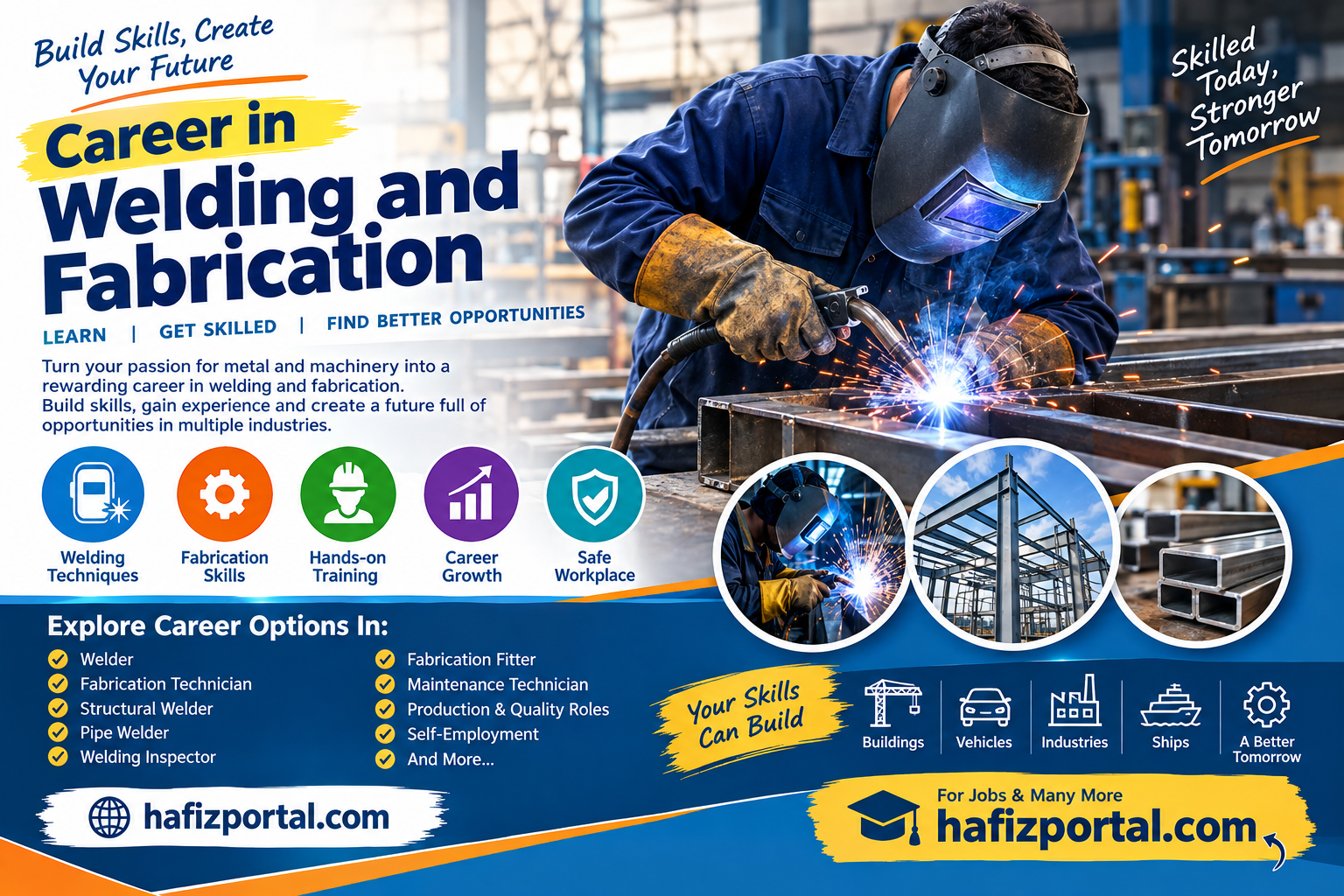
Career in Welding and Fabrication: Courses, Jobs, Skills and Future Scope
Career in Welding and Fabrication: Courses, Jobs, Skills and Future Scope
A career in welding and fabrication can be a practical option for students who enjoy working with tools, machines, metal, and technical equipment. Welding and fabrication are important skills used in construction, manufacturing, engineering, automobiles, infrastructure, shipbuilding, repair services, and many other industries.
Welding is mainly used to join metal parts using heat, pressure, or a combination of processes. Fabrication is a broader activity that can include measuring, cutting, shaping, drilling, fitting, assembling, and joining metal components to create a finished structure or product.
People trained in this field can work in different technical roles. Depending on their education and experience, they may become welders, fabricators, welding technicians, fabrication fitters, structural welders, pipe welders, welding inspectors, maintenance workers, or supervisors.
For students looking for a skill-based career, welding and fabrication can provide a path from vocational training to employment, specialization, and potentially self-employment.


What Is Welding and Fabrication?
Welding is a manufacturing and repair process used to join two or more materials, usually metals, by applying heat, pressure, or both.
Fabrication involves turning raw metal or metal components into useful structures or products. A fabrication worker may read a drawing, measure material, cut it to size, prepare edges, fit components together, and then join them using an appropriate process.
For example, fabrication work may be involved in making:
- Metal frames
- Gates and grills
- Industrial structures
- Machinery components
- Storage systems
- Steel structures
- Pipelines
- Vehicle components
- Tanks
- Equipment supports
- Construction structures
The exact work depends on the industry and job role.
Why Choose a Career in Welding and Fabrication?
There are several reasons students consider this technical field.
1. Practical Skill-Based Career
Welding and fabrication are hands-on careers. Workers use tools, machines, measuring equipment, and safety equipment during their daily work.
Students who enjoy practical learning may find this type of work interesting.
2. Used in Many Industries
Welding and fabrication skills are used in many sectors, including:
- Construction
- Manufacturing
- Automobile
- Engineering
- Infrastructure
- Railways
- Shipbuilding
- Heavy machinery
- Oil and gas
- Power projects
- Maintenance
- Metal workshops
- Industrial plants
Because welding is used for manufacturing, construction, maintenance, and repair, trained workers can explore different work environments.
3. Multiple Career Paths
A person can begin as a trainee and gradually develop specialized skills.
With experience, a worker may move into roles such as:
Trainee → Welder → Skilled Welder → Senior Welder → Supervisor
Another possible route is:
Welder → Specialized Welder → Welding Inspector → Quality or Production Role
Career progression depends on qualification, experience, industry, technical ability, and employer requirements.
4. Opportunity for Self-Employment
Experienced workers can also consider starting a small welding or fabrication business.
A workshop may provide services such as:
- Gate fabrication
- Grills and railings
- Metal repair
- Structural fabrication
- Machine repair
- Custom metal work
- Industrial maintenance
- Welding services
Before starting a business, it is important to understand local registration, taxation, workplace safety, equipment, insurance, and other applicable requirements.
Welding and Fabrication Courses in India
Students can enter this field through vocational and technical education.
One important route in India is the Welder trade under the Directorate General of Training (DGT).
The current DGT Craftsmen Training Scheme information lists the Welder trade as a one-year engineering trade with 1,200 hours of training and an entry qualification of passing Class 8. The listed NSQF level is 2.5.
Students can also find specialized trade options. DGT’s current trade information includes areas such as:
- Welder
- Welder (Fabrication & Fitting)
- Welder (GMAW & GTAW)
- Welder (Pipe)
- Welder (Structural)
- Welder (Welding & Inspection)
The current DGT listing shows several of these as one-year, 1,200-hour trades, although the exact course details can vary by trade and approval year.
Students should always check the latest official information before applying because qualifications, course structures, and admission requirements can be revised.
What Is the Eligibility for a Welder Course?
Eligibility depends on the course and institution.
For the current DGT Welder trade under the Craftsmen Training Scheme, the entry qualification is listed as Class 8 pass.
However, advanced programmes may have higher educational requirements.
For example, DGT’s Advanced Vocational Diploma listing includes Welding Technology, with entry routes that include an NTC/NAC in Welder or a diploma in mechanical or related engineering fields. The listed programme duration is two years and the NSQF level is 6.
Before admission, students should check:
- Educational qualification
- Age requirement
- Course duration
- Practical training
- Certification
- Institute recognition
- Examination system
- Workshop facilities
- Apprenticeship opportunities
- Placement information
What Do Students Learn in Welding and Fabrication?
A good welding and fabrication programme should develop both theoretical knowledge and practical skills.
Welding Fundamentals
Students learn the basic principles of welding and how different welding processes work.
Metal Preparation
Before welding, metal surfaces may need to be cleaned, measured, cut, shaped, or prepared.
Welding Equipment
Students learn how to operate appropriate welding machines and related equipment under proper supervision.
Welding Positions
Different welding positions can require different techniques and levels of control.
Joint Preparation
Workers need to understand how components should be positioned and prepared before joining.
Fabrication
Fabrication training may include measuring, cutting, fitting, assembling, and joining metal components.
Drawing and Measurement
A fabrication worker may need to understand technical drawings and measurements to produce components according to specifications.
Inspection
Welds and fabricated components may need to be inspected to check quality and identify defects.
Workplace Safety
Safety is one of the most important parts of welding training.
Welding involves heat, sparks, electrical equipment, fumes, and other workplace hazards. Proper protective equipment and safe working procedures are essential.
Important Skills for a Welder and Fabricator
Technical knowledge is only one part of the profession.
1. Hand Skills
Welding and fabrication require control, coordination, and accuracy.
2. Measurement Skills
A small measurement error can affect the final product. Workers should learn to use measuring tools correctly.
3. Technical Drawing
Understanding drawings and dimensions can help fabricators produce components accurately.
4. Welding Machine Operation
Workers need to understand how to use appropriate equipment according to their training and workplace procedures.
5. Problem-Solving
A weld or fabricated structure may not always come out as expected. A skilled worker needs to identify problems and correct them safely.
6. Quality Awareness
Good welding is not only about making a joint. The finished work should meet the required specifications and quality standards.
7. Safety Awareness
Welding work requires careful attention to protective equipment, ventilation, electrical safety, fire prevention, and safe equipment handling.
8. Communication
Workers often communicate with supervisors, engineers, other technicians, and customers. Good communication can reduce mistakes and improve teamwork.
Different Types of Welding
There are different welding processes used for different applications.
Shielded Metal Arc Welding
This is commonly known as SMAW or stick welding. It is widely used for many general welding applications.
Gas Metal Arc Welding
GMAW, commonly associated with MIG/MAG welding, uses a continuously supplied wire electrode.
Gas Tungsten Arc Welding
GTAW, commonly known as TIG welding, can provide precise and clean welds when used correctly.
Gas Welding
Gas welding uses a flame to heat and join materials.
Specialized Welding
Certain industries require specialized welding methods and qualifications. Workers interested in specialized areas should seek appropriate training and certification.
The welding process selected depends on the material, application, design, equipment, workplace requirements, and applicable standards.
What Is Fabrication Work?
Fabrication is more than welding.
A fabrication worker may perform several stages of production.
A typical project can involve:
Planning → Measuring → Marking → Cutting → Shaping → Drilling → Fitting → Welding → Grinding → Inspection → Finishing
The exact process varies according to the product and industry.
For example, when manufacturing a metal frame, the worker may first study the drawing. Next, the required material is measured and marked. The pieces are then cut, positioned, fitted, and joined. Finally, the finished structure is checked for dimensions, appearance, and quality.
Career Options in Welding and Fabrication
Training and experience can lead to different technical roles.
Welder
A welder joins metal components using an appropriate welding process.
Fabrication Technician
A fabrication technician may measure, cut, fit, assemble, and weld metal components.
Welding Technician
A welding technician may work with welding equipment, processes, production requirements, and quality procedures.
Structural Welder
Structural welders work on structures and components used in construction and industrial applications.
Pipe Welder
Pipe welding involves joining pipes and related components. Some industries require specialized training and qualifications.
Fabrication Fitter
A fabrication fitter prepares and aligns components before final joining or assembly.
Welding Inspector
With appropriate education, experience, and certification, professionals can move into welding inspection and quality-related roles.
Welding Supervisor
Experienced workers may progress into supervisory positions where they coordinate teams and monitor work.
Maintenance Technician
Welding skills can be useful in industrial maintenance and repair.
Technical Sales
People with technical knowledge can also explore sales and customer-support roles for welding equipment, machinery, tools, and industrial products.
Self-Employment
Experienced professionals may establish their own welding and fabrication workshop.
Industries That Hire Welding and Fabrication Workers
Welding and fabrication professionals can work across many industries.
Construction Industry
Construction projects use fabricated metal structures, supports, frames, railings, and other components.
Automobile Industry
Welding and fabrication are used in vehicle manufacturing, components, bodywork, repair, and production systems.
Manufacturing Industry
Factories use welding and fabrication in machinery, equipment, structures, and maintenance.
Infrastructure
Large infrastructure projects can require fabricated steel and other metal components.
Shipbuilding
Shipbuilding uses specialized welding and fabrication processes.
Heavy Engineering
Heavy engineering projects often involve large metal structures and machinery.
Industrial Maintenance
Factories and industrial facilities may require welding skills for repair and maintenance work.
Salary in Welding and Fabrication
Salary varies from person to person and depends on several factors.
Important factors include:
- Qualification
- Work experience
- Welding specialization
- Location
- Industry
- Employer
- Type of project
- Certification
- Technical skills
- Shift requirements
- Job responsibilities
Beginners normally start in entry-level positions. As workers gain experience and develop specialized skills, they may qualify for more advanced responsibilities.
Instead of relying on a single salary figure, students should compare current job vacancies in their location and preferred industry.
A good career decision should consider training quality, practical experience, working conditions, career growth, and job requirements—not salary alone.
Career Growth in Welding and Fabrication
Welding can offer several directions for career development.
A worker can specialize in:
- Structural welding
- Pipe welding
- TIG welding
- MIG/MAG welding
- Industrial fabrication
- Heavy fabrication
- Welding inspection
- Maintenance
- Production
- Quality control
Additional training can help professionals move into specialized roles.
DGT also lists specialized welding-related training and advanced programmes, including Welding Technology.
The career path will depend on the individual’s education, experience, skills, certifications, and industry.
Safety in Welding and Fabrication
Safety should always be a major priority.
Welding can involve:
- High temperatures
- Sparks
- Ultraviolet radiation
- Electrical equipment
- Welding fumes
- Sharp metal
- Heavy materials
- Fire risks
- Grinding operations
Workers should follow their employer’s safety procedures and use appropriate protective equipment.
Common protective equipment may include:
- Welding helmet
- Safety glasses
- Welding gloves
- Protective clothing
- Safety shoes
- Hearing protection where required
- Appropriate respiratory protection where required
Proper ventilation is also important where welding fumes may be produced.
Workers should never ignore safety instructions to save time.
Why Practical Training Matters
Welding is a skill that improves through supervised practice.
A classroom can explain welding principles, but practical training allows students to develop:
- Hand control
- Welding technique
- Equipment handling
- Measurement accuracy
- Joint preparation
- Fabrication skills
- Defect identification
- Workplace discipline
Students should look for institutes with properly equipped workshops and qualified instructors.
Practical experience can also help students understand what type of welding or fabrication work they enjoy.
Apprenticeship and Work Experience
Apprenticeship or supervised workplace experience can be valuable for students entering technical careers.
It can help learners understand how professional workshops and industrial workplaces operate.
During practical work, students can learn about:
- Workplace communication
- Production schedules
- Quality checks
- Safety procedures
- Tools
- Materials
- Equipment maintenance
- Teamwork
- Customer requirements
Students should use official government and institutional sources to verify apprenticeship opportunities and eligibility.
Future Scope of Welding and Fabrication
Welding and fabrication remain connected to manufacturing, construction, infrastructure, maintenance, engineering, and other industrial activities.
Technology is also changing the industry.
Modern workplaces can involve:
- Automated welding
- Robotic welding
- CNC fabrication
- Digital measurement
- Computer-aided design
- Advanced welding machines
- Quality inspection technology
This does not mean traditional welding skills are no longer useful. Instead, technicians may benefit from combining practical welding skills with modern technical knowledge.
A worker who understands both hands-on processes and modern production technology can develop a broader skill set.
How to Become a Welder or Fabrication Technician
Students can follow a simple career path.
Step 1: Complete the Required Education
Check the eligibility requirements for the course you want to join.
Step 2: Choose a Recognized Training Programme
Compare institutes based on recognition, practical training, equipment, instructors, fees, and certification.
Step 3: Learn Basic Welding
Build a strong foundation in welding processes and safety.
Step 4: Learn Fabrication
Develop measurement, cutting, fitting, assembly, and finishing skills.
Step 5: Gain Practical Experience
Work under proper supervision and learn from experienced professionals.
Step 6: Develop Specialized Skills
Depending on your career goal, consider areas such as structural welding, pipe welding, TIG, MIG/MAG, or welding inspection.
Step 7: Build Professional Skills
Improve communication, teamwork, problem-solving, and workplace discipline.
Step 8: Continue Learning
Technology changes over time, so continuous skill development can help professionals remain competitive.
How to Choose the Right Welding Course
Before joining a welding or fabrication course, ask the following questions:
- Is the institute recognized?
- What is the exact course duration?
- What is the minimum qualification?
- Is practical training included?
- Does the workshop have suitable equipment?
- Are safety procedures taught?
- What certificate will be provided?
- Is apprenticeship support available?
- Does the course cover modern welding processes?
- What are the actual placement details?
Avoid choosing an institute solely because an advertisement promises a high salary or guaranteed employment.
Always verify claims directly with the institute or official authority.
Is Welding and Fabrication a Good Career?
Welding and fabrication can be suitable for people who enjoy practical technical work.
It may suit students who like:
- Working with machines
- Metalwork
- Tools
- Technical projects
- Repair work
- Construction
- Manufacturing
- Problem-solving
- Hands-on learning
However, students should also understand the challenges.
Welding and fabrication can involve physical work, heat, noise, protective equipment, standing for long periods, industrial environments, and strict safety requirements.
Therefore, students should understand the actual working conditions before choosing the career.
Advantages of a Career in Welding and Fabrication
Some potential advantages include:
- Practical skill development
- Multiple industry applications
- Different specialization options
- Opportunities for employment
- Scope for career progression
- Potential for self-employment
- Opportunities to work with modern technology
- International career possibilities in some specialized areas, subject to qualifications and applicable requirements
The actual opportunities depend on the worker’s skills, qualifications, location, employer, and industry.
Frequently Asked Questions
What is a career in welding and fabrication?
A career in welding and fabrication involves joining, cutting, shaping, fitting, assembling, repairing, and inspecting metal components and structures.
What qualification is required for a welding course?
Requirements depend on the programme. The current DGT Welder trade lists passing Class 8 as the entry qualification.
How long is the DGT Welder course?
The current DGT listing shows the Welder trade as a one-year course with 1,200 hours of training.
Can I start a welding business after training?
Yes, an experienced technician can explore self-employment or start a welding and fabrication workshop, subject to applicable local business, safety, tax, registration, and other legal requirements.
What skills are important for a welder?
Important skills include welding technique, measurement, metal preparation, equipment operation, fabrication, technical drawing, troubleshooting, quality awareness, communication, and safety.
What is fabrication?
Fabrication is the process of producing metal structures or components through activities such as measuring, cutting, shaping, drilling, fitting, assembling, and joining.
Is welding different from fabrication?
Yes. Welding is one method of joining materials, while fabrication is a broader process that can include planning, measuring, cutting, shaping, fitting, welding, assembly, and finishing.
Can women work in welding and fabrication?
Yes. Women can pursue welding and fabrication careers if they meet the relevant training, workplace, safety, and job requirements. Technical careers are open to qualified individuals.
Does welding have future opportunities?
Welding and fabrication are used in manufacturing, construction, engineering, infrastructure, maintenance, and other industries. Opportunities depend on industry demand, location, qualifications, specialization, and practical skills.
Can a welder become a supervisor?
With suitable experience, technical skills, workplace knowledge, and additional qualifications where required, a skilled worker may progress into senior or supervisory responsibilities.
Final Thoughts
A career in welding and fabrication can be a practical pathway for students who want to develop hands-on technical skills. Welding is used in many areas, from construction and manufacturing to automobile production, infrastructure, maintenance, and engineering.
The journey can begin with a vocational course and continue through practical experience and specialization.
The most important things to develop are technical knowledge, practical ability, safety awareness, accuracy, problem-solving, and continuous learning.
Students should carefully compare courses before admission. Check the institute, course recognition, eligibility, practical facilities, certification, fees, apprenticeship options, and current career information.
For students in India, the Directorate General of Training (DGT) is an important official source for checking current vocational trade information. The current DGT listing provides information about the Welder trade, while its trade database also lists specialized welding and fabrication-related options.
A successful career does not depend only on completing a course. Practical experience and the ability to work safely and accurately are equally important.
If you enjoy working with metal, machines, tools, and technical projects, welding and fabrication may be an area worth exploring.
Always verify the latest eligibility, course duration, certification, admission dates, job requirements, and salary information from official or reliable sources before making an education or career decision.
Suggested Internal Links
For better website navigation and topical structure, link this article naturally to related pages on your website:
- [ITI Courses After 10th]
- [Best Technical Courses After 10th]
- [ITI Welder Course]
- [Welding Courses in India]
- [Fabrication Courses]
- [Career Options After ITI]
- [Technical Jobs in India]
- [Apprenticeship Opportunities]
- [Skilled Jobs in India]
- [Vocational Courses After 10th]
Use your actual website URLs for these internal links rather than creating pages that do not exist.
Useful Official External Links
- DGT – Welder Trade — current government information on the Welder trade.
- DGT – CTS Trade Details — useful for checking current trade eligibility, duration and related programmes.
- DGT – Advanced Vocational Diploma Courses — includes Welding Technology among advanced vocational programmes.
- Google AdSense – Content Guidelines — official guidance for publishers.
- Google AdSense – Prepare Your Site for AdSense — guidance on unique, useful content and site readiness.
- Google Publisher Policies — current publisher policy information.