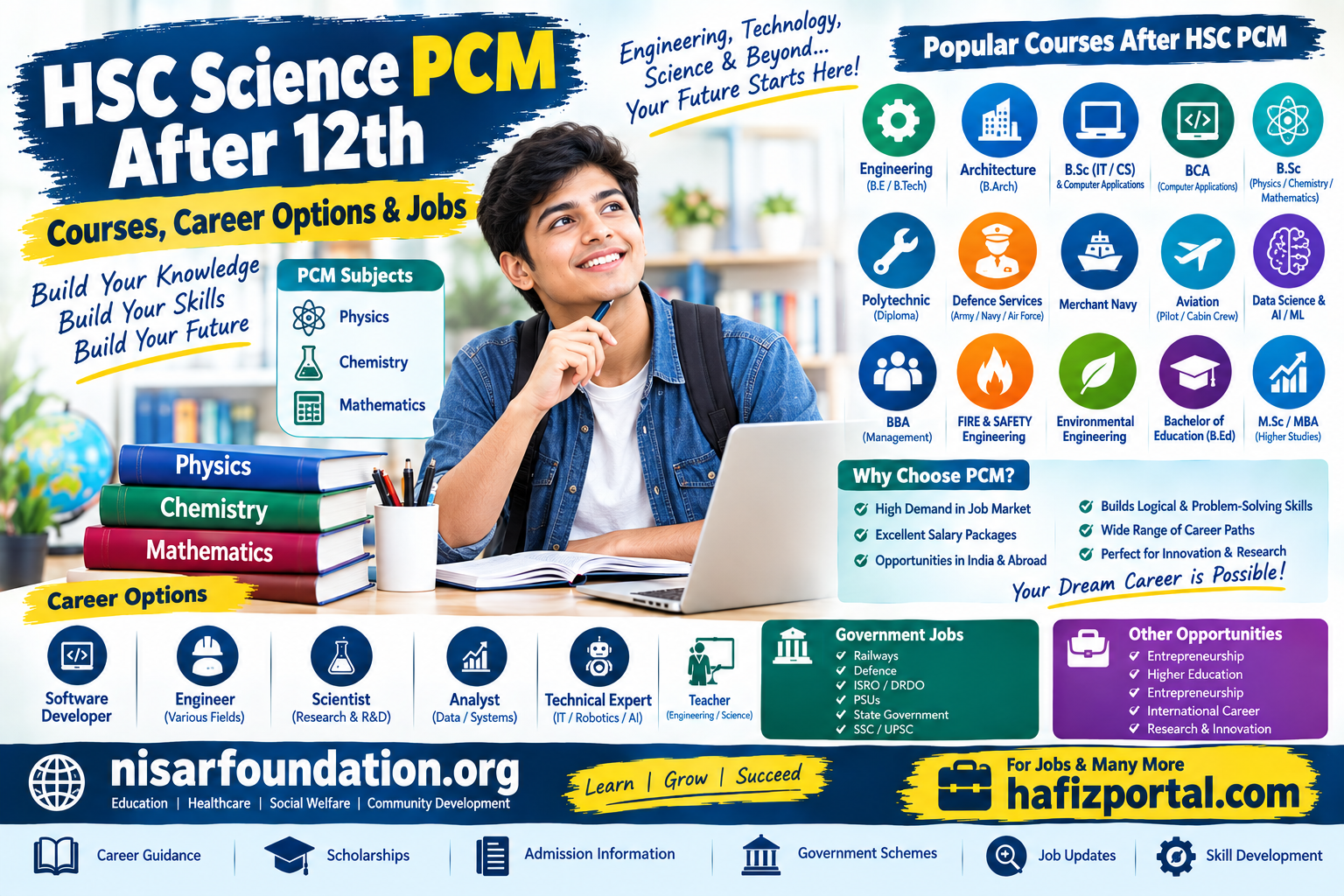
HSC Science PCM After 12th: Courses, Career Options & Jobs
HSC Science PCM After 12th: Courses, Career Options & Jobs in India


Completing HSC Science with Physics, Chemistry and Mathematics (PCM) opens the door to a wide range of higher education and career opportunities. Many students believe that engineering is the only option after 12th Science PCM. However, that is not true.
PCM students can explore engineering, computer science, artificial intelligence, data science, architecture, pure sciences, defence, aviation, merchant navy, design, mathematics, statistics, economics, teaching, research, government jobs and entrepreneurship.
The right choice depends on your interests, academic performance, entrance-exam preparation, financial situation and long-term career goals.
This guide explains the best courses after HSC Science PCM, entrance examinations, career options, job opportunities, skills to develop and how to choose the right path.
Important: Course eligibility, entrance examinations, admission rules and government recruitment requirements can change. Always verify the latest rules from the official examination authority or institution before applying.
What Is PCM in HSC Science?
PCM stands for:
- P – Physics
- C – Chemistry
- M – Mathematics
Students who study these subjects in Class 11 and 12 develop a strong foundation in:
- Mathematical reasoning
- Problem-solving
- Logical thinking
- Scientific understanding
- Numerical analysis
- Technical concepts
- Analytical skills
This combination is particularly useful for students interested in engineering, technology, architecture, physical sciences, defence, aviation and quantitative careers.
PCM can also provide a strong foundation for several interdisciplinary careers.
Best Courses After HSC Science PCM
There is no single “best course” for every PCM student. The best course is the one that matches your interest, ability and career objective.
Here are some of the most important options.
1. B.E. or B.Tech – Engineering
Engineering remains one of the most popular choices after HSC Science PCM.
A B.E. or B.Tech degree generally takes four years and allows students to specialise in a technical discipline.
Popular Engineering Branches
Students can consider:
- Computer Science Engineering
- Information Technology
- Artificial Intelligence and Machine Learning
- Data Science
- Cyber Security
- Electronics and Telecommunication Engineering
- Electrical Engineering
- Mechanical Engineering
- Civil Engineering
- Chemical Engineering
- Aerospace Engineering
- Automobile Engineering
- Instrumentation Engineering
- Robotics and Automation
- Mechatronics
- Production Engineering
- Biomedical Engineering
- Environmental Engineering
The choice should not be based only on the name of the branch. Students should compare the college, curriculum, fees, internships, placement record, location and their own interests.
Engineering Entrance Exams
One of the most important national-level examinations is JEE Main, conducted by the National Testing Agency.
The official JEE Main website provides examination information, bulletins, syllabus, notices and results.
Depending on the institution and state, students may also have other entrance pathways, including state-level examinations and university-specific admission processes.
2. Computer Science and Information Technology
Students interested in computers, programming and technology can consider:
- B.Tech Computer Science
- B.Tech Information Technology
- B.Sc Computer Science
- BCA
- B.Sc Data Science
- B.Sc Artificial Intelligence
- B.Tech AI and Machine Learning
- Cyber Security programmes
- Software development programmes
Career Opportunities
After gaining the required education and skills, students may work as:
- Software Developer
- Software Engineer
- Web Developer
- Mobile App Developer
- Data Analyst
- AI Engineer
- Machine Learning Engineer
- Cyber Security Analyst
- Cloud Engineer
- Database Administrator
- QA Engineer
- DevOps Engineer
- System Administrator
- Technical Support Engineer
Technology careers are increasingly skill-oriented. Therefore, students should not depend only on a degree.
Learning Python, Java, JavaScript, SQL, Git, cloud technologies, databases and problem-solving can improve employability.
3. Artificial Intelligence and Machine Learning
AI and Machine Learning are important areas for students interested in mathematics, programming and technology.
Possible courses include:
- B.Tech AI and ML
- B.Tech Data Science
- B.Sc Data Science
- B.Sc Artificial Intelligence
- B.Tech Computer Science with AI specialisation
- Mathematics or statistics followed by advanced study in data-related fields
Possible Careers
Students can eventually work toward roles such as:
- Machine Learning Engineer
- AI Engineer
- Data Scientist
- Data Analyst
- AI Product Specialist
- Research Assistant
- Automation Engineer
However, students should remember that AI is not simply about using AI tools. Strong foundations in mathematics, statistics, programming and data structures are valuable.
4. B.Sc in Physics, Chemistry or Mathematics
Not every PCM student wants to become an engineer.
Students interested in fundamental science can choose undergraduate science programmes such as:
- B.Sc Physics
- B.Sc Chemistry
- B.Sc Mathematics
- B.Sc Statistics
- B.Sc Geology
- B.Sc Computer Science
- B.Sc Data Science
- B.Sc Electronics
- B.Sc Astronomy-related programmes where available
A B.Sc can be followed by postgraduate study such as an M.Sc.
Students interested in research may continue toward a PhD or research-oriented career.
5. IISER and Research-Oriented Science Careers
Students who genuinely enjoy science and research should explore research-focused institutions and programmes.
The Indian Institutes of Science Education and Research (IISERs) offer programmes including BS-MS, BS and B.Tech pathways depending on the programme and eligibility.
The IISER 2026 information brochure lists admission pathways for 5-year BS-MS, 4-year BS and B.Tech programmes.
IISER Admissions Official Website
Possible Research Careers
A research-oriented student can eventually work in:
- Physics research
- Chemistry research
- Mathematics
- Materials science
- Space science
- Computational science
- Scientific computing
- Renewable energy research
- Environmental research
- Defence research
- Academic teaching and research
Research careers usually require higher qualifications, so students should be prepared for a longer academic journey.
6. Architecture – B.Arch
PCM students who enjoy drawing, design, buildings, creativity and mathematics can consider architecture.
The Bachelor of Architecture is a professional undergraduate programme.
Admission requirements can include an aptitude examination such as NATA or other recognised admission routes, depending on current regulations and the institution.
The Council of Architecture states that NATA assesses areas including cognitive skills, visual perception, aesthetic sensitivity, logical reasoning and critical thinking.
Career Options After Architecture
Graduates may explore:
- Architect
- Architectural Designer
- Interior-related design roles
- Urban planning
- Landscape architecture
- Building design
- Sustainable design
- Architectural visualisation
- Project coordination
Architecture is suitable for students who enjoy combining technical knowledge with creativity.
7. Defence Services After 12th PCM
PCM students can also consider a career in the armed forces.
One important pathway after Class 12 is the National Defence Academy (NDA) examination conducted by UPSC.
The UPSC website lists the National Defence Academy and Naval Academy Examination among its examinations.
Defence Career Areas
Depending on eligibility and selection, students can explore opportunities related to:
- Army
- Navy
- Air Force
- Technical services
- Defence engineering
- Aviation-related roles
- Logistics and administration
Defence careers require more than academic preparation. Physical fitness, discipline, medical fitness, leadership and mental strength are also important.
Students should always check the current UPSC notification before applying because age limits, educational requirements and other conditions are notification-specific.
8. Commercial Pilot and Aviation Careers
Students with PCM can explore aviation-related careers.
Possible pathways include:
- Commercial Pilot
- Flight Operations
- Aviation Management
- Airport Management
- Aircraft Maintenance-related education
- Aerospace Engineering
- Aviation safety and operations
Students interested in becoming pilots must carefully check the current requirements of the Directorate General of Civil Aviation (DGCA) and the approved training pathway.
Aviation can be an attractive career, but training costs can be significant. Students and parents should compare approved institutes, total training cost, medical requirements, licensing conditions and employment prospects before making a financial commitment.
9. Merchant Navy
PCM students who enjoy ships, travel, engineering and marine operations can explore the Merchant Navy.
Possible courses include:
- B.Tech Marine Engineering
- B.Sc Nautical Science
- Marine-related diploma programmes
- Other approved maritime programmes
The Indian Maritime University is an important institution to explore for maritime education and admissions.
Students should carefully verify medical fitness, eyesight requirements, course approval, training requirements and placement conditions before admission.
10. Mathematics and Statistics
Students who genuinely enjoy mathematics can consider:
- B.Sc Mathematics
- B.Sc Statistics
- Actuarial Science
- Applied Mathematics
- Computational Mathematics
- Mathematical Economics
- Statistics and Data Analytics
These subjects can lead to careers in:
- Data analysis
- Statistics
- Research
- Banking
- Insurance
- Finance
- Business analytics
- Government statistical services
- Education
- Quantitative research
Strong mathematics can be a valuable foundation for many modern careers.
11. Economics and Quantitative Finance
A less obvious but interesting option for PCM students is economics.
Students with strong mathematical ability can explore programmes related to:
- Economics
- Econometrics
- Financial mathematics
- Statistics
- Finance
- Business analytics
Potential career areas include:
- Financial analysis
- Business analysis
- Economic research
- Investment research
- Risk analysis
- Banking
- Insurance
- Consulting
Admission eligibility varies significantly between universities, so students must check the subject requirements of each programme.
12. Design and Creative Careers
PCM does not mean that students must choose a purely technical career.
Students interested in creativity can explore:
- Product Design
- Industrial Design
- UI/UX Design
- Communication Design
- Animation
- 3D Design
- Game Design
- Digital Design
Students should investigate entrance examinations and portfolio requirements where applicable.
A technical background can sometimes be an advantage in design because many modern design careers involve technology, user research, digital products and problem-solving.
13. Management After PCM
PCM students can also enter management-related education.
Possible undergraduate programmes include:
- BBA
- Business Management
- Integrated Management programmes
- Economics and management-related programmes
- Entrepreneurship programmes
Later, students may pursue:
- MBA
- Business Analytics
- Finance
- Marketing
- Human Resources
- Operations
- Entrepreneurship
Therefore, choosing PCM does not permanently restrict a student to science and engineering.
14. Government Jobs After Graduation
A PCM student can also prepare for government careers after completing an appropriate degree.
Depending on the recruitment rules, graduates can explore opportunities in:
- Banking
- Staff Selection Commission examinations
- Railways
- State government recruitment
- Public sector organisations
- Defence
- Teaching
- Technical services
- Administrative services
- Scientific organisations
Students should remember that many government jobs require a specific educational qualification, age limit, examination and selection process.
Do not depend on social-media posts for recruitment information. Always verify vacancies from the official recruitment authority.
Best Career Options After 12th PCM – Quick Comparison
| Career Area | Popular Course | Suitable For |
|---|---|---|
| Engineering | B.E./B.Tech | Technical and problem-solving students |
| Computer Science | B.Tech/B.Sc/BCA | Programming and technology enthusiasts |
| AI & Data Science | B.Tech/B.Sc | Mathematics and technology students |
| Architecture | B.Arch | Creative + technical students |
| Pure Science | B.Sc | Research and science enthusiasts |
| Defence | NDA + further training | Disciplined and physically fit students |
| Aviation | Pilot/Aviation programmes | Students interested in aviation |
| Merchant Navy | Marine programmes | Students interested in ships and travel |
| Mathematics | B.Sc Mathematics | Strong mathematics students |
| Statistics | B.Sc Statistics | Analytical and quantitative students |
| Design | Design degree | Creative and technology-oriented students |
| Management | BBA/Integrated programmes | Business-minded students |
| Economics | Economics programmes | Mathematics + finance interests |
Entrance Exams for PCM Students
Different courses have different admission processes.
JEE Main
Important for many engineering and architecture pathways. The official JEE Main portal provides information about Paper 1 for B.E./B.Tech and Paper 2 for B.Arch/B.Planning.
JEE Advanced
Students targeting IIT admissions should follow the official JEE Advanced admission process and eligibility rules for the relevant year.
CUET-UG
CUET-UG can be relevant for undergraduate admissions at participating universities. NTA states that CUET scores are used for UG admissions across participating Central, State, Deemed and Private Universities, subject to each university’s programme requirements.
NATA
NATA is relevant to architecture admissions under the applicable rules.
NDA
NDA is an important pathway for eligible students who want to pursue a defence career.
Other Examinations
Depending on the course and college, students may also encounter:
- State CET examinations
- University entrance tests
- Institute-specific examinations
- Scholarship examinations
- Aptitude tests
- Portfolio-based selection
Always check the official admission notification.
What Jobs Can PCM Students Get After Graduation?
A PCM student does not get a professional job simply because they have completed Class 12.
A degree, diploma, professional qualification, technical certification, portfolio or relevant skill is usually required for most career-track jobs.
Some potential job roles include:
Technology
- Software Developer
- Web Developer
- Data Analyst
- Cyber Security Analyst
- AI/ML Engineer
- Cloud Support Engineer
Engineering
- Graduate Engineer Trainee
- Design Engineer
- Mechanical Engineer
- Civil Engineer
- Electrical Engineer
- Electronics Engineer
- Production Engineer
Science
- Research Assistant
- Laboratory Assistant
- Scientific Assistant
- Data Analyst
- Technical Assistant
- Science Educator
Architecture and Design
- Junior Architect
- Architectural Assistant
- CAD Designer
- 3D Visualisation Artist
- Design Assistant
Defence and Government
- Defence Officer pathways
- Technical government roles
- Scientific recruitment pathways
- Banking and administrative careers after graduation
Skills PCM Students Should Develop
A degree is important, but modern employers also look for practical skills.
Students should consider developing:
1. Communication Skills
Improve:
- English communication
- Writing
- Presentation
- Interview skills
- Team communication
2. Digital Skills
Learn relevant tools such as:
- MS Office
- Google Workspace
- Basic programming
- Data analysis
- Online collaboration tools
3. Programming
For technology careers, students can start with:
- Python
- C
- C++
- Java
- JavaScript
- SQL
Students should choose languages according to their career path rather than trying to learn everything simultaneously.
4. Problem-Solving
Practice:
- Logical reasoning
- Quantitative aptitude
- Coding problems
- Real-world projects
- Case studies
5. English and Professional Communication
Good communication can help students during:
- College presentations
- Internships
- Interviews
- Group discussions
- Job applications
How to Choose the Right Course After HSC PCM
Do not select a course simply because your friends are selecting it.
Ask yourself these questions:
Question 1: What subjects do I enjoy?
If you enjoy mathematics and coding, technology may suit you.
If you enjoy physics and machines, engineering may be suitable.
If you enjoy drawing and buildings, architecture may be worth exploring.
If you enjoy scientific experiments, pure science and research may be better.
Question 2: Do I want a job quickly or higher education?
Some students want to enter employment after graduation.
Others are comfortable studying for many years to build a research or specialist career.
Your decision should consider your long-term objective.
Question 3: What is my budget?
Compare:
- Tuition fees
- Hostel fees
- Travel
- Equipment
- Coaching
- Examination fees
- Training costs
Do not choose an expensive course simply because it sounds prestigious.
Question 4: What is the college quality?
Check:
- Accreditation
- Recognition
- Faculty
- Curriculum
- Laboratories
- Internship opportunities
- Placement information
- Alumni
- Total fees
Question 5: What entrance exam is required?
Before preparing for an entrance examination, check:
- Eligibility
- Subjects
- Syllabus
- Exam pattern
- Application dates
- Fees
- Reservation rules
- Counselling process
Common Mistakes PCM Students Should Avoid
Mistake 1: Thinking Engineering Is the Only Option
PCM is much broader than engineering.
Explore multiple pathways before making a final decision.
Mistake 2: Choosing a Branch Only for Salary
Salary is important, but it should not be the only factor.
Interest, skills, college quality and long-term growth also matter.
Mistake 3: Ignoring Skills
A degree without practical skills may not be enough for competitive private-sector jobs.
Mistake 4: Following Friends
Your friend’s strengths may be completely different from yours.
Mistake 5: Ignoring College Quality
The same course can provide very different learning and career opportunities at different institutions.
Mistake 6: Trusting Unofficial Admission Information
Admission rules change. Use official portals whenever possible.
A Simple Career Roadmap After HSC Science PCM
Step 1: Complete HSC
Focus on Physics, Chemistry and Mathematics fundamentals.
Step 2: Identify Your Career Interest
Choose one or two broad areas:
Technology | Engineering | Research | Architecture | Defence | Aviation | Mathematics | Design | Management
Step 3: Shortlist Courses
Compare at least 3–5 relevant courses.
Step 4: Identify Entrance Exams
Check the official examination websites.
Step 5: Research Colleges
Compare fees, location, recognition, faculty, facilities and placements.
Step 6: Build Skills
Start learning relevant technical and communication skills before or during college.
Step 7: Complete Internships and Projects
Projects can help you understand whether you actually enjoy the field.
Step 8: Prepare for Employment
Create a professional resume and portfolio.
Step 9: Continue Learning
Technology and job requirements change continuously. Keep upgrading your skills.
Is PCM a Good Choice for the Future?
Yes. PCM can provide a broad academic foundation.
It can lead to careers in engineering, computing, AI, research, architecture, defence, aviation, maritime studies, mathematics, statistics, design and several interdisciplinary areas.
But there is an important point:
PCM itself is not a career. It is a foundation for a career.
Your success will depend on what you do after Class 12.
A student who combines a good degree with practical skills, communication ability, internships and continuous learning can create many opportunities.
Frequently Asked Questions About HSC Science PCM After 12th
What are the best courses after HSC Science PCM?
Popular options include B.E./B.Tech, Computer Science, AI and Data Science, B.Sc Mathematics, Physics, Chemistry, Statistics, B.Arch, defence pathways, aviation, merchant navy and design.
Can PCM students do B.Sc?
Yes. PCM students can consider B.Sc programmes such as Mathematics, Physics, Chemistry, Statistics, Computer Science and other eligible programmes. However, eligibility varies by university.
Can PCM students become software engineers?
Yes. B.Tech/B.E. Computer Science or IT is one direct route. Other degrees can also lead to software careers when combined with strong programming and practical skills.
Can PCM students apply for architecture?
Yes, eligible PCM students can pursue architecture subject to the current eligibility and admission rules. NATA and JEE-related pathways may be relevant depending on the institution and regulations.
Can PCM students join defence services?
Eligible candidates can explore NDA and other defence-entry pathways. The exact eligibility conditions should always be checked in the current UPSC notification.
Can PCM students choose data science?
Yes. Mathematics is particularly useful for data-related studies. Students can explore B.Tech, B.Sc and other eligible programmes in data science, statistics, computer science and related fields.
Is B.Tech compulsory for a technology career?
No. B.Tech is a major pathway, but technology careers can also be entered through other degrees and skill-based routes. The right path depends on the role, employer and student’s skills.
Can PCM students prepare for government jobs?
Yes. Depending on the recruitment rules, graduates can apply for many government examinations and recruitment opportunities.
Final Career Advice for HSC Science PCM Students
Choosing a career after Class 12 is an important decision, but it does not mean that one decision will determine your entire life.
If you are strong in mathematics and enjoy technology, explore engineering, computer science, AI, data science and cybersecurity.
If you enjoy scientific concepts and experiments, consider B.Sc and research-oriented programmes.
If you enjoy creativity and buildings, explore architecture and design.
If you dream of serving the country, investigate NDA and defence careers.
If you love aviation, research the pilot and aviation pathway carefully.
If you enjoy ships and international travel, investigate merchant navy and maritime education.
If mathematics is your strongest subject, consider mathematics, statistics, economics and quantitative careers.
The most important rule is simple:
Do not choose a career only because someone else says it is the best. Choose a path that matches your interest, ability, financial situation and long-term goals.
HSC Science PCM gives students a strong starting point. With the right course, practical skills, internships, entrance-exam preparation and continuous learning, students can build careers in both traditional and emerging fields.
For students looking for career guidance, courses, jobs, scholarships and useful educational information, keep following HafizPortal for regularly updated career resources.
HafizPortal – Jobs, Scholarships & Career Guidance
Recommended Internal Links for HafizPortal
To strengthen the article’s internal SEO structure, link this page naturally to related HafizPortal content such as:
- HSC Arts After 12th: Courses, Career Options & Jobs
- HSC Commerce After 12th: Courses, Career Options & Jobs
- Career Guidance After 10th and 12th
- Government Jobs in India
- Private Jobs in India
- Scholarships for Students
- Government Schemes for Students
- Free Courses and Skill Development
- ITI and Diploma Courses After 10th
- Career Options After 12th Science