ABHA Health Card Complete Information And Online Application Guide
ABHA Health Card 2026: How to Create ABHA Number Online, Benefits, Documents and Complete Guide
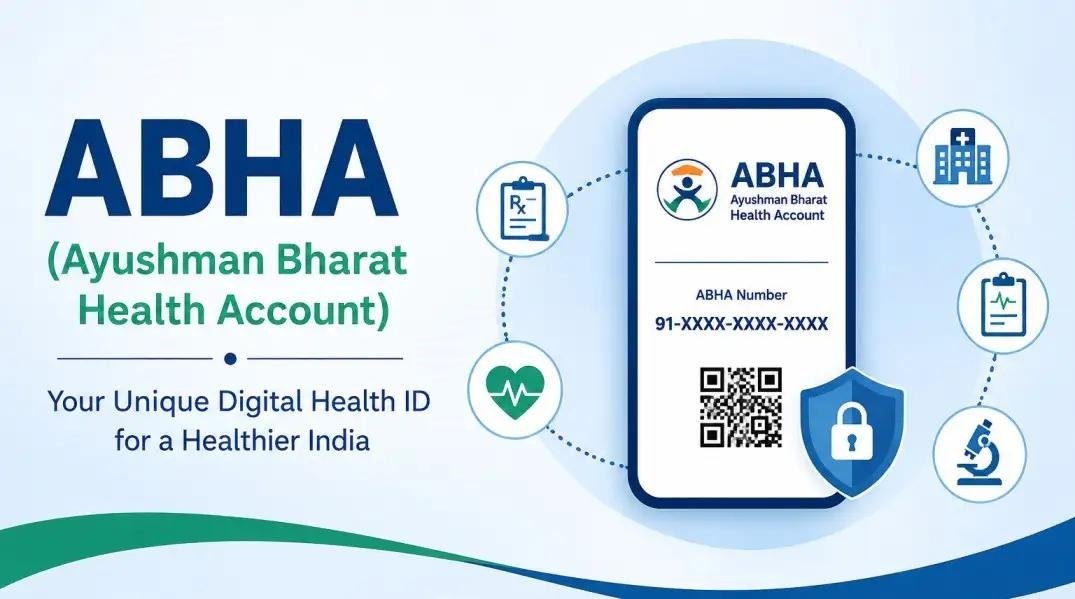
The ABHA Health Card is an important part of India’s Ayushman Bharat Digital Mission (ABDM). ABHA stands for Ayushman Bharat Health Account.
ABHA provides individuals with a digital health account that can help them access and manage their health information through the ABDM ecosystem. It can make it easier to connect health records from different healthcare providers when the required services and consent are available.
The official ABDM information describes ABHA as a digital account that can help citizens access health services and digitally manage health records. Health records can be linked, stored and accessed through compatible Personal Health Record applications, with sharing based on user consent.
This is different from an Ayushman Bharat PM-JAY card. An Ayushman card is associated with eligible beneficiaries under the health assurance scheme, while an ABHA account is a digital health identity/account.
In this guide, you will learn:
- What ABHA is
- What an ABHA number is
- What an ABHA address is
- Who can create an ABHA
- Documents required
- How to create ABHA online
- How to download the ABHA card
- How digital health records work
- Privacy and consent
- ABHA benefits
- ABHA vs Ayushman Card
- Frequently asked questions
- Official government links
What Is an ABHA Health Card?
ABHA means Ayushman Bharat Health Account.
It is a digital health account created under the Ayushman Bharat Digital Mission (ABDM).
The account provides a digital identity that can be used within the ABDM ecosystem to connect individuals with participating digital health services.
The official ABDM material explains that ABHA can be used to access health services and that health records can be linked and managed through compatible Personal Health Record applications.
An ABHA account is therefore better understood as a digital health identity and account, rather than an insurance card.
What Is the ABHA Number?
An ABHA Number is a unique 14-digit number associated with an individual’s ABHA.
The official ABDM material promotes the ABHA Number as a way to access health records through a single digital account.
For example, an ABHA number can look like a sequence of 14 digits.
It is different from:
- Aadhaar number
- PAN number
- Ayushman card number
- Insurance policy number
Your ABHA number is specifically associated with your digital health account.
What Is an ABHA Address?
Apart from the 14-digit ABHA Number, users can create an ABHA Address.
An ABHA Address is designed to make digital health interactions easier.
It can have a format similar to:
username@abdm
For example:
example123@abdm
The exact availability and creation process can depend on the ABHA platform or application being used.
The ABHA Address should not be confused with an email address.
It is a digital health identifier used within the ABDM ecosystem.
Why Was ABHA Created?
India has a large and diverse healthcare system.
People may visit:
- Government hospitals
- Private hospitals
- Clinics
- Diagnostic laboratories
- Pharmacies
- Specialists
- Telemedicine services
Health information can therefore exist in different places.
ABDM aims to create a connected digital health ecosystem.
ABHA can help individuals manage their digital health information and use compatible health services.
The official ABDM material describes an ecosystem involving citizens, hospitals, clinics, laboratories, pharmacies, insurers, doctors and other healthcare participants.
Main Benefits of an ABHA Account
ABHA can provide several useful digital health features.
1. Digital Health Identity
ABHA gives you a digital health identity that can be used with participating ABDM-enabled services.
Instead of relying only on paper records, users can have a digital account associated with their health services.
2. Access to Digital Health Records
Compatible Personal Health Record applications can allow users to link, store and access health records created by different healthcare facilities.
These records may include information such as:
- Prescriptions
- Diagnostic reports
- Health documents
- Treatment-related records
- Other supported digital health information
The availability of a particular record depends on whether the healthcare provider and service are digitally integrated with the ABDM ecosystem.
3. Consent-Based Sharing
One of the important features of ABDM is consent-based sharing of health records.
This means that creating an ABHA does not automatically give every doctor access to all your medical records.
When a record-sharing service is used, the user’s consent is an important part of the process.
The official ABDM material describes sharing health records with verified healthcare providers based on consent and for a defined period.
4. Easier Registration at Participating Facilities
ABDM also supports digital healthcare services such as Scan and Share, where participating facilities can provide faster registration processes.
The official ABDM material lists instant registration through Scan and Share as one of the citizen-focused features of the ecosystem.
Availability depends on the participating healthcare facility.
5. Easier Digital Health Management
Instead of keeping every health document only in physical form, users can use compatible digital health applications to manage supported records.
This can be particularly useful for people who:
- Visit multiple healthcare providers
- Travel frequently
- Need to share reports with another doctor
- Want to keep digital copies of health records
- Use digital healthcare services
6. Useful for Families and Senior Citizens
ABHA can be useful for people who regularly manage healthcare information.
For example:
- Senior citizens may have multiple medical records.
- Parents may need to manage children’s healthcare documents.
- Patients visiting different hospitals may want digital access to records.
- People using telemedicine may benefit from digital health services.
However, the exact services available depend on participating healthcare providers and applications.
Who Can Create an ABHA?
ABHA is designed as a citizen-facing digital health account under ABDM.
The official ABDM material provides methods for creating an ABHA using Aadhaar and mobile number, as well as other supported KYC methods and ABDM-compliant applications.
The process and identity-verification options can change over time.
Therefore, applicants should use the current official ABHA platform or an authorised ABDM-integrated application.
Is ABHA Free?
ABHA creation is generally provided as a free digital health account service through official ABDM channels.
However, users should be careful with websites or agents that claim to charge large amounts for creating an ABHA.
Use the official ABDM platform or a trusted ABDM-enabled service.
The official ABDM material promotes creating ABHA through its digital health ecosystem.
Documents Required for ABHA
One of the advantages of ABHA creation is that the process can be simple.
The official ABDM material states that ABHA can be created using:
- Aadhaar number
- Mobile number
It also describes other supported KYC options and methods through ABDM-compliant applications.
Depending on the method used, you may need:
Commonly Used Details
- Aadhaar number
- Mobile number
- OTP access
- Basic personal information
Other KYC documents or authentication methods may be supported through particular ABDM-compliant applications.
Important
Do not upload unnecessary documents to unofficial websites.
Always check the current official process before submitting personal information.
How to Create an ABHA Number Online
The exact website interface can change, so follow the current instructions displayed by the official ABDM platform.
Step 1: Open the Official ABHA Website
Use the official ABDM website and follow the current ABHA creation option.
Official ABDM Website:
Ayushman Bharat Digital Mission – Official Website
The official ABDM material also directs users to the ABHA platform for creating an account.
Step 2: Choose the ABHA Creation Option
Look for the option related to:
Create ABHA
or
Create ABHA Number
The wording can change as government platforms are updated.
Step 3: Select Your Verification Method
The available verification method may include Aadhaar-based authentication.
The official ABDM material states that Aadhaar number and mobile number can be used to create an ABHA.
Other KYC methods may also be available through supported platforms.
Step 4: Enter Your Aadhaar Details
If you choose Aadhaar-based creation:
- Enter your Aadhaar number.
- Follow the authentication instructions.
- Complete OTP verification where required.
- Check the personal information displayed.
Never share your Aadhaar OTP with another person.
Step 5: Enter or Confirm Your Mobile Number
A mobile number is used as part of the account creation and authentication process.
Make sure you have access to the mobile number being used.
Follow the OTP verification instructions shown on the official platform.
Step 6: Check Your Details
Before completing the process, check:
- Name
- Date of birth or year of birth
- Gender, where displayed
- Mobile number
- Other personal information
If the information is incorrect, follow the official correction process.
Step 7: Create Your ABHA Address
Where the service allows it, you may create or select an ABHA Address.
For example:
yourname@abdm
Choose an address that you can remember easily.
Step 8: Complete ABHA Creation
After successful verification, your ABHA account will be created.
You can then use the account through supported ABDM services.
The official ABDM material states that ABHA can be generated through the ABHA app and other ABDM-compliant applications.
How to Download Your ABHA Card
After creating your ABHA account, use the official ABHA platform or supported application.
The exact menu names can change.
Generally, you may need to:
- Log in to your ABHA account.
- Open your ABHA profile.
- Find the ABHA card or download option.
- Download or save the digital card.
- Keep a copy for future reference.
Avoid downloading your health documents on a public or shared computer.
ABHA App
The ABHA app is part of the digital health ecosystem.
The official ABDM material states that users can create ABHA and manage health records using the ABHA app or other supported Personal Health Record applications.
Users should download applications only from official or trusted app stores and verify the publisher before entering personal information.
What Health Records Can Be Linked to ABHA?
The exact records available depend on the healthcare provider, application and ABDM integration.
Supported digital records may include:
- Lab reports
- Prescriptions
- Diagnostic reports
- Treatment-related documents
- Other health records generated by participating facilities
The important point is that ABHA does not automatically contain every medical record a person has ever created.
A healthcare provider generally needs to be part of the relevant digital ecosystem, and the user may need to give consent for linking or sharing records.
The official ABDM material specifically describes the ability to link, store and access health records created across different health facilities through compatible PHR applications.
Can Every Doctor See My Medical History Through ABHA?
No.
This is an important correction to a common misunderstanding.
Creating an ABHA does not mean that every doctor in India automatically receives access to your complete medical history.
ABDM uses a consent-based approach for sharing health records.
The official ABDM material says that health records can be shared with verified healthcare providers based on user consent and for a defined period.
Therefore, ABHA should not be described as an unrestricted medical database that every hospital can automatically open.
ABHA Privacy and Data Security
Health information is sensitive personal information.
ABDM has published a privacy policy for the ABHA application.
The policy states that ABDM is committed to protecting users’ personal data and that collection and use of personal data should be limited to what is necessary for the relevant purpose. It also states that personal data should not be transferred by the app without user consent, subject to the applicable policy and legal framework.
The policy also discusses:
- Data collection
- Data processing
- Consent
- Privacy
- Storage limitations
- Personal information protection
This means users should still follow basic digital-security practices.
Never share:
- Aadhaar OTP
- ABHA login credentials
- Passwords
- Sensitive health documents
- Authentication codes
with unknown people.
ABHA vs Ayushman Card
This is one of the most important differences to understand.
| Feature | ABHA | Ayushman Card |
|---|---|---|
| Full name | Ayushman Bharat Health Account | PM-JAY/Ayushman Bharat beneficiary card |
| Main purpose | Digital health identity/account | Health assurance/beneficiary identification |
| Health records | Can help link and manage digital records | Not primarily a digital health-record account |
| Insurance benefit | Not an insurance card | Associated with eligible health assurance benefits |
| Eligibility | Designed as a digital health account | Eligibility depends on the applicable scheme rules |
| Main ecosystem | ABDM | Ayushman Bharat PM-JAY |
Therefore:
ABHA Card ≠ Ayushman Card
Having an ABHA does not automatically mean that you are eligible for free treatment under PM-JAY.
Similarly, having an Ayushman Card is not the same thing as having an ABHA account.
ABHA vs Aadhaar Card
These two cards also have completely different purposes.
Aadhaar
Aadhaar is a unique identity number issued under India’s Aadhaar system.
ABHA
ABHA is a digital health identity/account used within the ABDM ecosystem.
Aadhaar may be used as one of the methods for creating or verifying an ABHA.
But:
ABHA is not a replacement for Aadhaar.
Is ABHA Mandatory?
ABHA should not be described as a mandatory replacement for Aadhaar or as a compulsory health card for every citizen.
It is a digital health account created as part of India’s digital health ecosystem.
Citizens can choose to use the digital services available through the ABDM ecosystem according to the applicable processes.
Does ABHA Provide Free Treatment?
No.
ABHA itself does not provide free treatment or automatically provide health insurance.
Its primary purpose is digital health identity and management of health information within the ABDM ecosystem.
If you want to check eligibility for government-funded health coverage, you need to check the applicable health scheme separately.
Can ABHA Be Used for Health Insurance?
ABHA can be useful within the broader digital health ecosystem, and ABDM includes healthcare stakeholders such as insurers.
However, ABHA itself is not an insurance policy.
Insurance benefits depend on:
- Your insurance policy
- Insurer rules
- Government scheme eligibility
- Hospital network
- Claim conditions
- Applicable documents
Therefore, do not assume that creating an ABHA automatically makes insurance claims easier in every situation.
ABHA for Students
Students can use digital health services supported by ABDM.
An ABHA account may be useful for maintaining health-related digital records, especially if the student’s healthcare providers use compatible digital systems.
Students should protect their account information and avoid sharing sensitive medical documents unnecessarily.
ABHA for Senior Citizens
Senior citizens may have medical records from different hospitals and doctors.
A digital health account can help them manage supported records more conveniently.
For example, records from participating facilities may be linked and accessed through compatible PHR applications, subject to the required consent process.
Family members helping senior citizens should also take privacy seriously.
ABHA and Telemedicine
Digital health accounts can be useful in a wider digital healthcare environment.
Depending on the service provider, ABHA may be used alongside digital healthcare services.
However, ABHA itself is not a telemedicine platform.
Telemedicine services depend on the relevant healthcare provider or digital health service.
What Happens If You Lose Your ABHA Card?
An ABHA is a digital account.
If you lose a printed copy or downloaded PDF, you can generally access your account again through the official ABHA platform or supported application after completing the required authentication.
The physical printout itself is not the entire account.
Keep your account details secure and use official recovery procedures if you cannot access your account.
Can I Have More Than One ABHA Number?
Users should avoid creating multiple ABHA accounts unnecessarily.
If you already have an ABHA, first try to access or recover your existing account rather than creating another account.
Multiple identities can create confusion when managing digital health records.
Use the official platform’s recovery or support options if you cannot find your existing ABHA.
Important Safety Tips
Follow these precautions when creating or using ABHA.
1. Use Official Websites
Always verify the website before entering Aadhaar or health information.
2. Never Share OTP
No legitimate support person should need your OTP for their own use.
3. Check App Publisher
Download the ABHA app only from a trusted official app store and verify the developer/publisher.
4. Avoid Public Computers
Do not leave your ABHA account logged in on a cyber café or shared computer.
5. Protect Medical Reports
Health reports can contain sensitive personal information.
Share them only with the people or healthcare providers who need them.
6. Check Consent Requests
Before approving a health-record sharing request, read:
- Who is requesting the information
- Which records are being requested
- Why they are being requested
- How long access will remain available
The ABDM ecosystem uses consent-based health-record sharing.
Common Misunderstandings About ABHA
Misunderstanding 1: ABHA Is Health Insurance
Incorrect.
ABHA is a digital health account.
Misunderstanding 2: Every Doctor Can Automatically See Everything
Incorrect.
Health-record sharing is based on the applicable digital system and consent process.
Misunderstanding 3: ABHA Replaces Aadhaar
Incorrect.
Aadhaar and ABHA serve different purposes.
Misunderstanding 4: ABHA Guarantees Free Treatment
Incorrect.
ABHA does not itself provide free treatment.
Misunderstanding 5: Every Medical Record Automatically Appears
Incorrect.
Records generally need to come from participating/integrated healthcare services and be linked through supported digital systems.
ABHA Health Card: Quick Checklist
Before creating ABHA, keep these details ready:
- Aadhaar number, if using Aadhaar authentication
- Mobile number
- Access to OTP
- Basic personal information
- Email address, if requested
- Smartphone or computer with internet access
After creation:
- Save your ABHA number
- Remember your ABHA Address
- Download/save the digital card if available
- Protect your login details
- Review consent requests carefully
- Use official ABDM services
Frequently Asked Questions About ABHA Health Card
What is ABHA?
ABHA stands for Ayushman Bharat Health Account. It is a digital health account created under the Ayushman Bharat Digital Mission.
What is the ABHA number?
The ABHA Number is a unique 14-digit health account number associated with your ABHA.
Is ABHA free?
ABHA creation is provided through the official digital health ecosystem without a charge for creating the account.
Who can create ABHA?
ABHA is designed as a citizen-facing digital health account. The available identity-verification methods depend on the current official process.
Is Aadhaar required?
Aadhaar can be used to create ABHA, and the official ABDM material describes Aadhaar and mobile number as a way to create an ABHA. Other supported KYC methods may also be available.
Is a mobile number required?
A mobile number is used in the Aadhaar-based ABHA creation process described by ABDM. The exact verification method can depend on the current platform.
What is an ABHA Address?
It is a digital health address that can make interactions with the ABDM ecosystem easier. It can have a format such as username@abdm.
Can ABHA store medical reports?
Compatible Personal Health Record applications can link, store and access supported health records from participating healthcare facilities.
Can a doctor see all my records automatically?
No. Health-record sharing uses consent-based mechanisms and depends on participating healthcare systems.
Is ABHA an Ayushman Card?
No. ABHA and the Ayushman/PM-JAY beneficiary card have different purposes.
Does ABHA provide free treatment?
No. ABHA is not itself a health-insurance or free-treatment scheme.
Can I download my ABHA card?
Yes, after creating your account, use the official ABHA platform or supported application and follow the current download instructions.
What should I do if I lose the card?
Access your ABHA account through the official platform and use the available authentication/recovery process to access your digital information again.
Is ABHA secure?
ABDM has published a privacy policy describing data protection, consent and limitations on collection and use of personal information. Users should still protect their OTPs, passwords and health information.
Official ABHA and ABDM Links
Ayushman Bharat Digital Mission
Use the official ABDM website for information about India’s digital health ecosystem.
ABHA Portal
Use the official ABHA platform for ABHA-related services.
ABDM Privacy Policy
ABHA Application Privacy Policy
Read the official privacy policy for information about personal-data collection, processing, consent and privacy.
Final Conclusion
The ABHA Health Card is an important part of India’s digital healthcare system.
ABHA stands for Ayushman Bharat Health Account and provides a unique digital health identity associated with a 14-digit ABHA Number.
Its main purpose is not to provide health insurance. Instead, it helps users participate in the digital health ecosystem and can allow supported health records to be linked, stored and accessed through compatible Personal Health Record applications.
One of the most important features is consent-based health-record sharing. Creating an ABHA does not mean that every doctor can automatically access your complete medical history. The official ABDM information specifically describes sharing records with verified healthcare providers based on user consent and for defined periods.
ABHA is also different from the Ayushman/PM-JAY card. An ABHA account is a digital health identity, while the Ayushman card relates to eligible beneficiaries under the applicable health assurance scheme.
Before creating an ABHA, use the official ABDM platform and avoid unofficial websites that request unnecessary personal information or payment.
If you already have an ABHA, keep your account details secure, protect your OTPs and review consent requests before sharing health records.
For the latest information and services, always refer to the official Ayushman Bharat Digital Mission and ABHA websites.
Disclaimer: This article is for general information and educational purposes. Digital health services, eligibility processes, applications, features and procedures may be updated by the Government of India. Always check the latest information on the official ABDM/ABHA platform before submitting personal information or using a health service.