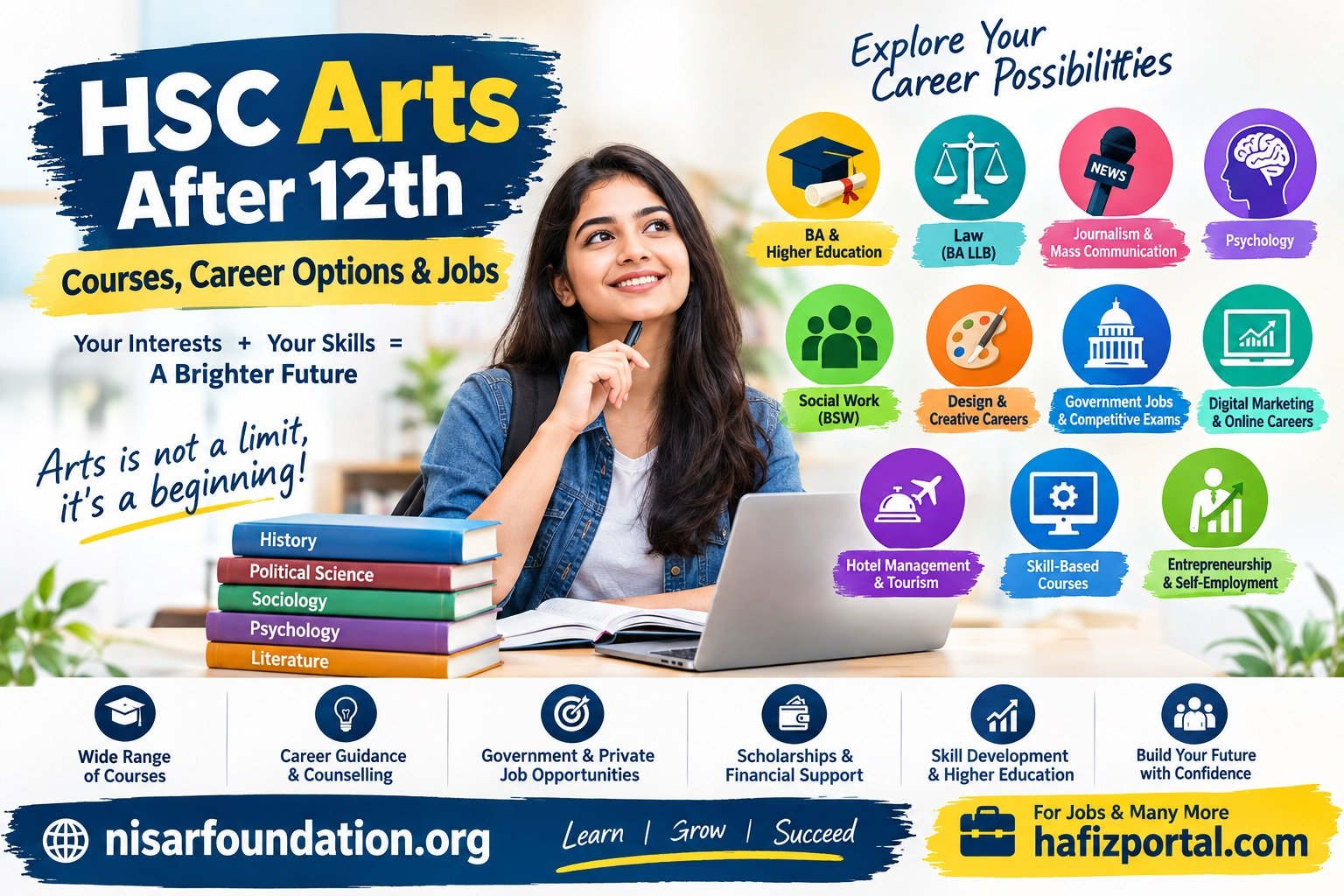
HSC Arts After 12th: Courses, Career Options & Jobs
Completing HSC Arts after 12th opens the door to many career and higher-education opportunities. Arts is not limited to traditional subjects or a small number of career choices. Students can explore degree courses, professional programs, law, journalism, social work, psychology, design, teaching, government jobs, competitive examinations, digital careers, and entrepreneurship.
The right career after HSC Arts depends on your interests, academic performance, skills, financial situation, eligibility, and long-term goals. Instead of choosing a course only because it is popular, students should understand the course structure, admission requirements, career opportunities, and future growth before making a decision.
This guide explains the major HSC Arts after 12th courses, career options, professional courses, government job opportunities, skill-based programs, and career planning strategies.
What Can You Do After HSC Arts?
After completing HSC Arts, students have several possible pathways. You can choose a traditional bachelor’s degree, a professional course, a skill-based program, a law course, a design course, or prepare for future competitive examinations.
Some popular options include:
- Bachelor of Arts (BA)
- Bachelor of Social Work (BSW)
- Bachelor of Journalism and Mass Communication
- Bachelor of Business Administration
- Bachelor of Laws through an integrated law program
- Psychology-related courses
- Bachelor of Fine Arts
- Design courses
- Hotel management
- Travel and tourism
- Digital marketing
- Foreign language courses
- Teaching and education-related pathways
- Computer and digital skill courses
- Government job preparation
- Entrepreneurship and self-employment
The best choice is the one that matches your interests and career objectives.
1. Bachelor of Arts (BA)
BA is one of the most popular choices after HSC Arts. Students can select subjects according to their interests and the subjects offered by the college.
Common BA subjects include:
- English
- Marathi
- Hindi
- History
- Political Science
- Sociology
- Psychology
- Economics
- Geography
- Philosophy
- Public Administration
- Literature
A BA can provide a foundation for careers in education, administration, media, research, social services, content creation, public policy, and many other fields.
Students who plan to pursue postgraduate education can also continue with MA and other advanced programs after completing their bachelor’s degree.
2. Law After HSC Arts
Law is another important career option for Arts students. Students interested in legal studies can explore integrated undergraduate law programs such as BA LLB, subject to the eligibility and admission rules of the institution.
Law can lead to career opportunities in areas such as:
- Legal practice
- Corporate legal services
- Legal research
- Compliance
- Legal administration
- Public policy
- Legal journalism
- Government and regulatory organisations
Students should check the latest admission rules and entrance-examination requirements before applying because eligibility and admission procedures can vary between institutions.
3. Bachelor of Social Work (BSW)
Students interested in community development, social welfare, education, healthcare support, and nonprofit organisations can consider BSW.
Social work can provide opportunities in:
- NGOs
- Community development organisations
- Hospitals
- Schools
- Rehabilitation organisations
- Government welfare programs
- CSR projects
- Community outreach
- Social research
After BSW, students can also consider postgraduate studies such as MSW or other relevant programs.
4. Journalism and Mass Communication
Students who enjoy writing, communication, news, photography, video production, or digital media may consider journalism and mass communication.
Possible career areas include:
- Journalism
- Content writing
- Digital media
- News media
- Public relations
- Social media management
- Copywriting
- Video production
- Communication
- Media research
The media industry is increasingly connected with digital platforms, making communication and digital-content skills valuable additions to a formal qualification.
5. Psychology and Human Behaviour
Psychology is another field that attracts students interested in human behaviour, communication, education, and social sciences.
Students can explore psychology at the undergraduate level and later pursue advanced study according to their career objectives.
Possible areas include:
- Psychology education
- Research
- Human resources
- Counselling-related fields
- Social services
- Mental-health support roles
- Education
- Behavioural research
Students should carefully check professional eligibility requirements before entering any regulated profession.
6. Design and Creative Careers
Arts students with creative interests can explore design-related courses.
Popular areas include:
- Graphic design
- Fashion design
- Interior design
- Animation
- Photography
- Fine arts
- UI/UX design
- Illustration
- Digital media
A strong portfolio can be very important in creative careers. Therefore, students should combine formal education with practical projects and software skills.
7. Digital Marketing and Online Careers
Digital skills can complement almost any Arts qualification. Students can learn areas such as:
- Digital marketing
- Search engine optimisation
- Social media marketing
- Content writing
- Website management
- Email marketing
- Graphic design
- Video editing
- E-commerce
- Online advertising
These skills can help students look for employment, freelance work, internships, or entrepreneurship opportunities.
However, students should select genuine training programs and focus on practical learning rather than simply collecting certificates.
8. Teaching and Education
Students interested in teaching can plan their education according to the level and subject they want to teach.
A common pathway is to complete a relevant bachelor’s degree and then pursue the teacher-education qualification required for the intended teaching role.
Students should always check the latest eligibility rules of the relevant education authorities and recruiting organisations because requirements can change.
9. Government Jobs After HSC Arts
Government employment is another area that attracts many Arts students.
Depending on the recruitment notification and eligibility requirements, 12th-pass candidates may find opportunities in areas such as:
- Clerical work
- Administrative support
- Defence services
- Police-related recruitment
- Railway recruitment
- Staff-support positions
- State government departments
- Other public-sector recruitment
Eligibility differs from one recruitment to another. Some positions require only 12th qualification, while others require graduation or additional qualifications.
For reliable employment information, students should verify recruitment notifications through official government websites.
The National Career Service (NCS) is an official Government of India platform that provides employment-related services, career counselling, vocational guidance, skill-development information, internships, and job-search facilities.
Students can also use the official NCS job-search facility to explore vacancies by qualification, location, sector, and other filters.
10. Competitive Examinations
Arts subjects can also provide a useful academic foundation for students who plan to prepare for competitive examinations after graduation.
Students may consider long-term preparation for examinations and recruitment processes conducted by organisations such as:
- UPSC
- State Public Service Commissions
- SSC
- Banking recruitment organisations
- Railway recruitment authorities
- Police recruitment authorities
- Other government departments
Students should understand that many major competitive examinations require graduation or specific eligibility. Therefore, completing a suitable bachelor’s degree can be an important part of a long-term government-career plan.
11. Banking and Financial Services
Although Commerce is traditionally associated with banking and finance, Arts students can also enter many banking-related careers, particularly after obtaining the required graduation and meeting recruitment eligibility.
Students can develop useful skills such as:
- Mathematics
- Reasoning
- English communication
- Computer knowledge
- General awareness
- Financial awareness
Graduation followed by competitive-examination preparation can create additional opportunities in banking and financial services.
12. Hotel Management and Tourism
Students interested in travel, hospitality, customer service, food services, and tourism can explore hotel management and related programs.
Career areas can include:
- Hotels
- Restaurants
- Travel companies
- Tourism organisations
- Event management
- Guest relations
- Front office
- Hospitality operations
Communication skills, personality development, computer skills, and knowledge of additional languages can improve employability in this sector.
13. Skill-Based Courses After HSC Arts
Not every student wants to spend several years pursuing a traditional degree. Short-term and job-oriented skill courses can also be considered.
Examples include:
- Advanced computer skills
- Tally and accounting software
- Excel
- Graphic design
- Web development
- Digital marketing
- Video editing
- Spoken English
- Fashion design
- Tailoring
- Beauty and wellness
- Photography
- Office administration
The best skill course is one that provides practical training and connects with a realistic employment or business opportunity.
How to Choose the Right Course After HSC Arts
Choosing a course should be a planned decision rather than a random choice.
Consider these five questions:
1. What do you enjoy?
Think about the subjects and activities you naturally enjoy. If you like writing, media may suit you. If you enjoy social interaction, social work or communication-related fields may be suitable.
2. What are your strengths?
Identify your strengths in communication, creativity, research, leadership, organisation, technology, or analytical thinking.
3. What is your career goal?
Your long-term goal should influence your course selection. For example, a student interested in law should research law programs and admission requirements rather than choosing an unrelated course.
4. What is your budget?
Compare tuition fees, travel expenses, hostel costs, study materials, and other expenses before taking admission.
5. What are the eligibility requirements?
Always verify eligibility from the official college, university, examination authority, or government recruitment notification.
Importance of Skills Along With a Degree
A degree can provide academic knowledge, but practical skills can improve employability.
HSC Arts students should consider developing:
- English communication
- Computer literacy
- MS Office
- Internet research
- Presentation skills
- Writing skills
- Public speaking
- Digital marketing
- Social media skills
- Basic financial knowledge
- Interview skills
- CV and resume writing
The National Career Service also provides career counselling, vocational guidance, skill-development information, internships, and employment services.
The Government of India’s NCS platform is designed to connect jobseekers with employers and also provides career information and counselling resources.
Career Planning After HSC Arts: A Simple Roadmap
Students can follow a simple approach:
Step 1: Identify your interests.
Step 2: List three possible career fields.
Step 3: Research the required qualification for each field.
Step 4: Compare colleges, courses, fees, duration, and admission requirements.
Step 5: Check whether an entrance examination is required.
Step 6: Develop one or two practical skills alongside your studies.
Step 7: Look for internships, projects, volunteering, or practical experience.
Step 8: Build a professional CV and online profile.
Step 9: Monitor verified job and scholarship opportunities.
Step 10: Review your career plan every year.
HSC Arts Does Not Limit Your Future
One of the biggest misconceptions about Arts is that it provides limited career opportunities. In reality, Arts can lead to a wide range of academic and professional pathways.
Students can move into law, education, media, social work, psychology, design, administration, digital careers, government services, hospitality, research, and entrepreneurship.
Your Class 12 stream is only one stage of your career journey. Your future can be shaped by your education, skills, experience, discipline, communication ability, and willingness to keep learning.
Useful Official Career Resources
Students should prefer official sources when checking admissions, examinations, scholarships, and recruitment information.
- National Career Service: Official NCS Career & Job Portal — Government of India platform for jobs, career guidance, counselling, internships, and skill-related information.
- NCS Job Search: Search Government & Private Jobs on NCS — Search jobs using qualification, location, sector, and other filters.
- My Career Advisor: NCERT My Career Advisor — A career-awareness initiative of the Ministry of Education, NCERT-PSSCIVE and Wadhwani Foundation, offering career exploration and information on job roles.
Important: Admission rules, entrance examinations, course eligibility, fees, and government recruitment requirements can change. Always verify the latest information from the official institution or recruiting authority before applying.
Frequently Asked Questions About HSC Arts After 12th
Which is the best course after HSC Arts?
There is no single best course for every student. BA, law, social work, journalism, psychology, design, management, digital marketing, and other programs can be suitable depending on your interests and career goals.
Can Arts students get government jobs?
Yes. Arts students can apply for government recruitment when they meet the specific eligibility requirements. Some jobs are available after 12th, while many important competitive examinations require graduation.
Can Arts students study law?
Yes. Eligible students can explore integrated undergraduate law programs after 12th, subject to the admission rules of the institution and relevant entrance examinations.
Can Arts students enter banking?
Yes. Arts graduates can pursue banking-related careers when they meet the qualification and recruitment requirements for the relevant examination or position.
Is BA a good option after HSC Arts?
BA can be a useful option for students interested in humanities, social sciences, education, public administration, research, media, and competitive examinations. The value of the degree also depends on the subject selected and the skills developed alongside it.
Can Arts students learn digital skills?
Absolutely. Digital marketing, SEO, content writing, graphic design, video editing, website management, and other digital skills can complement an Arts qualification.
Final Thoughts
HSC Arts after 12th can lead to many different academic and career pathways. Students can choose a traditional degree, professional course, law, social work, media, psychology, design, hospitality, digital skills, government-job preparation, or entrepreneurship.
The most important step is not simply choosing a popular course. It is understanding your interests, identifying your strengths, researching eligibility, comparing opportunities, and developing practical skills.
A successful career is usually built step by step. Start with the right course, add useful skills, gain practical experience, and continue learning.
If you are an HSC Arts student, do not think that your options are limited. Your stream is a starting point—not a limitation.
- courses after 12th Arts
- career options after 12th Arts
- jobs after 12th Arts
- government jobs after 12th Arts
- best courses after HSC Arts
- Arts career options
- BA after 12th Arts
- professional courses after 12th Arts
- HSC Arts career guidance