NVIDIA ASIC Verification Engineer Jobs 2026 in Hyderabad – 0–2 Years Experience
NVIDIA ASIC Verification Engineer Jobs 2026 in Hyderabad
NVIDIA is offering an opportunity for early-career engineers through its ASIC Verification Engineer position in Hyderabad, India. The role combines hardware verification, software development, SoC infrastructure, simulation, emulation and silicon bring-up activities.
According to the vacancy information provided, the position is designed for candidates with 0–2 years of experience and a Bachelor’s or Master’s degree in Computer Science, Electronics Engineering, Computer Engineering, Electrical Engineering, Software Engineering or an equivalent background.
The official NVIDIA job posting identifies this role as ASIC Verification Engineer and describes it as a Hardware and Software Developer position involving SoCV testbench infrastructure, bare-metal boot, silicon bring-up tools and CPU, SoC and GPU test frameworks. The official listing covers Hyderabad and Bengaluru. (NVIDIA Careers)
For candidates interested in semiconductor technology, embedded systems, computer architecture and verification, this position can provide exposure to several areas of modern computing.
NVIDIA ASIC Verification Engineer Recruitment 2026 Details
| Particular | Details |
|---|---|
| Company | NVIDIA |
| Job Title | ASIC Verification Engineer |
| Role Type | Hardware and Software Developer |
| Location | Hyderabad, India |
| Additional Listed Location | Bengaluru, India |
| Experience | 0–2 Years |
| Qualification | BS or MS in Computer Science, Electronics Engineering or equivalent |
| Job Category | Engineering |
| Employment Type | Full Time |
| Key Languages | C, C++, Python |
| Core Areas | SoC, ASIC Verification, Emulation, FPGA, Silicon Bring-Up |
| Application Mode | Online |
| Job ID | JR2020484 |
| Application Link | NVIDIA Careers |
The official NVIDIA listing currently identifies the requisition as JR2020484 and lists Hyderabad and Bengaluru as locations. (NVIDIA Careers)
About the NVIDIA ASIC Verification Engineer Role
The ASIC Verification Engineer role is focused on developing tools, infrastructure and test frameworks used throughout different stages of hardware development and validation.
NVIDIA’s official description says the position involves SoCV testbench infrastructure, bare-metal boot, silicon bring-up tools and CPU/SoC/GPU test frameworks. The role requires an understanding of NVIDIA CPU, GPU and SoC architectures and how different intellectual-property blocks work together. (NVIDIA Careers)
This makes the position relevant to candidates who enjoy working across both hardware and software.
The role can involve software that interacts closely with hardware components, simulation environments and physical silicon. Candidates may therefore need to understand not only programming but also computer architecture, operating systems and hardware verification concepts.
What Will the Selected Candidate Do?
The NVIDIA ASIC Verification Engineer position includes several technical responsibilities.
Build Verification Tools and Infrastructure
One major responsibility is developing tools, infrastructure and test frameworks used for:
- RTL simulation
- C simulation
- Emulation
- FPGA testing
- Silicon validation
These tools help engineering teams test hardware behavior before and after silicon becomes available. (NVIDIA Careers)
Work With Tegra System Architecture
The position requires an understanding of Tegra system architecture and the different IP blocks involved in areas such as boot and security.
This means candidates should be comfortable understanding how different components of a system interact rather than focusing only on individual software modules.
Develop Access to Hardware Features
The tools created in this role can help design and verification teams access registers, memory, DMA engines and other hardware features.
The official description also mentions technologies and areas such as FUSE, ATE, security, Flash/DMA, board I2Cs and USB debugging devices. (NVIDIA Careers)
Support Silicon Bring-Up
Silicon bring-up is an important part of the role. Engineers may work on tools and frameworks that help teams test and debug hardware when new silicon becomes available.
Experience with silicon bring-up is listed by NVIDIA as a way candidates can stand out. (NVIDIA Careers)
Develop C-Model and RTL-Simulation Capabilities
The role also involves assessing and developing C-model or RTL-simulation capabilities.
These capabilities allow engineers to simulate hardware features before physical silicon is available, helping teams identify and solve issues earlier in the development process. (NVIDIA Careers)
Educational Qualification
According to NVIDIA’s official listing, candidates should have a BS or MS in Computer Science or Electronics Engineering, or equivalent experience, with 0–2 years of experience. (NVIDIA Careers)
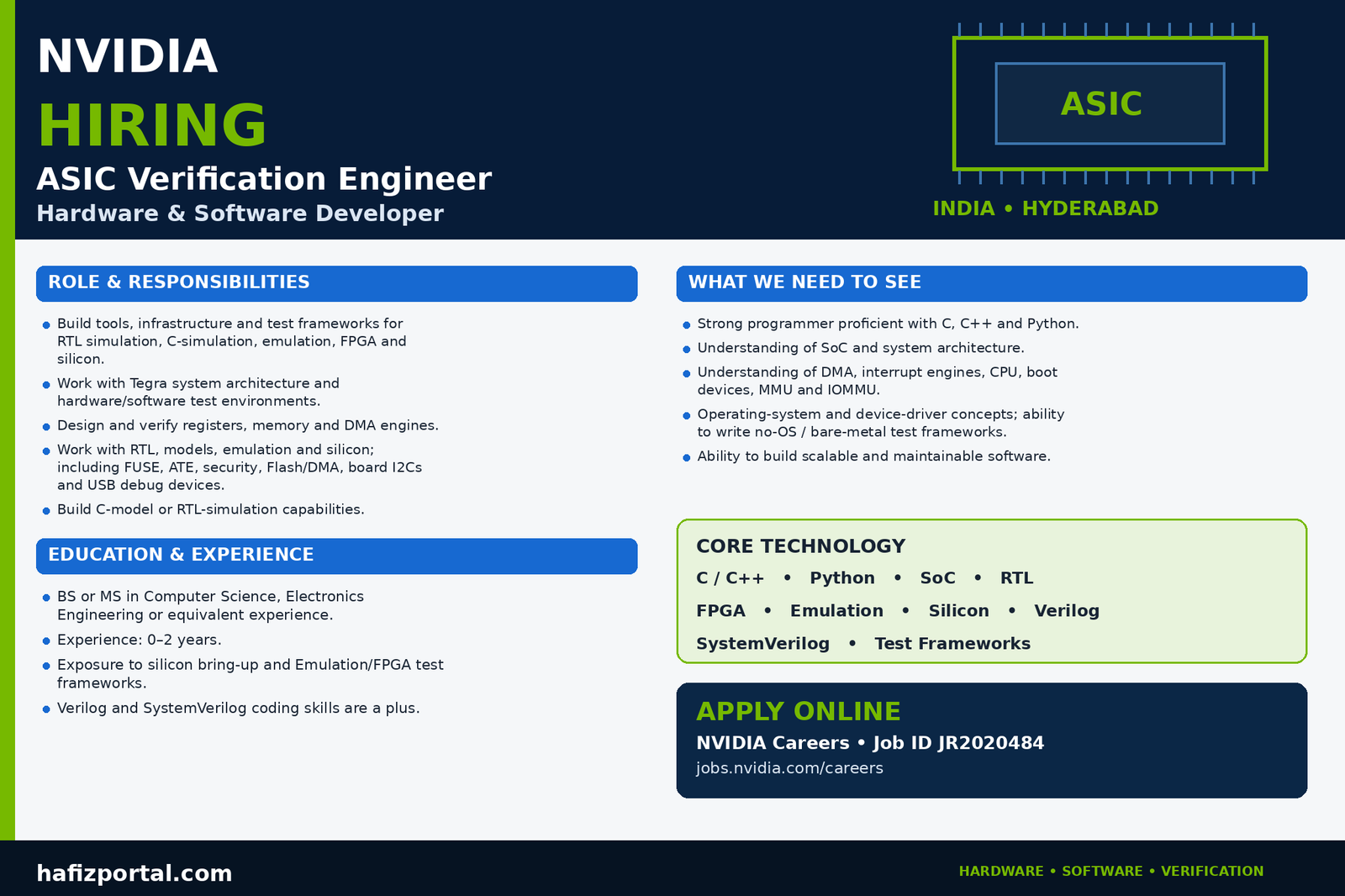
The supplied vacancy graphic also mentions Computer Science, Electronics Engineering, Computer Engineering, Electrical Engineering, Software Engineering or equivalent experience.
Relevant educational backgrounds may therefore include areas such as:
- Computer Science
- Computer Engineering
- Electronics Engineering
- Electrical Engineering
- Software Engineering
- Related technical disciplines
Candidates should always check the live NVIDIA listing before applying because qualification requirements can change.
Experience Requirement
The vacancy is suitable for candidates with 0–2 years of experience. This makes it relevant to fresh graduates and early-career engineers who have developed a strong foundation in programming, computer architecture or hardware/software development.
However, experience is not the only factor. The technical requirements indicate that candidates should have a strong understanding of programming and system architecture.
Skills Required for NVIDIA ASIC Verification Engineer
Programming Skills
Strong programming ability is an important requirement.
Candidates should be proficient in:
- C
- C++
- Python
NVIDIA specifically lists these programming languages in the official job description. (NVIDIA Careers)
SoC and System Architecture
Candidates should understand SoC and system architecture.
This includes understanding how different components communicate and how processors, memory systems and peripheral devices interact.
Hardware Components
The role requires an understanding of how SoC devices such as the following operate:
- DMA
- Interrupt engines
- CPUs
- Boot devices
- MMU
- IOMMU
A basic understanding of these components can help candidates work effectively on hardware and software test frameworks. (NVIDIA Careers)
Operating Systems and Device Drivers
Knowledge of operating-system and device-driver concepts is also important.
The role specifically involves creating no-OS test frameworks, meaning tests that can run directly on bare-metal SoC environments. (NVIDIA Careers)
Software Development
NVIDIA also expects candidates to understand hardware and software development life cycles.
The company highlights the importance of building software that is scalable and maintainable. (NVIDIA Careers)
Additional Skills That Can Strengthen Your Profile
NVIDIA lists several areas that can help candidates stand out.
Silicon Bring-Up Experience
Previous experience working with silicon bring-up can be valuable for this position.
Students and fresh graduates can demonstrate relevant exposure through academic projects, internships, laboratory work or personal projects involving embedded hardware.
Emulation and FPGA
Experience with Emulation and FPGA-related test frameworks is another useful area.
Projects involving FPGA development, hardware simulation or embedded systems can help candidates demonstrate practical understanding.
C++ Testbenches
Exposure to C++ testbench architectures can also be useful.
Testbenches are important because they allow engineers to systematically verify whether hardware behaves according to its specifications.
SystemVerilog and Verilog
NVIDIA lists Verilog and SystemVerilog coding skills as a plus. (NVIDIA Careers)
Candidates interested in ASIC verification can therefore benefit from learning digital design concepts and hardware-description languages alongside traditional programming.
Who Can Apply?
This opportunity can be relevant to early-career candidates who have:
- A BS or MS in a relevant technical field
- 0–2 years of experience
- Strong C, C++ or Python programming ability
- Understanding of SoC and system architecture
- Knowledge of operating systems and device drivers
- Interest in ASIC verification and hardware/software development
- Understanding of computer architecture
- Interest in simulation, emulation and silicon validation
The official NVIDIA listing does not describe the position simply as a conventional software-development role. It combines software development with hardware architecture, verification and validation. (NVIDIA Careers)
Why This Role Can Be Relevant for Fresh Graduates
The 0–2-year experience requirement makes this position particularly relevant to candidates at the beginning of their engineering careers.
A candidate who has completed projects involving C/C++, Python, embedded systems, FPGA, computer architecture or hardware verification may be able to demonstrate skills related to the position.
For example, a graduate could strengthen their profile through projects involving:
- CPU or SoC simulation
- FPGA-based systems
- C/C++ embedded programming
- Python automation
- Verilog or SystemVerilog
- Device-driver concepts
- Bare-metal programming
- Hardware test frameworks
- Computer architecture
Practical projects can help candidates explain how their academic knowledge applies to real engineering problems.
How to Apply for NVIDIA ASIC Verification Engineer Jobs 2026
Interested candidates should apply through the official NVIDIA careers platform.
Step 1: Visit NVIDIA Careers
Go to the official NVIDIA careers website and search for ASIC Verification Engineer.
Step 2: Find Requisition JR2020484
The official vacancy is listed under Job Requisition ID JR2020484. (NVIDIA Careers)
Step 3: Review the Requirements
Before applying, carefully review the current job description, location, qualification requirements and other application information.
Step 4: Prepare Your Resume
Your resume should clearly highlight relevant technical skills such as:
- C
- C++
- Python
- SoC architecture
- Computer architecture
- FPGA
- Verilog
- SystemVerilog
- Embedded systems
- Hardware verification
- Simulation
- Emulation
Only include skills that you genuinely understand or have experience using.
Step 5: Submit Your Application
Use the official NVIDIA application system to submit your application.
Apply Online:
NVIDIA ASIC Verification Engineer – Official Job Listing
The vacancy graphic supplied with this article also shows a NVIDIA careers application URL. Candidates should prefer the official NVIDIA careers platform and verify that the position is still active before submitting an application.
Important Note About Job Availability
Job listings can be updated, closed or modified without notice. The official NVIDIA page currently identifies this ASIC Verification Engineer role as JR2020484 and lists Hyderabad and Bengaluru. (NVIDIA Careers)
Therefore, candidates should check the official listing immediately before applying for the latest location, experience requirements and application status.
Conclusion
The NVIDIA ASIC Verification Engineer Jobs 2026 opportunity in Hyderabad is aimed at early-career engineers interested in the combination of hardware and software development.
The role involves developing tools and test frameworks for RTL simulation, C simulation, emulation, FPGA and silicon environments. It also covers SoC architecture, bare-metal testing, silicon bring-up and CPU, GPU and SoC test frameworks. (NVIDIA Careers)
Candidates with a BS or MS in Computer Science, Electronics Engineering or a related discipline and 0–2 years of experience can review the opportunity. Strong knowledge of C, C++ and Python, together with an understanding of SoC architecture, operating systems, device drivers and hardware/software development, is important for the position. (NVIDIA Careers)
Additional exposure to silicon bring-up, FPGA, emulation, C++ testbenches, SystemVerilog or Verilog can further support a candidate’s profile.
For the most accurate and current information, candidates should use the official NVIDIA job listing before applying.
Frequently Asked Questions
What is the NVIDIA ASIC Verification Engineer experience requirement?
The official listing specifies 0–2 years of experience for the ASIC Verification Engineer role. (NVIDIA Careers)
Where is the NVIDIA ASIC Verification Engineer position located?
The official listing identifies Hyderabad and Bengaluru, India as locations. (NVIDIA Careers)
What qualification is required?
NVIDIA lists a BS or MS in Computer Science or Electronics Engineering or equivalent experience. (NVIDIA Careers)
Which programming languages are required?
The vacancy specifically mentions C, C++ and Python. (NVIDIA Careers)
Is Verilog required?
Verilog and SystemVerilog coding skills are listed as a plus, rather than the primary programming requirement. (NVIDIA Careers)
What is the NVIDIA job requisition ID?
The official listing identifies the position as JR2020484. (NVIDIA Careers)