HSC Science PCB After 12th: Courses, Career Options & Jobs
Completing HSC Science with PCB (Physics, Chemistry and Biology) opens the door to a wide range of courses and career opportunities. Many students immediately think of MBBS after studying PCB, but medicine is only one of many possible career paths.
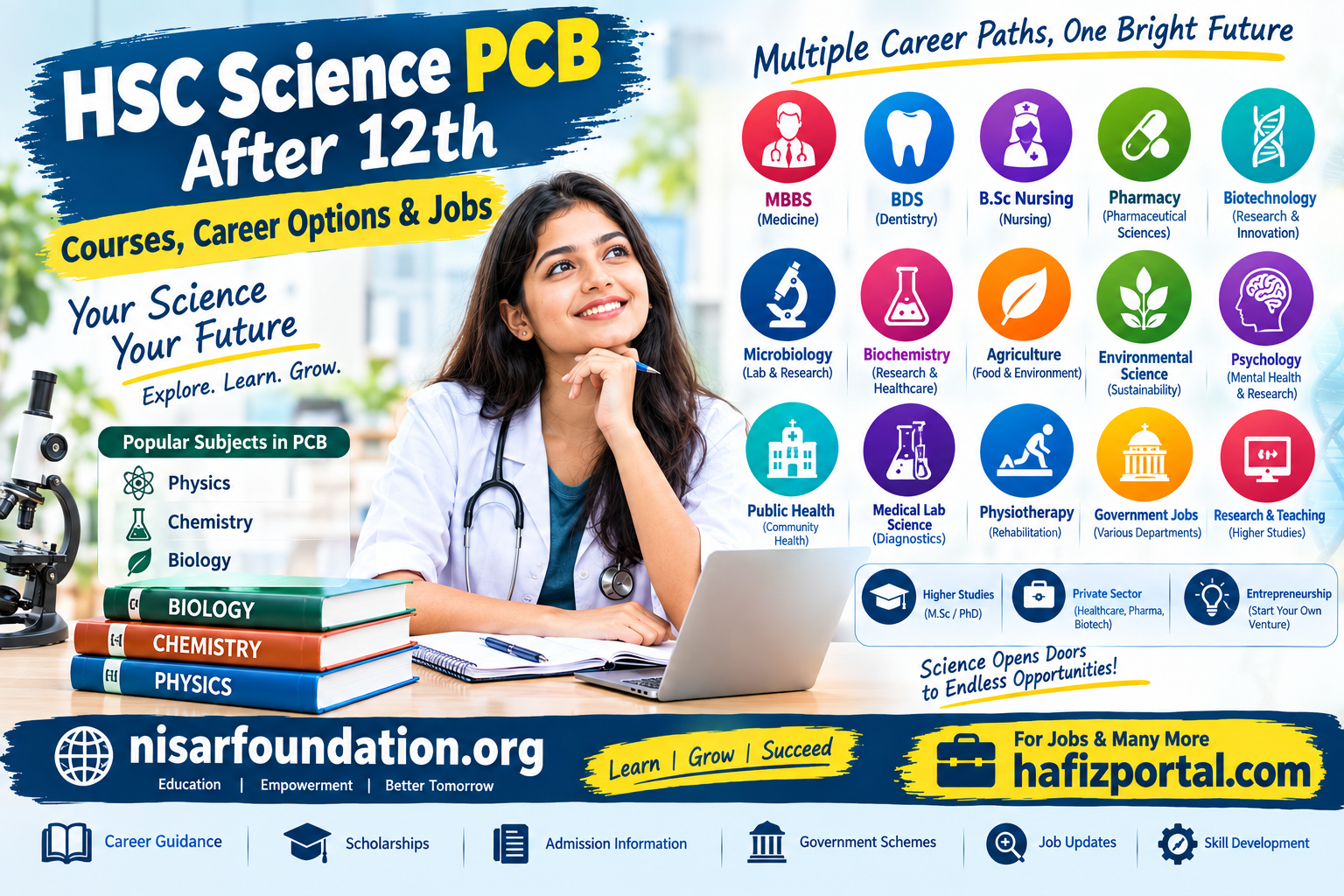
PCB students can explore healthcare, dentistry, nursing, pharmacy, biotechnology, microbiology, biochemistry, life sciences, physiotherapy, agriculture, food science, environmental science, psychology, research, teaching, government jobs, public health, laboratory careers and several other fields.
The best career after HSC PCB depends on your interests, academic performance, entrance-examination requirements, financial situation and long-term goals. A student who enjoys patient care may prefer medicine or nursing, while someone interested in laboratory work may prefer biotechnology, microbiology or medical laboratory science. Students who enjoy research can explore life sciences, biotechnology and postgraduate research.
This guide explains the best courses after HSC Science PCB, medical and non-medical options, entrance examinations, career opportunities, government jobs, scholarships, skill development and career planning.
What Is PCB in HSC Science?
PCB stands for:
- P – Physics
- C – Chemistry
- B – Biology
Students who choose PCB generally develop a foundation in physical science, chemical science and biological science.
This combination is particularly useful for students interested in healthcare, medicine, biological sciences and research.
However, having PCB does not mean that every student must become a doctor.
There are many alternative career paths. Students should therefore explore several options before deciding on a course.
Best Courses After HSC Science PCB
The following are some of the major courses that PCB students can consider after 12th.
Popular options include:
- MBBS
- BDS
- BAMS
- BHMS
- BUMS
- BSMS
- B.Sc Nursing
- Pharmacy
- Physiotherapy
- Biotechnology
- Microbiology
- Biochemistry
- Medical Laboratory Science
- Life Sciences
- Nutrition and Dietetics
- Food Science
- Agriculture
- Environmental Science
- Psychology
- Public Health
- Forensic Science
- Veterinary-related education
- Paramedical courses
- Allied healthcare programs
- Research-oriented science programs
Eligibility differs between courses and institutions, so students should always check the latest admission notification before applying.
1. MBBS After HSC PCB
Bachelor of Medicine and Bachelor of Surgery (MBBS) is one of the most popular choices for PCB students.
Students who dream of becoming doctors can consider MBBS after completing HSC Science with PCB and meeting the applicable eligibility requirements.
Admission to undergraduate medical education in India is linked to NEET (UG). The National Testing Agency states that NEET (UG) is the common and uniform entrance examination for undergraduate medical education in medical institutions. It is also applicable to BAMS, BUMS and BSMS under the Indian System of Medicine framework and to BHMS under the relevant law.
Students should check the current NEET information bulletin and counselling rules before applying.
Career Opportunities After MBBS
After completing the required medical education and registration requirements, doctors can work in areas such as:
- Hospitals
- Clinics
- Government healthcare
- Private healthcare
- Community health
- Medical research
- Public health
- Healthcare administration
- Medical education
Students can also pursue postgraduate medical education according to their interests.
Is MBBS Right for You?
MBBS requires dedication, patience and a strong interest in healthcare.
Students should consider the course length, academic workload, clinical training and financial requirements before choosing medicine.
2. BDS After HSC PCB
Bachelor of Dental Surgery (BDS) is another important healthcare option.
BDS is suitable for students interested in:
- Oral healthcare
- Dentistry
- Dental surgery
- Preventive dental care
- Oral health education
- Clinical practice
Dental professionals can work in hospitals, dental clinics, public health programs, academic institutions and private practice, subject to applicable professional registration requirements.
Students should check the current admission and entrance requirements before applying.
3. BAMS After HSC PCB
Bachelor of Ayurvedic Medicine and Surgery (BAMS) is an undergraduate healthcare pathway focused on Ayurveda.
Students interested in traditional Indian systems of medicine may consider BAMS.
Career areas can include:
- Ayurvedic healthcare
- Clinics
- Hospitals
- Wellness
- Research
- Teaching
- Public health
NEET (UG) is applicable for admission to undergraduate BAMS programs under the applicable national framework.
Students should verify the latest eligibility, counselling and college-recognition requirements.
4. BHMS After HSC PCB
Bachelor of Homoeopathic Medicine and Surgery (BHMS) is another healthcare pathway.
Students interested in homoeopathy can explore this course after PCB.
Possible career areas include:
- Homoeopathic clinics
- Hospitals
- Healthcare services
- Teaching
- Research
- Community healthcare
NEET (UG) is also applicable to BHMS admissions under the relevant national framework.
Students should confirm the latest admission rules before selecting a college.
5. BUMS and BSMS
Students interested in Indian systems of medicine can also explore:
- BUMS – Bachelor of Unani Medicine and Surgery
- BSMS – Bachelor of Siddha Medicine and Surgery
These programs are suitable for students who want to study specific traditional systems of medicine.
Admission requirements, counselling procedures and recognised institutions should be checked through the appropriate official authorities.
6. B.Sc Nursing After HSC PCB
B.Sc Nursing is an excellent option for students interested in healthcare and patient care but who may not want to pursue MBBS.
Nursing professionals play an important role in:
- Hospitals
- Clinics
- Community health
- Public health
- Emergency care
- Patient support
- Healthcare education
Nursing can provide opportunities in both public and private healthcare organisations.
Students should check the eligibility and admission requirements of the nursing institution and relevant regulatory authority.
Some nursing admissions may use entrance examinations or merit-based processes, depending on the institution and program.
7. Pharmacy After HSC PCB
Students interested in medicines, pharmaceutical science and healthcare products can explore pharmacy.
Popular options may include:
- B.Pharm
- D.Pharm
- Pharmaceutical sciences
- Related healthcare programs
Career Areas in Pharmacy
Pharmacy-related careers can include:
- Community pharmacy
- Hospital pharmacy
- Pharmaceutical companies
- Quality control
- Manufacturing
- Research
- Sales and marketing
- Regulatory functions
Students should check the latest eligibility and approval status of the institution before admission.
8. Physiotherapy
Students interested in rehabilitation, movement, physical health and patient recovery can explore physiotherapy-related undergraduate programs.
Physiotherapy professionals may work with patients recovering from:
- Injuries
- Surgery
- Musculoskeletal conditions
- Physical disabilities
- Sports injuries
- Movement-related problems
Career opportunities can exist in hospitals, rehabilitation centres, sports organisations, clinics and other healthcare settings.
Students should check the exact degree name, duration and professional requirements of the institution before admission.
9. Biotechnology After HSC PCB
Biotechnology combines biology with technology and laboratory science.
It can be an attractive option for students who enjoy:
- Biology
- Laboratory work
- Genetics
- Microorganisms
- Molecular biology
- Scientific research
Possible career areas include:
- Biotechnology companies
- Research laboratories
- Pharmaceutical companies
- Food technology
- Agriculture
- Environmental science
- Quality control
- Research institutions
Higher education can be particularly important for students who want advanced research careers.
10. Microbiology
Microbiology focuses on microorganisms such as bacteria, fungi and other microscopic life forms.
Students interested in laboratory science can consider microbiology-related undergraduate programs.
Possible areas include:
- Medical laboratories
- Food industries
- Pharmaceutical companies
- Biotechnology
- Research
- Quality control
- Environmental science
Students can later pursue postgraduate education and research depending on their career goals.
11. Biochemistry
Biochemistry studies the chemical processes that occur within living organisms.
It connects biology and chemistry and can be useful for students interested in:
- Laboratory research
- Molecular science
- Healthcare research
- Biotechnology
- Pharmaceuticals
- Food science
A strong foundation in chemistry and biology can help students understand the subject.
12. Medical Laboratory Science
Students interested in diagnostic laboratory work can explore medical laboratory-related programs.
Laboratory professionals may work with:
- Blood samples
- Urine samples
- Tissue samples
- Microbiology
- Biochemistry
- Pathology-related testing
- Diagnostic procedures
These professionals support doctors and healthcare teams by providing laboratory information.
Students should verify the exact course title, recognition and professional requirements before admission because programs can differ between institutions.
13. Life Sciences
Life Sciences is a broad academic field covering living organisms and biological processes.
Students may explore areas such as:
- Zoology
- Botany
- Genetics
- Ecology
- Molecular biology
- Cell biology
- Evolution
- Environmental biology
A life-sciences degree can be particularly useful for students considering research or postgraduate education.
14. Psychology After HSC PCB
PCB students can also explore psychology where the institution’s eligibility requirements permit.
Psychology may be suitable for students interested in:
- Human behaviour
- Learning
- Communication
- Research
- Education
- Counselling-related fields
- Organisational behaviour
Students should understand that some professional psychology roles require specific postgraduate qualifications, supervised training or other professional requirements.
Therefore, students should distinguish between studying psychology as an academic subject and entering a regulated professional role.
15. Nutrition and Dietetics
Students interested in food, nutrition and health can explore nutrition and dietetics-related courses.
Possible career areas include:
- Hospitals
- Wellness centres
- Sports organisations
- Food companies
- Public health
- Community nutrition
- Health education
Students should check the professional requirements associated with any title or regulated role they intend to pursue.
16. Agriculture After HSC PCB
Agriculture is another possible pathway for students interested in biology, plants, food production and rural development.
Possible areas include:
- Agriculture
- Horticulture
- Plant science
- Agricultural research
- Food production
- Agricultural technology
- Rural development
Agriculture can offer opportunities in both government and private sectors.
Students interested in agricultural education should check the current admission rules of agricultural universities and institutions.
17. Environmental Science
Students concerned about climate, biodiversity, pollution, conservation and sustainability can explore environmental science.
Possible areas include:
- Environmental monitoring
- Conservation
- Sustainability
- Water management
- Waste management
- Environmental research
- Wildlife-related studies
- Environmental consulting
This field can be particularly suitable for students who enjoy biology and are interested in environmental problems.
18. Forensic Science
Forensic science combines scientific knowledge with investigation.
Students can explore areas such as:
- Forensic biology
- DNA-related science
- Toxicology
- Forensic chemistry
- Crime-scene science
- Laboratory analysis
Career opportunities may exist in forensic laboratories, research institutions and related organisations, depending on qualifications and recruitment requirements.
19. Public Health
Students interested in community-level healthcare can explore public-health education.
Public health focuses on improving health at the population level through areas such as:
- Disease prevention
- Health education
- Community health
- Epidemiology
- Health programs
- Healthcare management
Advanced study may open additional opportunities in research, policy and public-health organisations.
20. Research Career After HSC PCB
If you enjoy asking scientific questions and working in laboratories, research can become a long-term career.
A typical research-oriented pathway may involve:
HSC PCB → Bachelor’s Degree → Master’s Degree → Research/Doctoral Study
Students can specialise in:
- Biotechnology
- Microbiology
- Biochemistry
- Genetics
- Molecular biology
- Zoology
- Botany
- Environmental science
- Pharmaceutical science
- Biomedical science
Research careers often require postgraduate education and practical laboratory experience.
Government Jobs After HSC PCB
PCB students can also explore government employment.
Depending on the specific recruitment notification, opportunities may exist in:
- Healthcare
- Laboratories
- Public health
- Agriculture
- Environmental departments
- Defence
- Police
- Railways
- Administrative services
- Technical and support roles
Some government jobs are available after Class 12, while many professional and officer-level positions require graduation or specialised qualifications.
Students should never rely on social-media posts alone for recruitment information.
Always verify:
- Official notification
- Eligibility
- Age limit
- Qualification
- Application dates
- Examination pattern
- Application fee
- Selection process
The National Career Service (NCS) is a Government of India platform that provides employment and career-related services and can be useful for students and jobseekers.
Competitive Exams for PCB Students
Depending on their career goals, PCB students may prepare for different examinations.
Examples can include:
- NEET (UG)
- University entrance examinations
- CUET-UG
- State-level admission examinations
- Government recruitment examinations
- Defence recruitment examinations
- Other institution-specific entrance tests
The important point is that not every course uses the same entrance examination.
Before preparing for an examination, students should check the official notification and syllabus.
NEET After HSC PCB
NEET is particularly important for students interested in undergraduate medical education.
The official NEET (UG) information states that NEET is the common and uniform entrance examination for undergraduate medical education in India. The official framework also applies NEET to undergraduate BAMS, BUMS and BSMS programs and to BHMS, subject to the applicable laws and rules.
Therefore, students planning medical or certain Indian-system medicine pathways should carefully monitor the official NEET website.
Do not rely on coaching advertisements for final eligibility information.
CUET-UG for PCB Students
Some PCB students may want to pursue undergraduate degrees in universities participating in CUET-UG.
Depending on the university and course, students may explore programs in areas such as:
- Biological sciences
- Life sciences
- Biotechnology
- Environmental science
- Psychology
- General science
- Other undergraduate disciplines
Eligibility and subject combinations can differ between universities.
Students should therefore check the course-specific requirements before selecting subjects for the entrance examination.
Scholarships for PCB Students
The cost of higher education can be a major concern for students and families.
Students should regularly check the National Scholarship Portal (NSP) and other official scholarship sources.
The National Scholarship Portal currently provides information for the 2026–27 academic year, including merit-based and welfare-based scholarship schemes. The portal also states that One Time Registration (OTR) is required for scholarship applications under the current system.
Scholarship eligibility can depend on factors such as:
- Academic performance
- Family income
- Category
- Course
- Institution
- State
- Specific scheme conditions
Students should read the complete eligibility conditions before applying.
Never pay an unofficial agent simply because they promise a scholarship.
Skills PCB Students Should Develop
Academic marks are important, but practical skills can also strengthen a student’s career profile.
PCB students can develop:
Communication Skills
Good communication is useful in healthcare, research, teaching and almost every professional field.
Computer Skills
Students should learn:
- MS Office
- Excel
- Internet research
- Presentation software
- Basic data handling
English Language Skills
Strong English communication can help students in higher education, interviews, research and professional communication.
Laboratory Skills
Students interested in science careers should develop safe and accurate laboratory practices.
Research Skills
Learn how to:
- Find reliable information
- Read scientific material
- Record observations
- Analyse information
- Present findings
Time Management
Medical and science-related courses can be academically demanding. Good time management is therefore extremely valuable.
How to Choose the Right PCB Course After 12th
Do not choose a course only because your friends are choosing it.
Use this simple process.
Step 1: Identify Your Interest
Ask yourself:
- Do I want to treat patients?
- Do I enjoy laboratory work?
- Do I like biology research?
- Am I interested in medicines?
- Do I enjoy working with people?
- Do I want a government career?
- Do I want to become a researcher?
Your answers can help narrow your options.
Step 2: Check Eligibility
Check the exact requirements of the university or professional authority.
Do not assume that studying PCB automatically makes you eligible for every science or healthcare course.
Step 3: Understand Entrance Exams
Find out whether the course requires:
- NEET
- CUET-UG
- State entrance examination
- University entrance test
- Merit-based admission
Step 4: Compare Colleges
Compare:
- Recognition
- Accreditation where applicable
- Course structure
- Fees
- Faculty
- Laboratory facilities
- Clinical exposure
- Internship opportunities
- Location
- Hostel facilities
Step 5: Calculate Total Cost
Do not look only at tuition fees.
Also consider:
- Books
- Travel
- Hostel
- Equipment
- Examination fees
- Coaching
- Living expenses
Step 6: Think About the Future
Ask yourself where the course can take you after graduation.
Research:
- Job roles
- Higher education
- Entrance exams
- Professional registration
- Industry opportunities
- Government jobs
PCB Students Should Not Fear Alternative Careers
Many students feel that they have failed if they do not become doctors.
This is not true.
Healthcare and science need professionals in many different areas.
Hospitals need nurses, pharmacists, laboratory professionals, physiotherapists, administrators and public-health workers.
Research institutions need scientists and laboratory professionals.
Pharmaceutical companies need professionals in research, quality control, manufacturing and other functions.
Agriculture needs scientific knowledge.
Environmental organisations need biological and environmental expertise.
Therefore, MBBS is one career option, not the only successful career option after HSC PCB.
Career Roadmap for HSC PCB Students
A simple roadmap can make career planning easier.
After Class 12
Identify your interests and shortlist suitable courses.
During Entrance Preparation
Prepare according to the official syllabus and examination pattern.
During Graduation
Focus on academics and develop practical skills.
During the Course
Look for:
- Internships
- Projects
- Workshops
- Research exposure
- Volunteering
- Practical training
After Graduation
Decide whether you want:
- Employment
- Postgraduate study
- Research
- Government service
- Entrepreneurship
- Professional specialisation
Career Options Based on Your Interest
If You Want to Treat Patients
Consider:
- MBBS
- BDS
- BAMS
- BHMS
- BUMS
- BSMS
- Nursing
If You Like Medicines
Consider:
- Pharmacy
- Pharmaceutical sciences
- Pharmacology-related higher studies
If You Like Laboratory Work
Consider:
- Microbiology
- Biotechnology
- Biochemistry
- Medical laboratory science
- Life sciences
If You Like Research
Consider:
- Biotechnology
- Genetics
- Molecular biology
- Biochemistry
- Life sciences
- Environmental science
If You Like Community Healthcare
Consider:
- Nursing
- Public health
- Nutrition
- Community-health programs
- Social and health sciences
If You Like Nature and Environment
Consider:
- Environmental science
- Botany
- Zoology
- Agriculture
- Ecology
Common Mistakes PCB Students Should Avoid
Choosing a Course Under Pressure
Do not select a career simply because relatives or friends recommend it.
Ignoring Eligibility
Always check the official eligibility criteria.
Depending Only on Coaching Institutes
Coaching material can be useful, but official notifications should be your primary source for examination rules.
Ignoring Alternative Careers
Medicine is not the only PCB career.
Selecting a College Without Research
Check recognition, fees, facilities, admission rules and course structure.
Ignoring Practical Skills
Build communication, computer, laboratory and research skills alongside academic study.
Believing Guaranteed Job Claims
No genuine course can guarantee a specific salary or government job without considering eligibility, recruitment and performance.
Frequently Asked Questions About HSC Science PCB After 12th
What are the best courses after HSC Science PCB?
Popular choices include MBBS, BDS, BAMS, BHMS, BUMS, BSMS, B.Sc Nursing, Pharmacy, Physiotherapy, Biotechnology, Microbiology, Biochemistry, Life Sciences, Medical Laboratory Science, Agriculture, Environmental Science, Nutrition and other healthcare or science programs.
Is MBBS the only option after PCB?
No. PCB students have many alternatives, including dentistry, nursing, pharmacy, physiotherapy, biotechnology, microbiology, biochemistry, life sciences, agriculture, environmental science, public health and research.
Is NEET required for MBBS?
Yes. NEET (UG) is the common national entrance examination for undergraduate medical education in India.
Is NEET required for BDS?
Admission requirements should be checked against the current national and institutional rules. Students should always refer to the latest official admission notification.
Can PCB students do B.Pharm?
Students who meet the applicable eligibility requirements can explore B.Pharm and related pharmacy programs.
Can PCB students study biotechnology?
Yes. Biotechnology is a major alternative for students interested in biology, laboratory science and research.
Can PCB students get government jobs?
Yes. Eligibility depends on the specific government recruitment. Some opportunities are available after 12th, while others require graduation or specialised qualifications.
Can PCB students pursue research?
Yes. Research is an important long-term career option. Students can study biotechnology, microbiology, biochemistry, life sciences and related subjects before progressing to postgraduate and research programs.
Can PCB students study psychology?
Yes, where the institution’s eligibility rules permit. Students interested in professional psychology should also understand the additional qualifications and requirements that may apply to specific professional roles.
Which is better: MBBS or B.Sc?
Neither is automatically better. MBBS may suit students who want a medical career, while B.Sc can be better for students interested in science, research, laboratory work, teaching or specialised postgraduate study.
Can PCB students study abroad?
Yes. Students can explore international universities for medicine, life sciences, biotechnology, nursing, pharmacy and other programs. However, admission requirements, entrance examinations, licensing rules, language requirements and costs vary by country.
Official Resources for HSC PCB Students
Students should use official websites when checking admissions, examinations, scholarships and government opportunities.
NEET (UG)
The official NTA NEET website provides the current examination information, notices, syllabus and information bulletin.
CUET-UG
The official NTA CUET-UG portal provides information about undergraduate entrance admissions for participating universities.
National Scholarship Portal
The National Scholarship Portal provides information about scholarship schemes and application procedures.
National Career Service
The National Career Service provides employment and career-related services, including job search and career guidance.
Students should always verify dates, eligibility, fees and admission rules from the relevant official website because information can change.
Final Conclusion
HSC Science PCB after 12th offers far more opportunities than many students realise.
MBBS may be the most visible option, but it is only one pathway. Students can also build careers in dentistry, nursing, pharmacy, physiotherapy, biotechnology, microbiology, biochemistry, medical laboratory science, life sciences, agriculture, nutrition, environmental science, public health, research and other areas.
The right career depends on your interests, strengths and goals.
If you enjoy patient care, healthcare programs may suit you.
If you enjoy laboratory work, biotechnology, microbiology or medical laboratory science may be worth exploring.
If you enjoy research, life sciences and advanced scientific study may be a better direction.
If you are interested in nature, agriculture or environmental science can provide meaningful opportunities.
If you want government employment, you can plan your graduation and competitive-examination preparation together.
The most important thing is to make an informed decision.
Do not select a course simply because it is popular. Check eligibility, entrance requirements, fees, recognition, career opportunities and future study options before applying.
Build practical skills alongside your qualification. Improve communication, computer knowledge, research ability, time management and professional skills.
Most importantly, remember that PCB is a starting point, not a limitation.
Your HSC stream does not decide your entire future. Your choices, education, skills, experience, discipline and continuous learning will shape your career.
Explore your options, verify information from official sources, choose carefully