ITI, Diploma & Other Courses After 12th: Best Courses, Career Options & Jobs in India
ITI, Diploma & Other Courses After 12th: Complete Career Guide
Below is a publication-ready, SEO-focused article for HafizPortal. I have structured it around search intent, featured-snippet opportunities, short paragraphs, FAQs, internal-link opportunities, and practical career guidance. Official sources confirm that DGT currently operates ITI vocational training through the Craftsmen Training Scheme and that Skill India Digital provides access to skills, certification, jobs and apprenticeships.


Completing Class 12 is an important turning point for students. While many students choose traditional degree programmes, others want to develop practical skills and enter the workforce sooner. For such students, ITI, diploma, vocational, technical and skill-based courses after 12th can provide valuable career pathways.
Students do not have to follow only one route after 12th. Depending on their stream, interests and eligibility, they can consider ITI trades, polytechnic diplomas, computer courses, healthcare programmes, design courses, hospitality, aviation-related training, technical certifications, apprenticeships and other vocational programmes.
The best choice depends on several factors:
- Your 12th stream
- Academic performance
- Interest in practical work
- Career objective
- Course duration
- Fees
- Recognition and affiliation
- Job opportunities
- Possibility of higher education
- Local employment opportunities
- Apprenticeship opportunities
The most important point is to choose a recognised course from a genuine institution rather than selecting a course only because it promises a quick job.
What Are ITI and Diploma Courses?
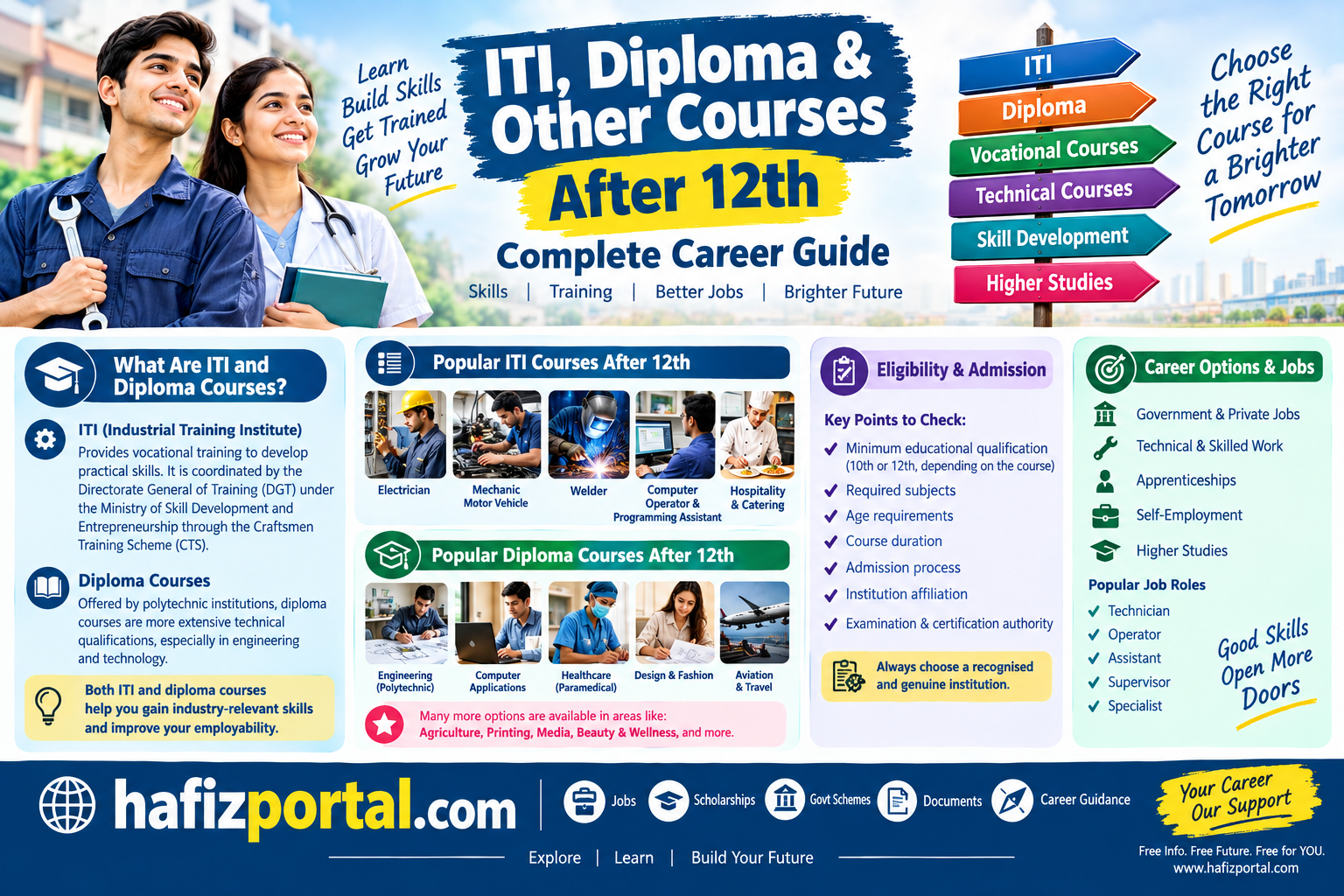
ITI stands for Industrial Training Institute. ITIs provide vocational training designed to develop practical occupational skills.
The Directorate General of Training (DGT), under the Ministry of Skill Development and Entrepreneurship, coordinates the Craftsmen Training Scheme (CTS) at the national level. ITI training is available through government and private institutions, with programmes covering different sectors.
A diploma, on the other hand, is generally a more extensive technical or vocational qualification. Polytechnic institutions offer diploma programmes in areas such as engineering and technology.
The two routes are different, although both can help students develop employment-oriented skills.
Can Students Do ITI After 12th?
Yes. Many ITI trades have eligibility requirements that allow candidates who have completed Class 10 or 12 to apply, depending on the specific trade.
However, eligibility varies from trade to trade.
Students should check:
- Minimum educational qualification
- Required subjects
- Age requirements
- Course duration
- Admission process
- Institution affiliation
- Examination and certification authority
DGT’s Skill India Digital platform provides access to ITI-related information, certification and other skilling services.
Skill India Digital – Official Government Platform
Best ITI Courses After 12th
The right ITI trade depends on your interests and career plans. Some popular areas include:
1. Electrician
Electrician is one of the most recognised technical trades.
Students learn areas related to:
- Electrical wiring
- Electrical safety
- Motors
- Basic electrical systems
- Maintenance
- Domestic and industrial electrical work
- Testing equipment
Career Options
After appropriate training and experience, candidates can explore work as:
- Electrician
- Maintenance Technician
- Electrical Assistant
- Service Technician
- Electrical Maintenance Worker
Experienced workers may also become self-employed and provide electrical installation and repair services.
2. Fitter
Fitter is another important industrial trade.
Training can include:
- Workshop practices
- Measurement
- Machine components
- Assembly
- Maintenance
- Tools
- Basic mechanical operations
Potential employment areas include:
- Manufacturing companies
- Engineering workshops
- Production units
- Maintenance departments
- Industrial plants
Fitter skills can also provide a foundation for further technical education.
3. Welder
Welding is used across construction, manufacturing, engineering and fabrication industries.
Students can learn different welding techniques, safety procedures and workshop practices.
Career opportunities may exist in:
- Fabrication units
- Manufacturing companies
- Construction
- Automobile workshops
- Industrial maintenance
- Engineering companies
Welding can also become a self-employment opportunity after gaining sufficient technical experience and equipment.
4. Mechanic Motor Vehicle
Students interested in automobiles can explore motor vehicle-related vocational training.
The field covers areas such as:
- Vehicle servicing
- Engine systems
- Automobile components
- Maintenance
- Diagnostics
- Workshop safety
Career opportunities can include:
- Automobile Technician
- Service Technician
- Garage Technician
- Workshop Assistant
- Vehicle Maintenance Technician
The automotive industry is also changing rapidly because of electric vehicles and electronic vehicle systems. Therefore, students should consider learning modern diagnostic and EV-related skills.
5. Refrigeration and Air Conditioning
Refrigeration and air-conditioning technicians are required in residential, commercial and industrial environments.
Training may cover:
- Refrigeration systems
- Air-conditioning systems
- Installation
- Maintenance
- Troubleshooting
- Electrical components
- Safety
This field can offer both employment and self-employment opportunities.
6. COPA and Computer-Related ITI Training
Students interested in computers can explore computer-related vocational training.
Possible learning areas include:
- Computer operation
- Office applications
- Internet usage
- Basic programming
- Data handling
- Digital services
- Computer-related workplace skills
Students interested in technology should consider adding modern skills such as:
- Web development
- Python
- Digital marketing
- Graphic design
- Cybersecurity fundamentals
- Data analysis
A vocational qualification combined with practical digital skills can improve career flexibility.
7. Draughtsman and CAD-Related Skills
Students interested in construction, mechanical design and technical drawing can consider relevant trades and then develop CAD skills.
CAD stands for Computer-Aided Design.
Possible applications include:
- Civil drawings
- Mechanical drawings
- Electrical drawings
- Architectural drawings
- Manufacturing designs
Students can explore software such as AutoCAD and other industry-specific design tools depending on their career direction.
8. Electronics-Related Trades
Electronics is another useful technical area.
Students can explore training related to:
- Electronics equipment
- Circuit systems
- Testing
- Repair
- Maintenance
- Electronic devices
With additional education and experience, candidates can move toward electronics servicing, industrial maintenance and related technical roles.
What Is a Diploma Course?
A diploma is generally a structured programme that provides specialised education and practical training.
For students interested in technical careers, polytechnic diploma courses can be an important option.
Popular diploma branches include:
- Diploma in Civil Engineering
- Diploma in Mechanical Engineering
- Diploma in Electrical Engineering
- Diploma in Computer Engineering
- Diploma in Information Technology
- Diploma in Electronics Engineering
- Diploma in Automobile Engineering
- Diploma in Mechatronics
- Diploma in Chemical Engineering
- Diploma in Instrumentation
- Diploma in Architecture-related fields
Eligibility depends on the institution and programme.
Diploma in Civil Engineering
Civil engineering is suitable for students interested in:
- Buildings
- Roads
- Bridges
- Construction
- Surveying
- Infrastructure
- Structural work
Students can develop skills in:
- Surveying
- Construction materials
- Estimation
- Technical drawing
- Site supervision
- Computer-aided design
Potential career roles include:
- Junior Technician
- Site Supervisor
- CAD Technician
- Survey Assistant
- Construction Supervisor
With further education, students can pursue higher technical qualifications.
Diploma in Mechanical Engineering
Mechanical engineering is suitable for students who enjoy machines and manufacturing.
Students may study:
- Engineering mechanics
- Manufacturing
- Machine design
- Workshop technology
- Production
- Automobile systems
- Maintenance
Career opportunities can exist in manufacturing, automotive, engineering and industrial companies.
Diploma in Electrical Engineering
Students interested in electricity and electrical systems can consider this pathway.
Possible career areas include:
- Electrical maintenance
- Power systems
- Industrial electrical work
- Building electrical systems
- Manufacturing
- Renewable energy
Additional skills in solar energy, electrical automation and industrial control can improve career options.
Diploma in Computer Engineering and IT
Students interested in computers can consider:
- Computer Engineering
- Information Technology
- Software-related diplomas
- Networking
- Cybersecurity
- Web development
Career possibilities may include:
- IT Support Technician
- Junior Developer
- Network Technician
- Computer Hardware Technician
- Technical Support Executive
- Web Developer
Students should build projects rather than relying only on classroom certificates.
ITI vs Diploma: Which Is Better?
There is no universal answer.
| Feature | ITI | Diploma |
|---|---|---|
| Main Focus | Practical vocational skills | Technical education |
| Typical Environment | Workshop and skill training | Classroom + laboratory |
| Career Direction | Skilled trades | Technical roles |
| Duration | Depends on trade | Depends on programme |
| Higher Education | Possible through eligible pathways | Strong pathway to further technical study |
| Best For | Students seeking practical trade skills | Students seeking broader technical education |
ITI is not inferior to a diploma. They serve different purposes.
A student who enjoys hands-on work may find ITI more suitable, while someone who wants a broader technical education may prefer a diploma.
Apprenticeship After ITI or Diploma
Apprenticeships are an important part of skill development.
An apprenticeship allows a learner to gain practical experience in a workplace.
DGT operates the Apprenticeship Training Scheme (ATS) as one of its major vocational-training programmes.
Students should explore the official apprenticeship system and check available opportunities.
Practical workplace exposure can help students understand:
- Workplace discipline
- Tools and equipment
- Safety procedures
- Production processes
- Teamwork
- Professional communication
- Industry expectations
An apprenticeship should not be viewed simply as a certificate. The practical experience can be extremely valuable when searching for employment later.
Advanced Vocational Diploma Opportunities
Students who want a deeper vocational pathway can also explore advanced vocational programmes.
DGT currently describes an Advanced Vocational Diploma programme that combines classroom modules with industry-based on-the-job training. The programme described by DGT is two years, with the second year including substantial industry training.
This illustrates an important career principle:
Practical training + technical knowledge + industry exposure can create a stronger employment profile.
Students should verify current eligibility, courses and admission information directly through official DGT sources.
Computer Courses After 12th
Students who do not want a traditional engineering course can consider computer and digital skills.
Depending on the institution and recognition, options may include:
- Computer Applications
- Web Development
- Graphic Design
- Digital Marketing
- Data Entry
- Computer Hardware
- Networking
- Programming
- CAD
- Animation
- Multimedia
- Office Administration
However, students should carefully check the credibility and recognition of private training providers before paying fees.
A certificate is useful only when the student also develops real skills.
Digital Marketing After 12th
Digital marketing is suitable for students interested in:
- Social media
- Websites
- Content
- Search engines
- Online advertising
- Business promotion
Students can learn:
- SEO
- Social media marketing
- Content marketing
- Email marketing
- Analytics
- Website management
- Online advertising
Possible career roles include:
- Digital Marketing Executive
- SEO Executive
- Social Media Executive
- Content Executive
- Website Assistant
Students can also use these skills to support their own business.
Graphic Design and Multimedia
Creative students can explore:
- Graphic design
- Video editing
- Animation
- 3D design
- Motion graphics
- UI design
- Multimedia
A portfolio is particularly important in creative careers.
Instead of collecting many certificates, students should create:
- Posters
- Social media designs
- Websites
- Videos
- Logos
- Animations
- Brand concepts
A strong portfolio can demonstrate practical ability to employers and clients.
Healthcare and Paramedical Courses
Students interested in healthcare can explore eligible vocational and paramedical programmes.
Depending on the programme and institution, options may include:
- Medical Laboratory Technology
- General Duty Assistant
- Emergency care-related training
- Healthcare assistant programmes
- Pharmacy-related programmes where eligible
- Nursing-related programmes where eligibility permits
- Radiology and imaging-related programmes where recognised
Healthcare education requires particular attention to recognition, affiliation, clinical training and legal eligibility.
Before admission, verify whether the qualification is accepted for the job or registration you intend to pursue.
Hospitality and Hotel Management Courses
Students who enjoy working with people may consider:
- Hotel Management
- Hospitality
- Food Production
- Bakery
- Catering
- Front Office
- Housekeeping
- Food and Beverage Service
- Culinary Arts
Potential career areas include:
- Hotels
- Restaurants
- Catering companies
- Resorts
- Event businesses
- Food-service companies
- Travel and hospitality organisations
Communication skills and professional behaviour are particularly important in hospitality.
Beauty, Wellness and Fashion Courses
Students interested in entrepreneurship can explore:
- Beauty and wellness
- Hair styling
- Cosmetology
- Makeup
- Fashion design
- Tailoring
- Mehndi
- Boutique management
These courses can potentially lead to both employment and self-employment.
A student can begin with basic training and gradually develop a customer base.
Other Skill-Based Courses After 12th
Students can also investigate:
Technical Courses
- Solar Technician
- Electrical Automation
- CNC-related skills
- Welding
- Refrigeration
- Automobile servicing
- Industrial maintenance
Digital Courses
- Web development
- Coding
- Graphic design
- Video editing
- Digital marketing
- Computer hardware
- Networking
Service Sector
- Hospitality
- Retail
- Tourism
- Beauty and wellness
- Healthcare support
Creative Fields
- Fashion design
- Photography
- Animation
- Multimedia
- Interior-related skills
- UI/UX design
Best Courses After 12th for Quick Skill Development
Students who want a relatively short and practical learning pathway can investigate:
- ITI trades
- Computer applications
- Digital marketing
- Graphic design
- Web development
- Hardware and networking
- Electrician training
- Refrigeration and AC
- Automobile servicing
- Welding and fabrication
- Healthcare assistant programmes
- Hospitality skills
The word “quick” should not be confused with “easy.”
A short course does not automatically guarantee a job.
Employment depends on:
- Skill level
- Practical experience
- Employer demand
- Location
- Communication
- Interview performance
- Industry exposure
Jobs After ITI and Diploma Courses
After completing an appropriate recognised qualification, students can explore roles such as:
Technical Jobs
- Technician
- Maintenance Assistant
- Electrical Technician
- Mechanical Technician
- Automobile Technician
- HVAC Technician
- Production Technician
- Machine Operator
Computer Jobs
- IT Support Executive
- Computer Operator
- Hardware Technician
- Network Support Technician
- Junior Web Developer
- Data Entry Operator
Construction Jobs
- CAD Operator
- Survey Assistant
- Site Assistant
- Junior Technician
- Construction Supervisor
Service Jobs
- Hospitality Executive
- Customer Service Executive
- Retail Associate
- Healthcare Support Worker
- Beauty Professional
The actual job title and salary depend on the qualification, employer, location, experience and skill level.
Government Jobs After ITI and Diploma
ITI and diploma holders may find opportunities in various government and public-sector recruitment processes when their qualification matches the vacancy requirements.
Potential areas can include:
- Railways
- Electricity departments
- Public works
- Defence establishments
- Government workshops
- Municipal services
- Public-sector organisations
- Technical departments
But candidates must check every recruitment notification carefully.
Do not assume that every ITI or diploma qualification is accepted for every technical government post.
Check:
- Trade
- Qualification
- Experience
- Age
- Technical requirements
- Recognition
- Examination
- Physical standards where applicable
Use official recruitment websites whenever possible.
Self-Employment After ITI or Diploma
One of the biggest advantages of practical skills is the possibility of self-employment.
For example:
Electrician
Start a local electrical service business.
Automobile
Open a repair or servicing workshop after gaining appropriate experience and meeting applicable requirements.
Welding
Start a fabrication service.
Refrigeration and AC
Provide installation and repair services.
Computer
Offer computer repair, networking or digital services.
Graphic Design
Work with businesses on branding and marketing material.
Digital Marketing
Provide online marketing services to local businesses.
This route requires more than technical skills. Students should learn:
- Customer service
- Pricing
- Accounting
- Marketing
- Digital payments
- Business communication
- Basic legal and compliance requirements
How to Choose the Right ITI or Diploma Course
Use this simple checklist before taking admission.
1. Identify Your Interest
Ask:
Do I enjoy machines, computers, construction, healthcare, design or working with people?
2. Check Eligibility
Do not rely only on advertisements.
Verify the official eligibility requirements.
3. Check Recognition
Find out who recognises or affiliates the institution and qualification.
For ITI-related programmes, verify the relevant DGT/Skill India information.
4. Compare Fees
Look at the complete cost rather than only the admission fee.
5. Visit the Institute
If possible, inspect:
- Workshops
- Laboratories
- Equipment
- Classrooms
- Faculty
- Practical training
6. Ask About Industry Exposure
Find out whether students receive:
- Practical training
- Apprenticeship opportunities
- Internship support
- Placement assistance
7. Check Higher-Education Options
Ask whether the qualification can support further study.
8. Avoid Unrealistic Job Guarantees
Be cautious about advertisements claiming:
- Guaranteed government job
- Guaranteed high salary
- Guaranteed foreign job
- Guaranteed placement without conditions
Always verify such claims.
ITI, Diploma or Degree: Which Path Should You Choose?
Choose ITI if:
- You prefer hands-on work.
- You want trade-specific training.
- You are interested in skilled technical occupations.
- You want to develop practical skills.
Choose Diploma if:
- You want broader technical education.
- You are interested in engineering technology.
- You may want further technical education.
- You enjoy mathematics and technical subjects.
Choose Degree if:
- You want graduate-level education.
- Your preferred profession requires a degree.
- You are comfortable with longer academic study.
Choose Skill Courses if:
- You want to develop a specific skill.
- You want to complement another qualification.
- You want to explore freelancing or entrepreneurship.
There is no single path that is best for everyone.
Career Roadmap After 12th
Here is a simple roadmap students can follow:
Step 1: Complete Class 12.
Step 2: Identify your interests.
Step 3: Decide whether you prefer academic, technical or practical education.
Step 4: Shortlist three to five courses.
Step 5: Check eligibility and recognition.
Step 6: Compare institutions and fees.
Step 7: Check internships, apprenticeships and placement support.
Step 8: Develop communication and digital skills.
Step 9: Gain practical experience.
Step 10: Build a professional resume.
Step 11: Apply for apprenticeships, internships and jobs.
Step 12: Continue learning even after getting your first job.
Skills That Can Increase Employability
Regardless of the course, students should work on these skills.
Technical Skills
Learn the tools used in your chosen occupation.
Communication
Improve:
- English
- Local-language communication
- Professional writing
- Telephone etiquette
- Interview skills
Digital Literacy
Understand:
- Online applications
- Documents
- Spreadsheets
- Digital payments
- Online professional platforms
Workplace Skills
Develop:
- Punctuality
- Teamwork
- Problem-solving
- Safety awareness
- Discipline
- Customer service
Entrepreneurship
If you want to become self-employed, learn:
- Cost calculation
- Marketing
- Customer management
- Bookkeeping
- Online promotion
Frequently Asked Questions
Can I do ITI after 12th?
Yes. Many ITI trades accept students with qualifications including Class 10 or 12, depending on the trade. Always check the current eligibility for the specific course.
Is ITI better than a diploma?
Neither is automatically better. ITI is strongly focused on vocational trade skills, while a diploma generally provides broader technical education.
Can I get a government job after ITI?
Eligible ITI candidates can apply for government vacancies where their specific trade and qualification are accepted. Recruitment conditions vary by vacancy.
Can diploma students get government jobs?
Yes, where the recruitment notification accepts the relevant diploma qualification. Candidates must verify the exact branch, recognition and other conditions.
Can ITI students continue higher education?
Yes, eligible students can explore further education pathways depending on their trade, qualification and applicable admission rules.
Can I get an apprenticeship after ITI?
Apprenticeship is an important vocational pathway, and DGT operates the Apprenticeship Training Scheme. Candidates should check the current official apprenticeship opportunities and eligibility.
Which ITI course is best for a job?
There is no single best trade. Electrician, fitter, welding, automobile, refrigeration and air-conditioning, electronics and computer-related trades can be useful, but employment depends on location, skill, experience and industry demand.
Which course is best for self-employment?
Trades such as electrician, automobile servicing, welding, refrigeration and AC, beauty and wellness, computer services and digital marketing can provide self-employment possibilities when combined with practical experience and business skills.
Can girls join ITI and diploma courses?
Yes. Women can pursue suitable technical, vocational and professional programmes. The best choice should be based on interest, eligibility and career objectives rather than gender stereotypes.
Are private ITIs valid?
Students should verify the institute’s current affiliation, recognition and certification status before admission. Do not assume that every private training centre offers an officially recognised qualification.
Official Resources for Students
Directorate General of Training
The DGT website provides information about vocational training programmes, including advanced vocational programmes and CITS courses.
Directorate General of Training – Government of India
Skill India Digital
Students can use the Skill India Digital platform to explore skilling-related services, certification, jobs and apprenticeship-related opportunities.
Skill India Digital – Official Platform
DGT ITI Affiliation Information
The DGT affiliation portal provides information related to ITI affiliation and the vocational-training system.
Recommended Internal Links for HafizPortal
For better SEO and user navigation, connect this article with relevant HafizPortal pages:
- HSC Science PCM After 12th: Courses, Career Options & Jobs
- HSC Science PCB After 12th: Courses, Career Options & Jobs
- HSC Arts After 12th: Courses, Career Options & Jobs
- HSC Commerce After 12th: Courses, Career Options & Jobs
- Career Guidance After 10th and 12th
- Government Jobs in India
- Private Jobs in India
- Scholarships for Students
- Government Schemes for Students
- Free Courses and Skill Development
- Diploma Courses After 10th
- ITI Courses and Admission Guide
Use descriptive anchor text rather than repeatedly using generic phrases such as “click here.”
Final Advice: Choose Skills, Not Just Certificates
After 12th, students often feel pressure to select a course immediately. However, a good career decision requires research.
An ITI trade can be a strong choice for a student who enjoys practical work. A diploma can be suitable for someone interested in technical education. A short vocational course can help someone develop a specific skill. A degree can be better for professions that require graduate-level education.
The most important thing is to combine qualification + practical skill + experience + communication + continuous learning.
Today’s employers increasingly value candidates who can actually perform tasks rather than candidates who only possess certificates.
Therefore, before taking admission, ask yourself:
What do I want to learn?
What kind of work do I want to do?
Where can this qualification take me?
Is the institute recognised?
What practical training will I receive?
Can I continue my education later?
What jobs or self-employment opportunities can this skill create?
A thoughtful answer to these questions can help you avoid an expensive wrong decision.