HSC Commerce After 12th: Courses, Career Options & Jobs
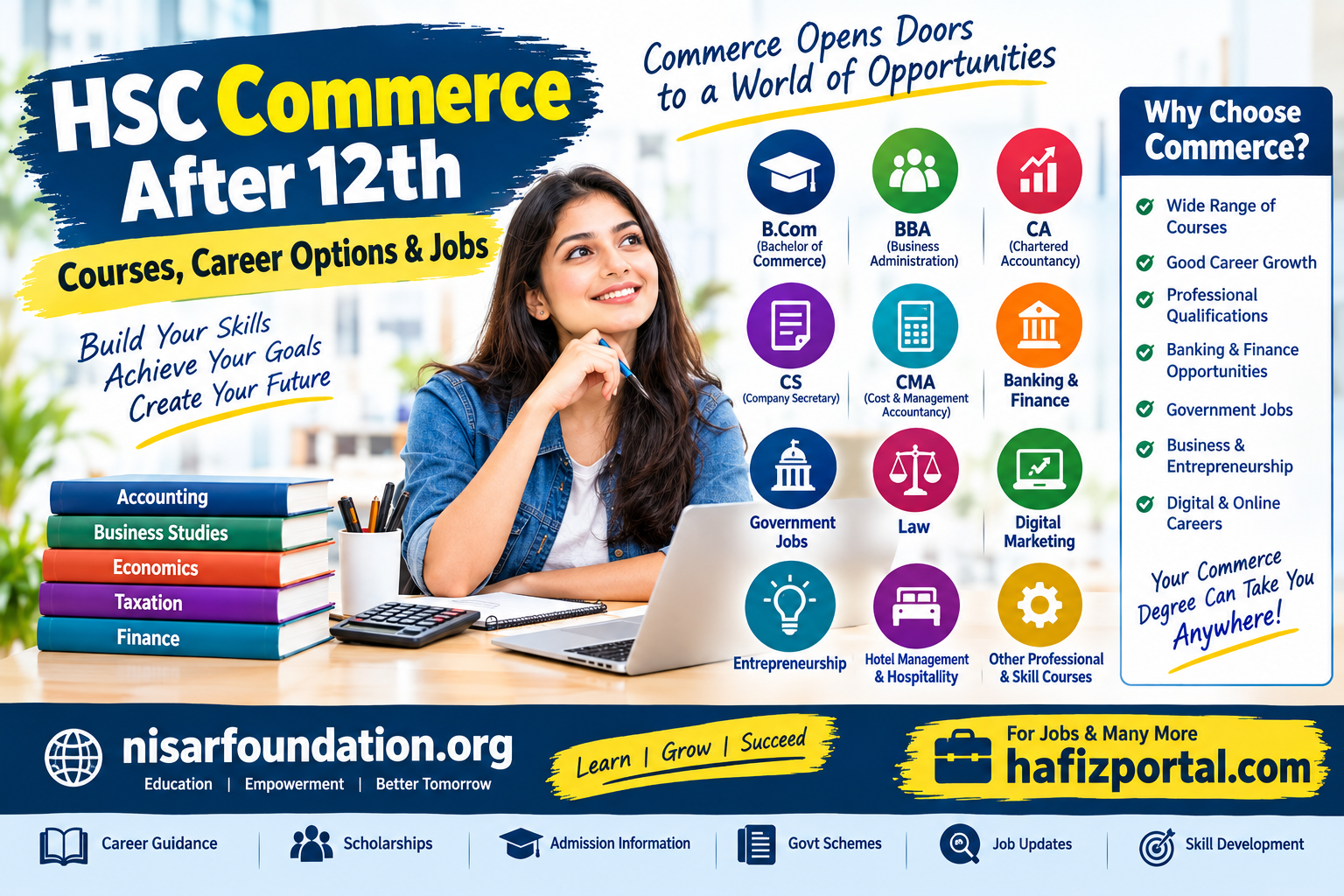
Completing HSC Commerce after 12th opens the door to a wide range of higher-education, professional, business, finance, accounting, banking, government, and career opportunities. Commerce students are not limited to only B.Com. Depending on their interests and eligibility, they can explore professional courses such as Chartered Accountancy (CA), Company Secretary (CS), Cost and Management Accountancy (CMA), management, banking, finance, taxation, economics, computer applications, law, digital marketing, entrepreneurship, and several skill-based programs.
Choosing the right course after HSC Commerce is an important decision. Students should consider their interests, academic strengths, career goals, budget, course duration, admission requirements, entrance examinations, and employment opportunities before making a final decision.
This detailed guide explains the best courses after HSC Commerce, career options, professional courses, government jobs, banking opportunities, business careers, skill-development options, scholarships, and career-planning strategies.
What Can You Do After HSC Commerce?
After completing HSC Commerce, students have several academic and career pathways. The most suitable option depends on individual interests and long-term goals.
Popular choices include:
- Bachelor of Commerce (B.Com)
- Bachelor of Business Administration (BBA)
- Bachelor of Management Studies (BMS)
- Chartered Accountancy (CA)
- Company Secretary (CS)
- Cost and Management Accountancy (CMA)
- Bachelor of Economics
- Bachelor of Computer Applications (BCA)
- Banking and finance courses
- Financial management
- Taxation and accounting
- Law
- Digital marketing
- Hotel and hospitality management
- Entrepreneurship
- Government-job preparation
- Professional skill courses
There is no single “best course” for every Commerce student. The right course is the one that matches your abilities, interests, financial situation, and career plans.
1. B.Com After HSC Commerce
Bachelor of Commerce (B.Com) is one of the most popular degree choices after HSC Commerce.
B.Com provides students with a foundation in areas such as:
- Accounting
- Business studies
- Economics
- Financial management
- Taxation
- Auditing
- Business law
- Banking
- Cost accounting
- Corporate finance
Depending on the college and university, students may also find specialised B.Com programs in areas such as accounting and finance, banking and insurance, financial markets, taxation, or business management.
Career Options After B.Com
After B.Com, students can explore careers in:
- Accounting
- Banking
- Finance
- Taxation
- Auditing
- Business administration
- Insurance
- Corporate offices
- Financial services
- Government departments
- Education
- Entrepreneurship
Students can also pursue postgraduate education or professional qualifications after graduation.
B.Com can therefore be a flexible option for students who want to keep several career pathways open.
2. Chartered Accountancy (CA)
Chartered Accountancy is one of India’s most recognised professional career pathways in accounting, taxation, auditing, finance, and corporate reporting.
The CA pathway is suitable for students who enjoy:
- Accounting
- Taxation
- Financial analysis
- Auditing
- Business law
- Corporate finance
Students can register with the Institute of Chartered Accountants of India and follow the current CA education and examination requirements.
ICAI’s official information states that students can provisionally register for the Foundation Course after Class 10, while eligibility for the Foundation Examination requires appearing in the Class 12 examination or an equivalent recognised examination. Students should always check ICAI’s latest rules before registration.
Career Areas After CA
A qualified CA can work in areas such as:
- Audit
- Taxation
- Financial reporting
- Corporate finance
- Risk management
- Consulting
- Accounting
- Investment analysis
- Internal audit
- Business advisory
CA can also provide a strong foundation for entrepreneurship and professional consultancy, subject to applicable professional rules.
3. Company Secretary (CS)
Students interested in corporate law, compliance, governance, company administration, and legal regulations can consider the Company Secretary course.
The course is conducted by the Institute of Company Secretaries of India.
The current ICSI CSEET structure was restructured from the June 2026 session. ICSI’s current information states that students who have passed or are appearing in Class 12 can enter the CS pathway through the CSEET route, subject to the applicable rules.
Career Opportunities in Company Secretary
CS professionals can work in areas related to:
- Corporate compliance
- Company law
- Corporate governance
- Secretarial compliance
- Legal documentation
- Regulatory filings
- Board procedures
- Corporate administration
Students interested in business law and corporate management may find CS particularly relevant.
4. Cost and Management Accountancy (CMA)
Another professional option after HSC Commerce is Cost and Management Accountancy (CMA).
The course is conducted by the Institute of Cost Accountants of India.
CMA focuses strongly on:
- Cost accounting
- Cost management
- Financial management
- Business strategy
- Management accounting
- Budgeting
- Performance analysis
ICMAI’s current eligibility information states that students who have passed Class 10 can seek admission to the Foundation Course, while students must meet the prescribed requirements to appear in the Foundation examination and progress to Intermediate.
Career Options After CMA
CMA-related career opportunities can include:
- Management accounting
- Cost accounting
- Financial planning
- Budgeting
- Cost control
- Business analysis
- Corporate finance
- Management reporting
Students who enjoy numbers and business decision-making may consider CMA.
5. BBA After HSC Commerce
Bachelor of Business Administration (BBA) is a popular choice for students interested in management and business.
BBA may cover subjects such as:
- Business management
- Marketing
- Human resources
- Finance
- Entrepreneurship
- Business communication
- Operations
- Business strategy
BBA can be useful for students who want to enter corporate careers or eventually pursue an MBA.
Career Opportunities After BBA
BBA graduates can explore roles in:
- Sales
- Marketing
- Human resources
- Operations
- Customer relations
- Business development
- Administration
- Digital marketing
- Financial services
- Entrepreneurship
Eligibility varies by university. For example, current CUET-UG university information includes BBA programs where 10+2 in any discipline is accepted, subject to the particular university’s conditions.
6. BMS and Management Courses
Students interested in business and management can also explore Bachelor of Management Studies (BMS) and similar undergraduate management programs.
These programs can develop knowledge in:
- Management
- Marketing
- Finance
- Human resources
- Entrepreneurship
- Business communication
- Organisational behaviour
Before applying, students should check whether the selected college requires an entrance test, merit-based admission, or a centralised admission process.
7. Economics After HSC Commerce
Students who enjoy economics, mathematics, statistics, research, and financial analysis can consider economics-related degree programs.
Possible areas include:
- Economics
- Applied economics
- Business economics
- Financial economics
- Economic research
- Data-related economic analysis
An economics degree can be followed by postgraduate education and specialised training.
Students should carefully check subject requirements because some economics programs may have specific mathematics or entrance-test requirements.
8. BCA and Computer-Related Careers
Commerce students who are interested in technology can explore Bachelor of Computer Applications (BCA) or other computer-related programs where eligibility permits.
Possible areas include:
- Software applications
- Web development
- Data management
- IT support
- Digital services
- Business technology
- E-commerce
- Database management
However, BCA eligibility varies considerably between institutions. Some universities require Mathematics or a specific subject combination.
For example, current CUET-UG university information shows BCA programs with Mathematics requirements at some institutions. Students must check the exact eligibility conditions of the university and course they want to apply for.
9. Banking and Finance Careers
Commerce is naturally connected with the banking and financial-services sector.
Students can build careers in:
- Banking
- Insurance
- Financial services
- Accounting
- Investment services
- Loan processing
- Customer service
- Financial operations
- Risk-related functions
A degree such as B.Com or BBA can be combined with banking-examination preparation and practical computer skills.
Useful skills include:
- Numerical ability
- Reasoning
- English communication
- Computer knowledge
- General awareness
- Financial awareness
- Customer communication
Students should always check the latest recruitment notification for exact educational and age requirements.
10. Government Jobs After HSC Commerce
Government employment is another important career pathway for Commerce students.
Depending on the recruitment notification, 12th-pass candidates may find opportunities in areas such as:
- Clerical positions
- Administrative support
- Railway recruitment
- Defence recruitment
- Police recruitment
- State government departments
- Staff-support positions
- Other public-sector vacancies
Many competitive government examinations, however, require graduation.
Therefore, students who want a long-term government career can consider completing a suitable bachelor’s degree while preparing for relevant examinations.
The National Career Service (NCS) is an official Government of India platform that provides job-search services, career counselling, internships, skill courses, and career-related information.
National Career Service – Government of India
11. Competitive Examinations
Commerce students can prepare for various competitive examinations depending on their qualifications.
Potential areas include:
- Banking examinations
- SSC examinations
- Railway recruitment
- State government examinations
- Public-sector recruitment
- Civil services
- Insurance recruitment
Students should understand the difference between examinations available after Class 12 and examinations that require graduation.
A good strategy is to complete graduation while gradually developing:
- General knowledge
- Reasoning
- Quantitative aptitude
- English
- Computer skills
- Current affairs
This approach can create multiple career opportunities instead of depending on only one examination.
12. Law After HSC Commerce
Commerce students can also explore law.
Students interested in business law can consider integrated law programs such as BBA LLB or B.Com LLB, where available and subject to institutional eligibility.
Law combined with Commerce can be particularly relevant to students interested in:
- Corporate law
- Taxation
- Business regulations
- Contracts
- Compliance
- Corporate governance
- Legal administration
Students should verify the latest admission rules and entrance requirements from the relevant university or law-admission authority.
13. Digital Marketing After HSC Commerce
Digital marketing has become an important skill for businesses of all sizes.
Commerce students can develop skills in:
- Search engine optimisation
- Social media marketing
- Content marketing
- Email marketing
- Online advertising
- Website management
- E-commerce
- Analytics
- Copywriting
Digital marketing can be used as an additional skill alongside B.Com, BBA, CA preparation, entrepreneurship, or another career pathway.
Students can also use these skills for internships, freelancing, business promotion, and employment.
14. Entrepreneurship and Business
Commerce students often have a natural academic connection with business, accounting, economics, and management.
Students who want to start a business can learn:
- Business planning
- Accounting
- Budgeting
- Marketing
- Customer management
- Digital promotion
- E-commerce
- Tax basics
- Inventory management
- Business communication
A student does not necessarily need to wait until completing a degree to learn entrepreneurship. Small practical projects can provide valuable experience.
However, business decisions involving taxation, legal compliance, licences, or regulated activities should be taken after consulting the relevant official authority or qualified professional.
15. Accounting and Tally-Based Careers
Students who enjoy accounting can develop practical software skills alongside their degree.
Useful skills include:
- Tally or accounting software
- MS Excel
- Advanced Excel
- GST-related accounting knowledge
- Bookkeeping
- Payroll basics
- Invoicing
- Financial reporting
These skills can be useful for entry-level accounting and office positions.
Students should remember that software training is most valuable when combined with strong fundamentals in accounting and business.
16. Hotel Management and Hospitality
Commerce students interested in customer service, travel, hospitality, food services, and business operations can explore hotel management and hospitality courses.
Career areas may include:
- Hotels
- Restaurants
- Travel companies
- Event management
- Front office
- Guest relations
- Hospitality operations
- Sales
- Customer service
Good communication skills and professional behaviour are particularly important in this sector.
17. Short-Term and Job-Oriented Courses
Students who want to develop employment-oriented skills can consider short-term courses.
Examples include:
- Advanced Excel
- Accounting software
- Digital marketing
- Graphic design
- Web development
- Data analysis
- Spoken English
- Communication skills
- Office administration
- E-commerce
- Video editing
- Social media management
A short course should ideally provide practical learning and a clear connection to a career or business opportunity.
Do not select a course only because it promises a certificate or guaranteed employment. Research the training provider, curriculum, practical exposure, fees, and actual career outcomes.
How to Choose the Best Course After HSC Commerce
There is no universal answer to the question, “Which is the best course after HSC Commerce?”
Use the following checklist before making your decision.
1. Identify Your Interests
Ask yourself what you enjoy most:
- Accounting?
- Business?
- Law?
- Technology?
- Marketing?
- Banking?
- Economics?
- Entrepreneurship?
Your interest can help you stay motivated during a longer course.
2. Understand Your Strengths
Consider your strengths in:
- Mathematics
- Accounting
- Communication
- Analysis
- Computer skills
- Leadership
- Creativity
- Public speaking
3. Check Eligibility
Do not assume that every Commerce student is eligible for every course.
Check:
- Required subjects
- Minimum marks
- Entrance examinations
- Age requirements
- University-specific rules
CUET-UG information, for example, shows that eligibility can vary by university and program, and students are advised to confirm the conditions of the specific university.
4. Compare Course Costs
Calculate the total cost, including:
- Tuition fees
- Examination fees
- Books
- Travel
- Hostel
- Coaching
- Computer or software expenses
Do not select a course solely because it is expensive or inexpensive.
5. Check Career Opportunities
Research what students typically do after completing the course.
Look at:
- Job roles
- Further-study options
- Industry demand
- Required skills
- Internship opportunities
- Professional certifications
Scholarships for Commerce Students
Financial support can make higher education more accessible.
Students should regularly check the National Scholarship Portal (NSP) for scholarships for which they may be eligible.
The NSP currently lists schemes for the 2026–27 academic year, and its portal includes merit-based and welfare-based scholarship schemes. Students should check individual scheme eligibility and deadlines before applying.
National Scholarship Portal – Government of India
Students should never pay an unofficial person or website for a scholarship application without verifying the information through the official portal.
Entrance Exams and University Admissions
Many universities use entrance examinations or centralised admission processes.
CUET-UG is one important entrance route used by participating universities for undergraduate admissions.
The official CUET portal lists participating universities across central, state, deemed, private, and other government institutions.
However, not every college or course uses CUET. Students should check the admission process of the exact university and program they want.
Skills Commerce Students Should Develop
A degree is important, but practical skills can make your profile stronger.
Commerce students should consider developing:
- Advanced Excel
- Accounting software
- Financial literacy
- Business communication
- English communication
- Presentation skills
- Computer literacy
- Data analysis
- Digital marketing
- Public speaking
- Resume writing
- Interview skills
- Problem-solving
- Time management
Students should try to gain practical experience through internships, projects, volunteering, part-time work, or entrepreneurship where appropriate.
Career Roadmap After HSC Commerce
A simple career roadmap can help students avoid confusion.
Step 1: Complete HSC Commerce
Understand your marks, subjects, strengths, and interests.
Step 2: Select a Career Direction
Choose two or three possible fields rather than immediately focusing on one option.
Step 3: Research Courses
Compare duration, fees, eligibility, admission process, and career outcomes.
Step 4: Apply to Suitable Courses
Keep multiple suitable options instead of depending on only one college.
Step 5: Develop Practical Skills
Learn Excel, accounting software, communication, digital skills, or another career-relevant skill.
Step 6: Gain Experience
Look for internships, projects, volunteering, competitions, or practical work.
Step 7: Build Your Professional Profile
Create a strong CV and maintain evidence of your projects and achievements.
Step 8: Continue Learning
The job market changes continuously. Keep upgrading your skills.
HSC Commerce Is More Than Accounting
One of the biggest misconceptions is that Commerce students have only accounting-related career options.
In reality, Commerce can lead to:
- Accounting
- Finance
- Banking
- Management
- Business
- Law
- Economics
- Corporate services
- Digital marketing
- Technology
- Government jobs
- Entrepreneurship
- Hospitality
- Professional qualifications
Your Class 12 stream is only the beginning of your career journey.
Frequently Asked Questions About HSC Commerce After 12th
Which is the best course after HSC Commerce?
There is no single best course. B.Com, BBA, BMS, CA, CS, CMA, economics, law, BCA, banking, finance, and other courses can be suitable depending on the student’s interests and career goals.
Can Commerce students do CA after 12th?
Yes. Commerce students can pursue the CA pathway through the applicable ICAI route. Students should check the latest Foundation registration and examination requirements directly with ICAI.
Can Commerce students become Company Secretaries?
Yes. Eligible students can pursue the Company Secretary course through the applicable ICSI pathway. ICSI’s current CSEET structure applies from the June 2026 session onward.
Can Commerce students pursue CMA?
Yes. Commerce students can pursue CMA and should check the latest eligibility and admission requirements published by ICMAI.
Can Commerce students apply for government jobs?
Yes, provided they meet the eligibility requirements of the particular recruitment notification. Some positions accept 12th-pass candidates, while many graduate-level opportunities require a bachelor’s degree.
Can Commerce students study law?
Yes. Eligible Commerce students can explore integrated law programs and other law pathways according to university and admission requirements.
Can Commerce students do BCA?
In some institutions, yes. However, BCA eligibility differs between universities. Some programs require Mathematics or specific subjects, so students should check the exact course requirements.
Is B.Com a good course after HSC Commerce?
B.Com can be a strong and flexible choice for students interested in accounting, finance, banking, taxation, business, and further professional studies.
Can Commerce students start a business?
Yes. Commerce knowledge can be useful for understanding accounting, budgeting, marketing, business operations, and finance. Students should also learn practical business and compliance skills.
Final Conclusion
HSC Commerce after 12th offers a wide range of academic and career opportunities. Students can choose B.Com, BBA, BMS, CA, CS, CMA, economics, law, BCA, banking, finance, digital marketing, entrepreneurship, hospitality, government-job preparation, or skill-based courses.
The most important thing is to avoid choosing a course only because friends are choosing it or because someone calls it the “best” course.
Instead, understand your interests, strengths, eligibility, budget, career goals, and future opportunities.
A strong career is built through a combination of education + practical skills + experience + continuous learning.
If you are an HSC Commerce student, remember:
Commerce is not only about accounts. It is a pathway to business, finance, management, law, technology, government careers, entrepreneurship, and many professional opportunities.
Start planning early, verify information through official sources, develop practical skills, and choose a career path that matches your strengths.
Important Official Resources
- National Career Service – Government of India
- ICAI – Institute of Chartered Accountants of India
- ICSI – Institute of Company Secretaries of India
- ICMAI – Institute of Cost Accountants of India
- CUET-UG – National Testing Agency
- National Scholarship Portal
Important: Course eligibility, entrance examinations, admission procedures, fees, scholarship deadlines, and recruitment rules can change. Always verify the latest information on the official website of the university, examination authority, professional institute, or government department before applying.