Bachelor of Arts (BA): Courses, Subjects, Career Options, Jobs & Higher Studies After 12th
Bachelor of Arts (BA): Courses, Subjects, Career Options, Jobs & Higher Studies After 12th


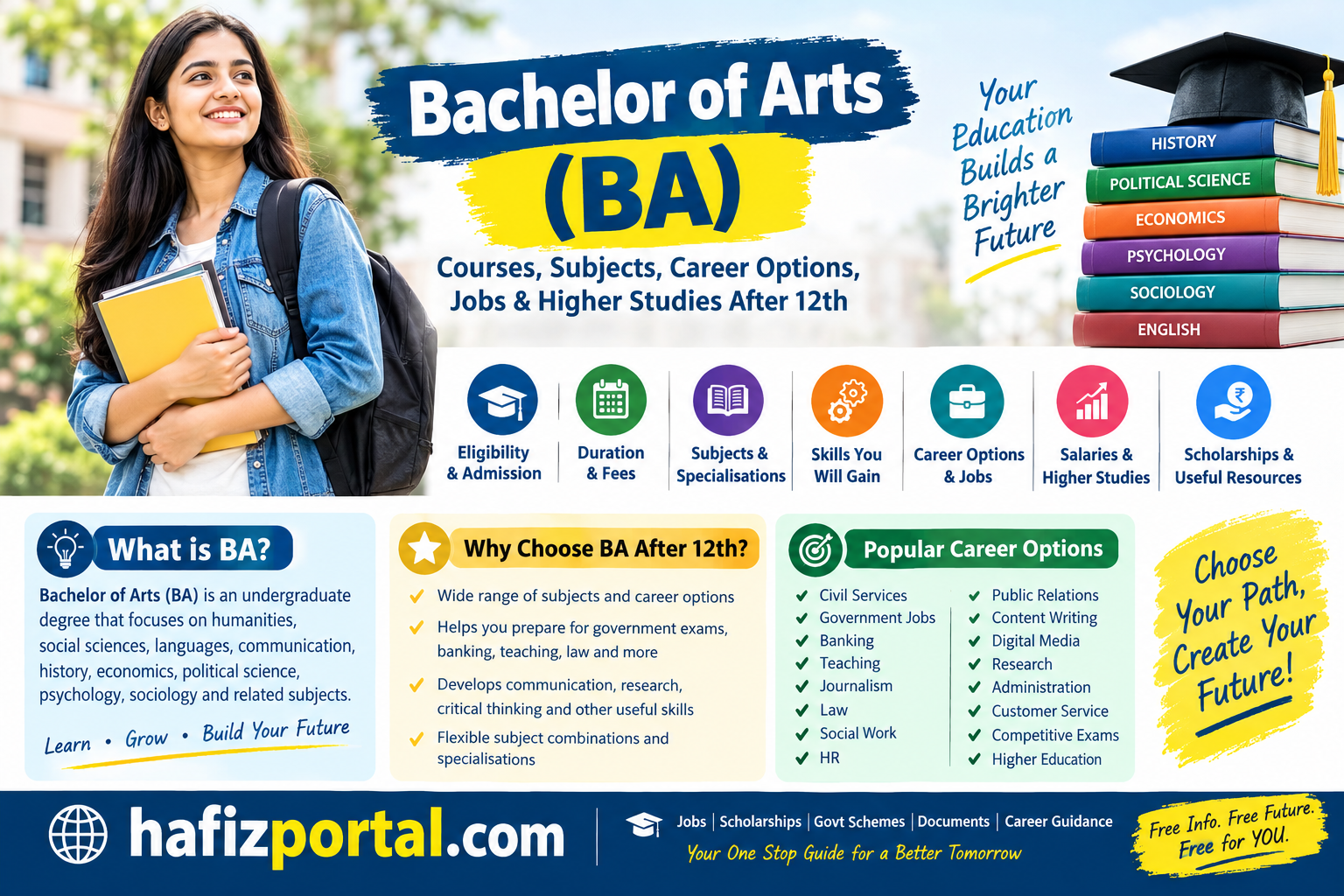
Bachelor of Arts (BA) is one of the most popular undergraduate degree programmes for students who want to study humanities, social sciences, languages, communication, history, economics, political science, psychology, sociology and related subjects.
A BA degree can be a good choice after Class 12, especially for students interested in civil services, teaching, law, journalism, government jobs, banking, social work, research, content creation, public administration, human resources and other careers.
The BA programme is also flexible. Depending on the university, students may choose a combination of subjects or specialise in an area such as English, Economics, Political Science, History, Psychology, Sociology, Geography, Hindi, Marathi or other languages.
This guide explains BA eligibility, admission, duration, subjects, specialisations, fees, skills, career options, jobs, salaries, higher studies, scholarships and useful official resources in simple English.
Bachelor of Arts (BA)?
Bachelor of Arts (BA) is an undergraduate degree that focuses mainly on humanities, social sciences, languages and related academic disciplines.
The BA programme helps students develop knowledge as well as practical skills such as:
- Communication
- Writing
- Reading and research
- Critical thinking
- Analysis
- Presentation
- Problem-solving
- Social awareness
- Public speaking
- Basic digital skills
A BA degree can be completed through different modes, depending on the institution and programme. Students should always check the current admission rules, syllabus and recognition status of the university before taking admission.
The exact subjects, duration, examination system and eligibility criteria can vary from one university to another.
BA Full Form
BA stands for Bachelor of Arts.
It is generally an undergraduate programme pursued after completing Class 12 or an equivalent qualification.
Common forms include:
- BA
- BA Honours
- BA Honours with Research
- BA programmes with different subject combinations
The exact programme structure depends on the university and its current academic regulations.
Why Choose Bachelor of Arts After 12th?
Many students think that BA is only suitable for students who want to become teachers. This is not true.
A BA degree can provide a foundation for several different careers.
Students can use their BA education to prepare for:
- Government examinations
- Civil services
- Banking examinations
- Teaching
- Journalism
- Law
- Social work
- Human resources
- Public relations
- Content writing
- Digital media
- Research
- Administration
- Customer service
- Competitive examinations
- Higher education
The biggest advantage of BA is the wide range of subjects and career pathways available to students.
However, students should not select a BA subject simply because it is considered easy. The best subject is one that matches the student’s interest, strengths and long-term career goal.
BA Eligibility Criteria After 12th
Generally, students who have completed Class 12 or an equivalent examination can apply for BA programmes.
However, eligibility varies between universities and colleges.
Depending on the institution, admission may be based on:
- Class 12 marks
- Entrance examination
- Merit
- University-specific admission process
- Combination of merit and entrance criteria
Some specialised BA programmes may also have specific subject requirements.
Important
Before applying, students should check:
- Official university website
- Current admission notification
- Eligibility criteria
- Required documents
- Application deadline
- Entrance examination requirements
- Reservation rules
- Fee structure
- Recognition and affiliation
Do not depend only on social media posts or unofficial websites for admission information.
BA Course Duration
The duration of a BA programme depends on the university and the academic structure under which it is offered.
Many undergraduate programmes are structured over multiple years, with the exact duration and exit options depending on the institution and applicable higher-education framework.
Students should therefore check the official prospectus of the university or college before applying.
Popular BA Subjects and Specialisations
One of the biggest advantages of Bachelor of Arts is the variety of subjects available.
Popular BA subjects include:
1. BA English
BA English is suitable for students who enjoy:
- Literature
- Writing
- Reading
- Communication
- Language
- Creative writing
Career areas may include teaching, content writing, editing, publishing, journalism, communication and media.
2. BA Political Science
Political Science focuses on:
- Government
- Constitution
- Political institutions
- Public administration
- International relations
- Political theory
It can be useful for students interested in civil services, government examinations, law, public administration, research and politics-related careers.
3. BA Economics
BA Economics introduces students to areas such as:
- Microeconomics
- Macroeconomics
- Indian economy
- Statistics
- Economic policies
- Development economics
Economics can be useful for careers in banking, finance-related support roles, research, government examinations and business analysis.
Students who enjoy mathematics and analytical subjects may particularly consider Economics.
4. BA History
History covers the study of:
- Ancient history
- Medieval history
- Modern history
- Indian history
- World history
- Culture and civilisation
History can be useful for students preparing for competitive examinations and careers in teaching, research, museums, archives, journalism and heritage-related fields.
5. BA Sociology
Sociology studies society, communities, institutions and social behaviour.
Students may study areas such as:
- Indian society
- Social change
- Rural society
- Urban society
- Social problems
- Family and community
- Social institutions
This subject can be useful for students interested in social work, research, NGOs, development organisations, public policy and competitive examinations.
6. BA Psychology
Psychology focuses on human behaviour and mental processes.
Students may learn about:
- Human development
- Social behaviour
- Learning
- Personality
- Psychological processes
- Research methods
BA Psychology can provide a foundation for further study in psychology and related fields.
Students should remember that a bachelor’s degree alone does not qualify someone for every professional psychology role. Specific careers may require postgraduate education, professional training or other qualifications.
7. BA Geography
Geography covers topics related to:
- Physical geography
- Human geography
- Environment
- Population
- Resources
- Maps
- Urban and rural development
Geography can also be useful for students preparing for competitive examinations.
8. BA Hindi / Marathi / Other Languages
Language-based BA programmes may include:
- Literature
- Grammar
- Linguistics
- Poetry
- Drama
- Fiction
- Communication
These programmes can support careers in teaching, translation, writing, publishing, media and government-related work.
BA Subject Combination
Many colleges offer BA programmes where students study more than one subject.
For example, combinations may include:
- English + Political Science
- History + Political Science
- Economics + Political Science
- Sociology + Political Science
- Psychology + Sociology
- Geography + Economics
- Hindi + English
- Marathi + Political Science
The actual combinations depend on the college or university.
Always check the official college prospectus before selecting a combination.
BA Admission Process
The BA admission process can differ from one university to another.
A typical process may look like this:
Step 1: Complete Class 12
Students should successfully complete their qualifying examination.
Step 2: Select BA Subject
Research different BA subjects and identify which one matches your career objective.
Step 3: Find Colleges
Compare colleges based on:
- Recognition
- University affiliation
- Faculty
- Course structure
- Fees
- Location
- Library
- Student support
- Placement or career services
- Reputation
Step 4: Check Admission Requirements
Read the latest admission notification carefully.
Step 5: Apply Online or Offline
Complete the application form using the official admission portal.
Step 6: Entrance Test, If Applicable
Some institutions may use entrance examinations or other selection methods.
Step 7: Merit List or Selection
Students may be selected based on the applicable admission criteria.
Step 8: Document Verification
Common documents may include:
- Class 10 certificate
- Class 12 marksheet
- Passport-size photographs
- Identity document
- Transfer certificate, if applicable
- Migration certificate, if applicable
- Caste/category certificate, if applicable
- Income certificate, if required
- Other university-specific documents
Step 9: Pay Fees
After selection, complete the admission formalities and fee payment within the deadline.
Documents Required for BA Admission
The exact requirements vary, but students may need:
- Aadhaar or another accepted identity document
- Class 10 marksheet
- Class 12 marksheet
- Leaving/Transfer Certificate
- Passport-size photographs
- Caste certificate where applicable
- Non-Creamy Layer certificate where applicable
- Income certificate where required
- Domicile certificate where applicable
- Migration certificate where applicable
- Disability certificate where applicable
- Application form
- Other documents requested by the institution
Keep both digital and physical copies of important academic documents.
BA Fees
There is no single fee for all BA colleges.
Fees can vary considerably based on:
- Government or private institution
- University
- Location
- Course specialisation
- College facilities
- Mode of education
- Category and scholarship eligibility
Government and aided colleges can sometimes be more affordable than private institutions.
Students should compare the total cost, not only the tuition fee.
Consider:
- Admission fee
- Tuition fee
- Examination fee
- Library fee
- Hostel fee
- Transportation
- Books
- Internet
- Other institutional charges
Always confirm the latest fee structure from the official college or university.
Is BA a Good Course After 12th?
Yes, BA can be a good option if it matches your interests and career plans.
It is especially useful for students who are interested in:
- Humanities
- Social sciences
- Languages
- Government jobs
- Civil services
- Teaching
- Law
- Journalism
- Research
- Social work
- Administration
However, students should combine their degree with practical skills.
For example, a BA student can learn:
- MS Office
- Excel
- Digital marketing
- Communication
- English speaking
- Graphic design
- Data analysis basics
- Content writing
- Social media management
- Computer applications
- Public speaking
This combination can make a graduate more employable.
Career Options After BA
A BA degree can open several career pathways.
1. Government Jobs
BA graduates can apply for many government examinations when they meet the eligibility conditions.
Potential areas include:
- Civil services
- Staff recruitment examinations
- Banking
- Railways
- State government recruitment
- Police and administrative services
- Public sector recruitment
- Defence-related examinations
- Teaching-related recruitment
Eligibility varies by examination, so students must check the official notification for each vacancy.
For employment information, students can also explore the Government of India’s National Career Service (NCS) portal. NCS provides job search, career services, internships, skill courses and other employment-related resources. (NCS)
National Career Service (Government of India)
2. Civil Services
Civil services are a popular career choice among BA graduates.
Subjects such as:
- Political Science
- History
- Geography
- Economics
- Sociology
can be particularly relevant to students preparing for competitive examinations.
However, choosing a BA subject only because it appears in an examination syllabus is not always the best strategy. Students should also consider their interest and academic strengths.
3. Teaching
BA graduates can consider teaching-related careers after obtaining the qualifications required for the specific teaching level.
A common pathway may include:
BA → Teacher Education Qualification → Teaching Career
The exact qualification depends on the school level, state rules and recruitment requirements.
4. Journalism and Media
Students with strong communication and writing skills can explore:
- Journalism
- Digital journalism
- Content writing
- News research
- Editing
- Copywriting
- Social media
- Media production
- Publishing
A BA in English, Political Science, History or Mass Communication-related areas can provide useful academic foundations.
5. Human Resources
BA graduates can enter entry-level HR and administration roles, particularly after developing relevant skills.
Useful additional skills include:
- Communication
- Excel
- Recruitment basics
- Interview coordination
- Payroll basics
- HR software
- Documentation
Students interested in management can later pursue an MBA or other postgraduate qualification.
6. Social Work and NGOs
BA graduates can work with:
- NGOs
- Community organisations
- Development organisations
- Social projects
- Educational programmes
- Healthcare support programmes
Students interested in this area can also consider postgraduate programmes such as social work or development studies.
7. Content Writing
Content writing is another option for graduates with strong language skills.
Possible work includes:
- Blog writing
- Website content
- SEO content
- Social media content
- Product descriptions
- Educational content
- Copywriting
A BA graduate can improve employability by learning SEO, WordPress, content strategy and digital marketing.
8. Digital Marketing
Digital marketing is a growing skill area.
BA students can learn:
- SEO
- Social media marketing
- Google Analytics
- Content marketing
- Email marketing
- Search advertising
- WordPress
- Basic graphic design
A degree combined with practical digital skills can create additional career opportunities.
9. Public Relations
Students with strong communication skills can explore public relations and communication roles.
Possible responsibilities include:
- Communication
- Event coordination
- Social media
- Media communication
- Content creation
- Public interaction
10. Research
Students interested in academic work can pursue:
BA → Master’s Degree → Research / Teaching / Further Study
Students who enjoy reading, writing and analysing information may find this pathway suitable.
Higher Studies After BA
Completing a BA does not mean education has to stop.
Popular higher-study options include:
MA – Master of Arts
Students can pursue an MA in areas such as:
- English
- Economics
- Political Science
- History
- Sociology
- Psychology
- Geography
- Languages
- Public Administration
- Other humanities and social science subjects
MBA After BA
BA graduates can also consider management education.
Possible MBA specialisations include:
- Human Resources
- Marketing
- Finance
- Operations
- Business Analytics
- International Business
Eligibility depends on the institution and admission examination.
LLB After BA
Students interested in law can explore undergraduate law pathways available to graduates, subject to the current admission and eligibility rules.
A graduate-level law programme can lead towards legal careers after meeting the applicable professional requirements.
B.Ed After BA
Students interested in school teaching can consider teacher education programmes where eligible.
The exact pathway depends on current regulations and the level at which the student wants to teach.
MSW After BA
Students interested in social work can consider a Master of Social Work (MSW).
It can be useful for careers in:
- NGOs
- Community development
- CSR
- Social welfare
- Development projects
- Human services
MA Psychology or Related Programmes
Students with a relevant undergraduate background may explore postgraduate psychology or related programmes.
Admission requirements differ between universities, so students should check the specific eligibility criteria.
BA and Government Competitive Examinations
BA is a popular undergraduate degree among students preparing for competitive examinations.
A student may use college years to build:
- General knowledge
- Current affairs awareness
- Reading habits
- Writing ability
- Analytical thinking
- Communication skills
- Time management
However, competitive examination preparation should be based on the latest official syllabus and notification.
Do not rely on old eligibility information because examination rules can change.
Scholarships for BA Students
Financial support can make higher education more accessible.
Students should check scholarships offered by:
- Central Government
- State Government
- Universities
- Colleges
- Trusts
- Foundations
- Other eligible organisations
The National Scholarship Portal (NSP) is an important official resource for students looking for government scholarship schemes. For the 2026–27 academic year, the portal states that it is open from 1 June 2026 and that students can apply for eligible merit-based and welfare-based schemes. (Scholarships Government of India)
National Scholarship Portal – Students
Students should carefully check the eligibility criteria and application deadlines for each scholarship.
Learn Additional Skills During BA
A degree is important, but practical skills can improve career opportunities.
Students can use online learning platforms to develop additional skills.
One useful government-supported platform is SWAYAM, an initiative of the Ministry of Education.
SWAYAM provides online courses across different areas. Its current course listings include undergraduate and other higher-education learning opportunities. (Swayam)
SWAYAM – Ministry of Education
Useful skills for BA students include:
- Computer applications
- Excel
- Communication
- English
- Digital marketing
- SEO
- Data analysis
- Research
- Presentation
- Public speaking
- Content writing
- Graphic design
- Social media management
Jobs After BA
Depending on qualifications, skills and experience, BA graduates may explore entry-level positions such as:
| Job Role | Useful Skills |
|---|---|
| Content Writer | Writing, SEO |
| Customer Support Executive | Communication |
| HR Assistant | Communication, Excel |
| Administrative Assistant | MS Office, documentation |
| Social Media Executive | Social media, content |
| Research Assistant | Research and writing |
| Sales Executive | Communication |
| Office Executive | Computer and documentation |
| Data Entry Executive | Computer skills |
| Education Coordinator | Communication and organisation |
| NGO Project Assistant | Documentation and communication |
| Junior Copywriter | Writing and creativity |
Actual job eligibility and salary depend on the employer, location, experience and required qualifications.
Salary After BA
There is no fixed salary for every BA graduate.
Salary depends on:
- Subject
- Skills
- College
- Location
- Job role
- Employer
- Experience
- Additional qualifications
- Communication skills
A fresher may start with an entry-level salary, while a graduate with strong professional skills and experience can progress into better-paying positions.
Instead of selecting a career only based on starting salary, students should consider long-term growth.
How to Get a Better Job After BA
Students can follow a simple strategy:
1. Complete Your Degree
Maintain good academic performance.
2. Develop Communication Skills
Improve English or another professional language according to your target industry.
3. Learn Computer Skills
MS Word, Excel, PowerPoint, email and online tools are useful in many jobs.
4. Build a Professional Resume
Keep your resume simple and focused.
5. Complete Internships
Internships can provide practical experience.
6. Build a Portfolio
Writers can create writing samples.
Digital marketers can create sample campaigns.
Designers can create portfolios.
Researchers can create research projects.
7. Apply Regularly
Use trusted job portals and official employment resources.
8. Prepare for Interviews
Practice:
- Self-introduction
- Communication
- Common interview questions
- Subject knowledge
- Basic computer skills
BA vs Other Courses After 12th
Students often compare BA with other undergraduate programmes.
BA vs B.Com
Choose BA if you are more interested in humanities, social sciences, languages or public-sector examination preparation.
Choose B.Com if you are more interested in accounting, commerce, taxation, business and finance.
BA vs B.Sc
Choose BA if your interests are mainly in humanities and social sciences.
Choose B.Sc if you prefer science, mathematics, laboratory work or technical subjects.
BA vs BBA
Choose BA for humanities and social sciences.
Choose BBA if your primary interest is business and management.
There is no universally “best” degree. The right course depends on the student’s interest, ability and career goal.
Skills BA Students Should Develop
For better career opportunities, students should develop a combination of academic and practical skills.
Communication
Learn to express ideas clearly.
Writing
Practice professional and creative writing.
Computer Skills
Learn common office software and online tools.
Research
Learn how to find, verify and organise reliable information.
Presentation
Develop confidence in presenting ideas.
Critical Thinking
Learn to compare information and form logical conclusions.
Time Management
Balance college, examination preparation and skill development.
Digital Skills
Understand online platforms, social media and basic digital tools.
Common Mistakes BA Students Should Avoid
Mistake 1: Choosing BA Without a Career Plan
Do not select a course only because friends are taking it.
Mistake 2: Ignoring Skills
A degree without practical skills may not be enough for competitive employment.
Mistake 3: Waiting Until Final Year
Start career preparation from the first year.
Mistake 4: Not Doing Internships
Practical experience can strengthen your resume.
Mistake 5: Ignoring Communication
Communication is important in almost every professional field.
Mistake 6: Depending on Unofficial Admission Information
Always verify important information from the official college or university.
Mistake 7: Applying for Jobs Without Research
Check the employer, job description and eligibility before applying.
Best BA Subjects for Different Career Goals
| Career Goal | BA Subjects to Consider |
|---|---|
| Civil Services | Political Science, History, Geography, Economics, Sociology |
| Teaching | English, History, Geography, Languages |
| Journalism | English, Political Science, History, Mass Communication-related subjects |
| Social Work | Sociology, Psychology, Political Science |
| Research | Economics, Sociology, Psychology, History, Political Science |
| Digital Content | English, Languages, Journalism-related subjects |
| Government Jobs | Any suitable BA subject + competitive exam preparation |
| HR | Any BA + HR/management skills |
| Law | Political Science, History, Economics or other suitable subject + law qualification |
| Public Administration | Political Science, Economics, Sociology |
This table is a career-planning guide, not a universal admission rule. Actual eligibility depends on the programme and institution.
Is BA Suitable for Arts Students?
Yes.
BA is one of the most natural undergraduate options for students from the Arts/Humanities stream.
However, students from other streams may also be eligible for many BA programmes, depending on the college or university.
For example, students from:
- Arts
- Commerce
- Science
may find BA options, subject to the institution’s eligibility rules.
Can Commerce Students Do BA?
In many institutions, Commerce students can apply for BA programmes if they satisfy the relevant eligibility requirements.
A Commerce student interested in:
- Economics
- Political Science
- Psychology
- Sociology
- English
- Public administration
can explore suitable BA programmes.
Always check the specific college rules.
Can Science Students Do BA?
Science students may also be eligible for several BA programmes, depending on university rules.
A Science student who develops an interest in:
- Psychology
- Economics
- Political Science
- History
- Languages
can investigate BA opportunities.
The important step is to check the current admission eligibility of the institution.
How to Choose the Right BA College
Before taking admission, compare at least five or six institutions.
Check:
- University affiliation
- Recognition
- Course syllabus
- Faculty
- Fees
- Location
- Library
- Student support
- Internship opportunities
- Career services
- Examination system
- Scholarship opportunities
Do not select a college only because of advertisements or social media popularity.
Important Official Resources for BA Students
National Career Service
For jobs, internships, career services and employment-related information:
NCS describes itself as a Government of India platform connecting jobseekers, employers and career-related services. (NCS)
National Scholarship Portal
For eligible government scholarship schemes:
The portal provides scholarship application and related services for students and institutions. (Scholarships Government of India)
SWAYAM
For online learning and additional courses:
SWAYAM is a Ministry of Education initiative and includes courses coordinated for undergraduate education through the appropriate national coordinator. (Swayam)
Frequently Asked Questions About Bachelor of Arts (BA)
What is BA?
BA stands for Bachelor of Arts. It is an undergraduate degree covering humanities, social sciences, languages and related subjects.
Can I do BA after 12th?
Yes. Students who have completed Class 12 or an equivalent qualification can apply for eligible BA programmes, subject to the admission rules of the university or college.
Which BA subject is best?
There is no single best BA subject. The right subject depends on your interest and career goal.
Is BA good for government jobs?
Yes. A BA degree can provide the undergraduate qualification needed for many competitive examinations, subject to the eligibility conditions of each examination.
Can BA students do MBA?
Yes, eligible BA graduates can pursue MBA programmes. Admission rules depend on the institution.
Can I do LLB after BA?
Yes, graduates can explore appropriate law programmes subject to current eligibility and admission requirements.
Can I do MA after BA?
Yes. MA is one of the most common postgraduate options after BA.
Can BA students get private jobs?
Yes. Graduates can apply for suitable private-sector positions based on their skills and the employer’s eligibility requirements.
Is BA useful for civil services?
Yes. Many BA subjects overlap with areas commonly studied for civil service examinations. However, success depends on preparation, examination strategy and individual performance.
Can Commerce students do BA?
In many colleges, yes, provided they meet the programme’s eligibility requirements.
Can Science students do BA?
Many BA programmes accept students from different Class 12 streams, but the exact rules vary by institution.
Final Career Advice for BA Students
A Bachelor of Arts (BA) is not simply a degree to complete after Class 12. It can become the foundation for a much wider career journey.
Students can use their BA years to develop three things:
Degree + Skills + Experience
For example:
BA + Computer Skills + Internship
or
BA + Communication + Competitive Exam Preparation
or
BA + Digital Marketing + Content Writing
or
BA + MA + Research Skills
or
BA + Law + Communication Skills
This approach can create more career possibilities than relying on the degree alone.
If you are a Class 12 student, do not ask only:
“Which course is easiest?”
Instead, ask:
“Which course can help me build the career I want?”
Research the course, compare colleges, check official eligibility requirements and understand the career pathway before paying admission fees.
For students looking for jobs, scholarships, government schemes, career guidance, courses and useful educational information, keep checking HafizPortal for updated opportunities and guidance.
HafizPortal – Jobs, Scholarships, Government Schemes & Career Guidance
Quick Summary: Bachelor of Arts (BA)
| Feature | Details |
|---|---|
| Full Form | Bachelor of Arts |
| Level | Undergraduate |
| Entry Qualification | Usually Class 12/equivalent |
| Main Areas | Humanities, Social Sciences, Languages |
| Popular Subjects | English, History, Political Science, Economics, Sociology, Psychology, Geography |
| Career Areas | Government, Teaching, Media, HR, NGOs, Administration, Content, Research |
| Higher Studies | MA, MBA, LLB, B.Ed, MSW and other eligible programmes |
| Government Exams | Many graduate-level examinations |
| Skills to Learn | Communication, Computer, Writing, Research, Digital Skills |
| Scholarships | Check National Scholarship Portal and state/institutional schemes |
| Online Learning | SWAYAM and other recognised platforms |